
https://triblive.com/sports/joe-starkey-my-unforgettable-afternoon-with-the-miracle-on-ice-team/
Joe Starkey: My unforgettable afternoon with the Miracle on Ice team

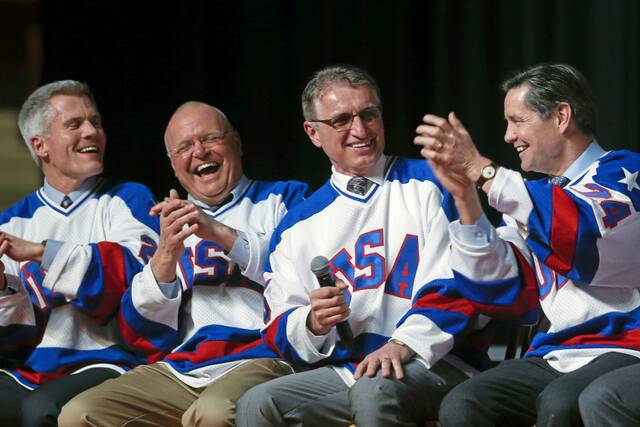
The icy glares had long since melted. Herb Brooks was no longer the fiery tyrant of 1980.
He was no longer the mad man who’d ordered his players to skate sprints in the dark after a lazy performance against Norway, telling them if they kept smashing their sticks on the boards in protest he’d “skate you until you die,” as team captain Mike Eruzione remembered it.
He was just Herbie now, more than two decades removed from the miracle. So when defenseman Mike Ramsey skated to the bench and asked, “Is this who you want out here?” Herbie laughed and said, “Do what you want.”
Can you imagine the Herb Brooks of 1980, the one who has been chronicled so many times since — most recently in a riveting Netflix documentary titled, “Miracle: The Boys of ’80” — telling his players that?
Well, it wasn’t 1980 anymore. The date was Friday, Feb. 1, 2002. The time was 3:30 p.m.. The site was a miniature, makeshift rink at the Los Angeles Convention Center.
The occasion was notable: The Miracle Men — the 20 players who had wrought the “Miracle on Ice” by upsetting the mighty Soviets — were all together in one place for the first time since visiting the White House a few days after striking gold 22 years earlier in Lake Placid, N.Y.
And I was standing behind their bench.
I have covered the Penguins winning Stanley Cups and the Steelers winning Super Bowls. Those events could never compare to this, at least on a personal level. It stands as the most memorable moment of my career.
A thin rope separated me from Herbie, but he was only a few feet away, joking with his players and barely paying attention to the “game,” in which legendary U.S. goalie Jim Craig, now deep into his 40s, had given up six goals in the first period.
“Their diets aren’t working,” Herbie said as he surveyed the bench. “I know that.”
It was a half-baked, 4-on-4 exhibition game against an NHL alumni team, so reporters had nearly unlimited access. That’s why I was able to stand near Brooks behind the bench. I wondered how he must have felt 22 years earlier in the same spot, masterminding the greatest triumph in American sports history.
I remembered clips of him shouting “Play your game!” as those interminable, final 10 minutes ticked away against the Soviets. I thought of that as I looked down and saw the names and numbers before me: Johnson 10, Eruzione 21, Ramsey 5, Morrow 3.
The bald spots and gray hairs on the backs of their heads only made the scene more poignant. What did it matter if they were 20, 40, 60 or 80? They would always be the fresh-faced kids who’d dismantled the nameless, faceless Soviet machine at a time when the nation needed them.
I remember Mark Johnson, Olympic hero and son of Penguins legend Badger Bob, telling me that five minutes after the boys were reunited in LA — as a precursor to the 2002 Olympic Games in Salt Lake City — it was as if they’d never been apart.
That became obvious when Ramsey started needling Craig after his rough first period.
“Couple bad bounces, Jimmy, hang in there, buddy,” Ramsey said. “Hang in there.”
All of this came pouring back to me Wednesday as I watched the Netflix doc. One part stood out: A few players, now in their late 60s, saying they wished they could have hung out with Herbie in his later years, before he passed away in 2003 at age 66. They said they almost never saw his lighter side.
“I think it was hard for him to resist being one of the guys and to joke and to laugh,” Brooks’ son, Dan, told Netflix. “He had to be so, so distant.”
I wondered, as I listened to that, if I might have witnessed the one time — or one of a very few — where Herbie did let his guard down with the boys. I do not know if that particular group ever congregated again before he died
But they were sure having fun that day in LA. Eruzione shouted to his buddies he was having a pretty good game. “Plus-2, not that I’m counting,” he said after a third-period shift.
The only player who didn’t skate was Mark Pavelich, who surprised everyone just by showing up. Pavelich, who struggled with mental health issues and has since passed away, had been living a reclusive life in the woods of northern Minnesota. Sporting a scraggly beard, he watched the exhibition in hunting boots, khakis and a thick winter vest.
Brooks and some of the players hadn’t seen Pavelich in 15 years. He’d rented a car and driven to L.A.
“Twenty-two hours and one speeding ticket,” Johnson said.
A reporter asked Pavelich what made him show up. His reply, as he walked away: “It was just that time.”
Herbie spoke so proudly of his players that day. Bill Baker became an oral surgeon. Johnson became the highly successful coach of the Wisconsin women’s team (he’s still there, fresh off a national title). Steve Christoff became a pilot for Meseba Airlines. Rob McClanahan became an investment broker. The list went on.
“They’ve really matured and grown into some fine guys,” Brooks said.
It has now been 24 years since that reunion and 46 since the Miracle. In addition to Brooks, three of the 20 players (Pavelich, Mark Wells, Bob Suter) have passed away. Thankfully, assistant coach Craig Patrick, who went on to great fame as Penguins general manager, recently survived a stroke and is at home recovering.
The world has changed. The country has changed. The Olympics have changed. NHL All-Stars now dot the rosters, as the U.S. prepares to play Slovakia with a showdown against Canada looming.
That would make for a great hockey game, but as iconic broadcaster Al Michaels explained in the Netflix doc, he has a stock response whenever he is asked what in sports could possibly top the Miracle on Ice: “Nothing.”
I would agree — although, come to think of it, that 4-on-4 exhibition game at the LA Convention Center was pretty special, too.
Copyright ©2026— Trib Total Media, LLC (TribLIVE.com)