
https://triblive.com/aande/movies-tv/stranger-things-finale-ending-a-series-is-hard/
About that ‘Stranger Things’ finale: Ending a series is hard

NOTE: Spoilers ahead for the entirety of the “Stranger Things” franchise through Wednesday’s series finale.
It’s hard to end a series. Really hard.
So hard, in fact, that not many of them manage to nail it.
It’s tough to blame them: Writers, directors, crew, actors all put years and years of work into telling a grand story, developing characters and story arcs that people care deeply about. It’s hard enough to see it come to an end, let alone find a way for that end to satisfy fans.
Two of my all-time favorites, HBO’s “The Wire” and F/X’s “The Shield,” despite being excellent all-around shows, still made some real missteps in trying to stick the landing.
One of the most critically lauded shows of all time, “Game of Thrones,” famously biffed it in the end, rushing a series of events that didn’t feel earned at all.
I can’t say the same of “Stranger Things.” In many ways, it was very satisfying to watch the gang from Hawkins, Ind., triumph over evil and save the world.
But I’m sure not everyone was satisfied. Let’s dive in.
O Death, where is thy sting?
One person who certainly was not satisfied was my teenage son. He was near inconsolable when the finale was over, but not for the reason I would have guessed.
”NO ONE EVEN DIED, DAD! THAT’S JUST BAD WRITING!” he exclaimed.
On the surface, that seems a bit harsh, but he’s not wrong in many ways.
Plot armor was firmly locked in place over-top every main character: Nancy Wheeler didn’t get crushed in a rock slide while a giant inter-dimensional kaiju tore down a mountain all around her. Jonathan Byers, who hasn’t exactly been a paragon of strength anytime in this entire series, found the might and will to haul Steve Harrington (a man at least his size) from certain death by just one arm. Heck, even the one character who “died” (more on that later) might still be alive! (Probably not.)
As “Stranger Things” progressed, the series began to lean into the gory aspects of the plot. The way Vecna dispatched minor characters in the fourth season was truly gnarly, and the prospect of that happening to one of our main characters in the final season upped the stakes a bit. Turns out, we didn’t have to worry much about that.
Speaking of Vecna, though, he did die, and he truly did turn out to be the series villain. Well, in conjunction with the Mind Flayer, that is.
His final character arc dialed that back slightly, showing a young Henry Creel unwillingly being co-opted as the Mind Flayer’s initial vessel. But in its larger themes, “Stranger Things” has placed a good deal of emphasis on characters having the strength to make their own choices. In the end, Henry chose to embrace his connection with the Mind Flayer.
Good thing too, because if they’d made him too sympathetic, it would’ve been even more difficult to sit though nearly 45 seconds of Joyce Byers chopping his head off.
That was a little much.
I kind of understand the writing choice here: For all the emotional heavy lifting Winona Ryder has done as the heart of this series, Joyce Byers — the character — has pretty much been sitting around the entire time waiting for one thing or another to happen. She deserved a big moment.
But instead of having a flashback of Vecna’s many transgressions powering Joyce’s many axe hacks, it would’ve been just as effective to run them all in rapid sequence, then cut back to her uttering the line that I am 100% sure is going to mean more bumper stickers with the F-word on them. Cue a single, clean killing blow.
‘Lord of the Rings’ ending
Peter Jackson may have revolutionized fantasy epic filmmaking with the “Lord of the Rings” trilogy, but its wind-down wound up becoming a meme — “Return of the King” is ending for what feels like an hour-and-a-half.
I didn’t time it, but it felt like the “Stranger Things” finale was ending for longer than necessary. And I can’t help but feel like it’s partly the result of everyone making it through the series. Nearly everyone is still around, so they all needed a proper end to their story. Everyone gets a denouement except my main man Murray Bauman — who is my dark horse to get his own spin-off series as an “X-Files”-style detective.
“Stranger Things” won’t even let its dead characters rest in peace: Fan favorite Eddie Munson kind-of-sort-of gets a second ending, as Dustin lives out Eddie’s dream and flips his principal the bird during the gang’s high school graduation while declaring it “their year.” Was that really necessary?
I felt like the series showed us some endings we didn’t really need. Did anyone not think Joyce and Hopper were going to end up together? Does it matter that it might be married and in Montauk, N.Y., the site of the alleged Montauk Project, another conspiracy theory about government experiments on people? It’s a cute Easter egg, but a quick shot of them seated at Enzo’s would’ve been perfect.
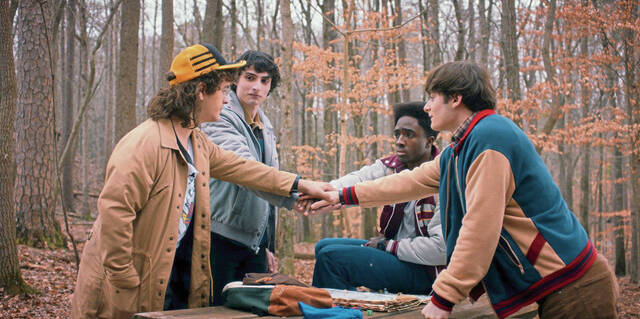
The graduation ceremony and the final D&D game in Mike’s basement would’ve made for a neat, tidy ending. And speaking of the storyline in that final game …
Where’s El?
So, what happened to Eleven? Is Jane Hopper still alive, traversing the highlands of some far-off country?
Probably not, but maybe, seems to be the social-media consensus.
It’s open to interpretation, perhaps. Is that bad writing?
The writing has taken a hit from critics and fans in this final season. But to circle back to the start, it’s really hard to end a series, especially when you take a step back and look at things from a business perspective. “Stranger Things” began life as this weird little one-off story that paid homage to Stephen King and the 1980s. Neither the Duffer brothers nor Ted Sarandos could have known it would shortly become the tent-pole franchise that put Netflix on the streaming map.
The second season expanded things a little, but not a lot. The show got exponentially more popular, and the pressure was on to keep cranking things up. The third season was criticized as over-the-top and a little cheesy/juvenile compared to its previous serious tone, and for a lot of fans, it’s where things begin to wobble.
The fourth season (for me at least) was a big recovery. Was Vecna always meant to be the series’ Big Bad? Was he shoe-horned in to keep making things bigger? The quality of the fourth season’s storytelling and some of its emotional punches helped me overlook that question.
But in the same way as “Game of Thrones,” successive seasons intensify the pressure to keep expanding, to keep making the stakes higher until the entire world is at risk. No one could really say for certain what the Mind Flayer’s goal was, and that ambiguity is a huge part of what makes cosmic horror so frightening. By bringing in Vecna and having us believe he was fully in control of the Mind Flayer and trying to bring his world into ours, the series introduces the ultimate stakes.
And in making something so bombastic, some of what made it endearing, offbeat and popular in the first place gets lost. In a lot of ways, you could substitute a half-dozen of Marvel’s Avengers into the final episode of “Stranger Things” and it would mostly be the same piece of entertainment. Nancy Wheeler already has most of the firearms training to be a pretty good Black Widow, to be honest.
The emotional climax of this episode was Eleven ultimately choosing to remain in the Upside Down and sacrifice herself, rather than be captured by the military (speaking of which, even Linda Hamilton’s pointlessly evil Dr. Kay didn’t catch a hot one in the finale!).
And whether it’s plot armor rearing its head again, or an unconscious desire to leave the slightest opening for a future Eleven series, Mike’s final Dungeons & Dragons story is told in just the right way to leave you wondering whether ol’ Jane Hopper might just still be out there somewhere, eating Eggo waffles and keeping a fresh Kleenex handy to wipe her nose.
Was it a perfect ending? Nope. It was never going to be perfect. Did it hit a lot of great emotional beats that had me getting misty thinking about the last decade of enjoying “Stranger Things”? Yes it did.
Ending a series is hard. The Duffer brothers did a pretty good job ending theirs.
Copyright ©2026— Trib Total Media, LLC (TribLIVE.com)