
https://triblive.com/aande/museums/andy-warhol-museum-will-present-carnegie-mellon-mfa-student-exhibition-time-honored-non-specifics/
‘Time Honored Non-Specifics’: Work by Carnegie Mellon MFA students at Warhol Museum

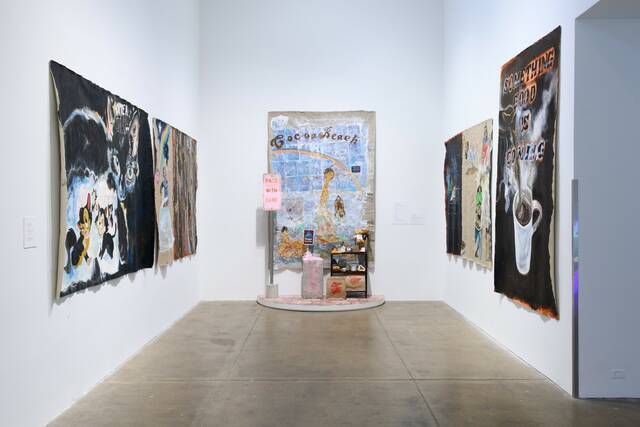
On the fourth floor of The Andy Warhol Museum on the North Side, three women have put the culmination of their artistic journeys on display.
Carnegie Mellon University School of Art MFA students Naomi Chambers, Bulumko Mbete and Afrooz Partovi have each created new work in an array of artistic mediums, and their pieces have been installed in four sections at the Warhol — three individual and one combined.
The exhibit, “Time Honored Non-Specifics,” opened Friday and runs through April 12.
This is the second year that Carnegie Mellon University’s MFA students have mounted their final exhibitions at the Warhol. “The space on CMU’s campus that was hosting this exhibition is currently closed, so this partnership is a really great way to honor the legacy of CMU’s most famous alum, Andy Warhol, and to connect that to the next generation of artists that are coming through our program,” said Elizabeth Chodos, associate professor of curatorial practice at Carnegie Mellon University, at a media preview on Thursday.
The three students have been working on this exhibition, from conceptualizing it to installing it, since the beginning of the fall semester. The show is the culmination of the university’s three-year MFA program.
“It’s a really nice opportunity to see these ideas come to life, particularly — especially — in this environment,” said Lyndon Barrois Jr., CMU School of Art’s MFA program director.
To the right of the gallery’s entrance is a shared exhibition space that contains aspects of all three artists’ work. Chambers contributed a dish of chocolates made from clay and several storybooks that her father bought her when she was a child; Mbete is represented through embroidering and images of family members and dahlias; and Partovi lent renderings and artifacts from the parking lot of Luna Park, a now-closed amusement park in the Iranian capital Tehran that is at the center of her installation.
Partovi’s section is an immersive, multimedia examination of the parking lot shared between Luna Park and a notorious prison in Tehran in the 1980s. Video screens loop on three walls while visitors can put on headphones to listen to the audio — but they are set in such a way that facing one screen means essentially turning your back to the other two.
“I was very much thinking about the parking lot as a place where the experience of people coming to visit their family members was being ignored by people going to the park. … It’s reflecting on that ignorance, sitting in a way where you are experiencing one aspect of that location, you’re ignoring the other aspects,” Partovi said.
The section also contains aerial photographs of the neighborhood around the park and prison. “These must be the only existing aerial photographs of this area of Tehran,” she said.
Patrovi is also a trained architect, so she integrates those skills in recreating the area.
Pittsburgh-born Naomi Chambers’ section of the exhibition is dominated by five large paintings, each of which she said represents a threshold or transitional moment in her life.
Many of the paintings also contain “brown things,” especially one that centers on Harriet Tubman. “She was able to use her brown and transmute it and sync it up with the fact that she was in the natural world, which is also a brown thing, and how to move through and be invisible in a way that allowed her to get her own freedom, and then also work towards teaching others to use their brownness in the same way.”
She also integrates themes of motherhood, creativity, food, womanhood and — most intriguingly — coffee in the paintings. She had an audio element as well, with a recording of her grandfather, the “Hot Tamale Man” in Pittsburgh’s Hill District, singing a song for his customers.
Mbete’s section contains pieces in a number of mediums that explore heritage, the importance of land and spirituality, combining symbols including dahlias, palm leaves, natural dyes and ceramic beads. There are representations of spiritual and ritual spaces, wars and struggles in South Africa and the connection between people and the natural world.
Her exhibit also has a sound piece. “It’s a meditation that reflects on … our relationship to knowledge,” she said.
She related the theme of site specificity, which are reflected in the South African symbols and artifacts in her installation, to Andy Warhol and his artistic ethos.
She said that this work began to come together while she was writing her thesis, and she got to integrate many of the same themes and explore them in different ways, through writing and visual art. “I’m really happy that I was able to honor the vision I had for the exhibition and see it finally come together,” she said.
“Time Honored Non-Specifics” is open until April 12 at The Andy Warhol Museum on the North Side. Details at Warhol.org.
Copyright ©2026— Trib Total Media, LLC (TribLIVE.com)