
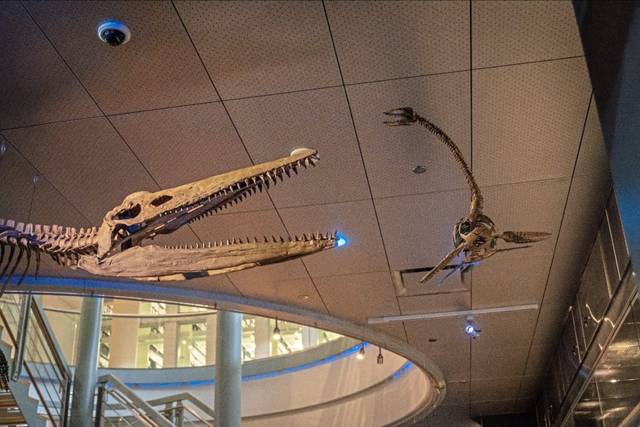
Once upon a time — let’s say, about 90 million years ago — a juvenile pliosaur was swimming around the waters of western Manitoba in central Canada.
If you were also in the water, it would be tough to miss, despite its young age: It would be about 18 feet long, roughly the size of a large saltwater crocodile.
As an adult, it would be among the largest marine reptiles of the dinosaur era, growing up to 40 feet long and holding a spot near the top of the food chain during the Cretaceous Period.
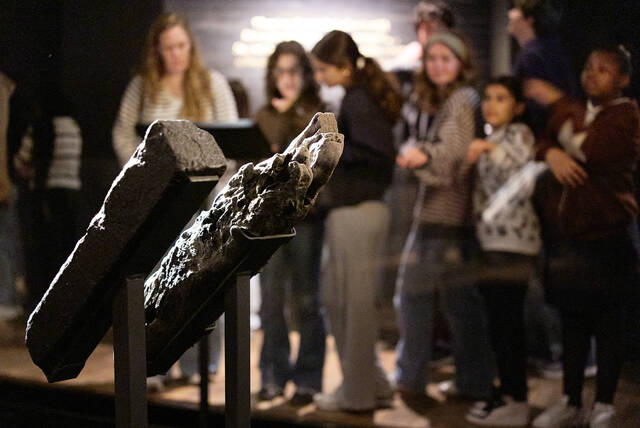
Visitors to the Carnegie Museum of Natural History will be able to look up and see the pliosaur along with four other new specimens in the museum’s Cretaceous Seaway, part of its flagship exhibit, “Dinosaurs in Their Time.”
“Our new Cretaceous Seaway displays put visitors smack dab in the middle of a life-and-death struggle taking place in midwestern North America some 92 million years ago,” said Matt Lamanna, the museum’s Daniel G. and Carole L. Kamin Co-Interim Director and Mary R. Dawson Associate Curator of Vertebrate Paleontology. “Collectively, our new Seaway beasts tell the story of evolution and extinction in an ancient ocean over the span of more than 30 million years. And they remind us that no species — not even humans — is immune to extinction.”
Other specimens include the restored fossil skull of a Tylosaurus, a type of mosasaur that also is among the largest of its kind; a juvenile plesiosaur; and an ancient fish.
The actual fossils that make up the pliosaur are on display at the Manitoba Museum in Canada.
All of the replica skeletons were created by Triebold Paleontology in Colorado.
In the display, the plesiosaur, Libonectes, is being hunted by the pliosaur, and Lamanna said it is the only one of its kind, replica or otherwise, anywhere in the world.
“Nobody’s ever found a baby Libonectes before, so to produce one, the gang at Triebold Paleontology and I had to digitally alter a virtual 3D model of an adult skull and then digitally sculpt other bones using photos of Libonectes skeletons and those of related plesiosaurs,” Lamanna said. “When all the computer work was done, the 3D models were then printed to yield the physical replica. The whole process really opened my eyes to the possibilities of 3D scanning, modeling and printing in paleontology.”
The new specimens are made possible with support from The Elijah Straw Memorial Fund. According to Tom Straw, Elijah’s father, the natural history museum was a special place for Elijah, particularly the skull of a prehistoric fish, Dunkleosteus terrelli.
That display has since been dedicated to Elijah’s memory, and the memorial fund has helped fund a variety of improvements in the Cretaceous Seaway area, along with the support of Dr. Richard W. Moriarty.
The museum is open using a timed ticket system. For more, see CarnegieMNH.org.