
MILAN — An Italian scholar and novelist has provided fresh fodder for an old debate over the identity of Leonardo da Vinci’s mother, proffering a recently unearthed document as evidence that she arrived on the Italian peninsula as a slave from the Caucasus region of Central Asia.
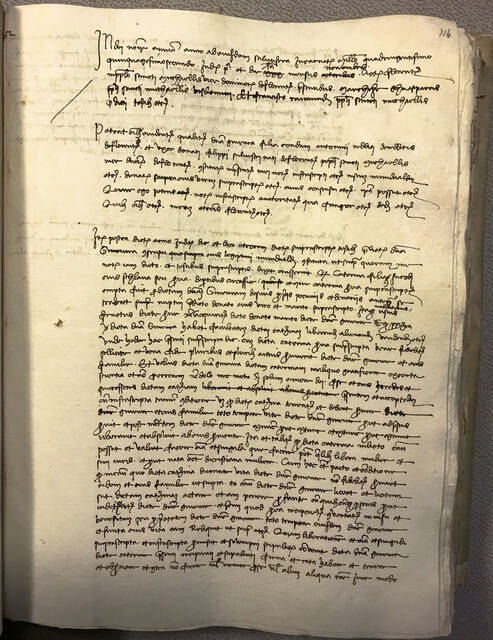
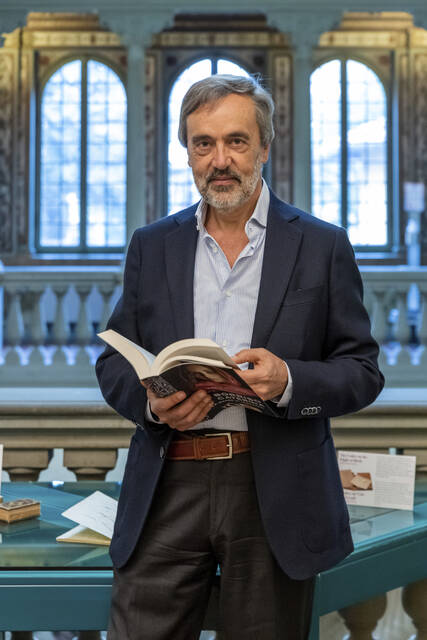
Carlo Vecce, an Italian literature professor at the University of Naples L’Orientale, has revealed his theory in a new novel, “Il Sorriso di Caterina,” or “Caterina’s Smile.” He based his claim on a document discovered in the State Archives in Florence that granted freedom to a girl named Caterina.
Leonardo’s father notarized the record six months after the birth of the Renaissance genius, who went on to paint masterpieces including the “Mona Lisa.”
Vecce said he originally was intent on proving that Leonardo’s mother was not an enslaved person from the East, one long-held theory. “But when the evidence goes in the other direction, one must pay attention,” he said.
He said he chose to put his research in a novel and not in a scholarly text because he felt an urgency to share his theory with a wider public. “I could joke that no one reads a book with footnotes and a bibliography,” the author added.
Martin Kemp, an Oxford University art history professor emeritus, co-wrote a 2017 book that identified Leonardo’s mother as Caterina di Meo Lippi, a 15-year-old orphan. He said he continued to favor the theory that the girl who gave birth to the masterpiece painter and inventor was a “rural mother.”
“There have been a number of claims that Leonardo’s mother was a slave,” Kemp said in a statement provided to The Associated Press. “This fits the need to find something exceptional and exotic in Leonardo’s background, and a link to slavery fits with current obsessions.”
The art historian suggested the document may not be conclusive.
It was Leonardo’s grandfather who said his mother’s name was Caterina, according to Kemp. Caterina was a common name given to slaves when they were forced to convert to Christianity, and the husband of the woman who freed the girl in Vecce’s document traded two slaves with that name in one year, Kemp said.
Kemp both praised Vecce’s work as a scholar and expressed surprise that the Italian professor published his findings as a fictionalized account.