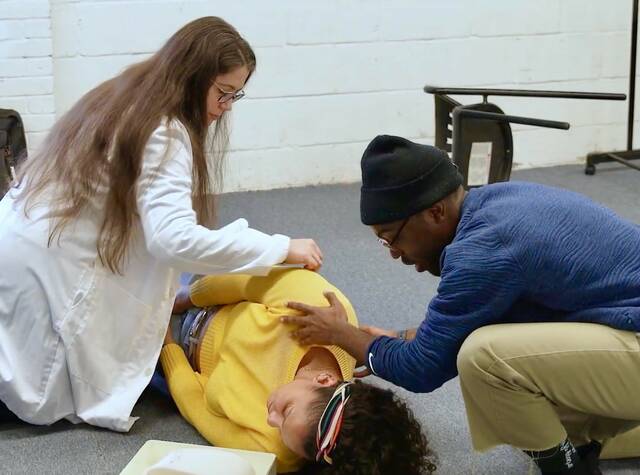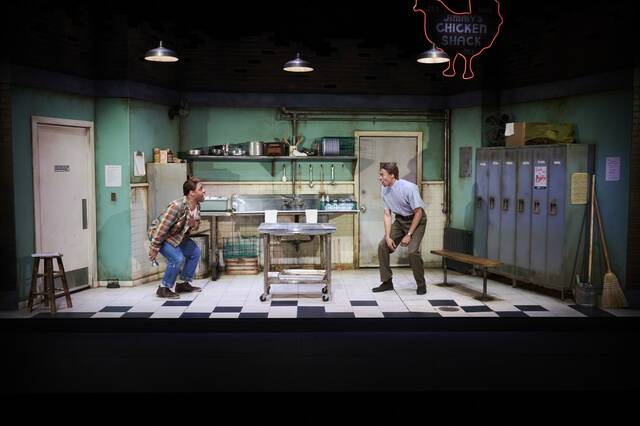
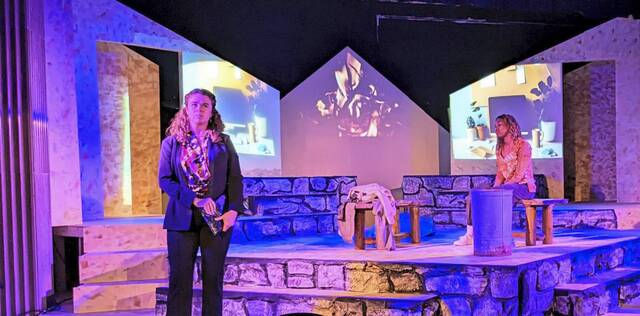
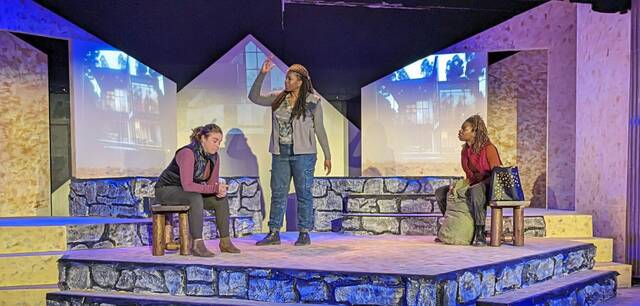


To help mark its 20th anniversary, the Pittsburgh Playwrights Theatre Company’s production of “Pyramid Builders” turns to racial issues of the past to bring its audience into a stark future that is meant to demonstrate the dangers of hatred—and make audiences think.
Director Bianca LaVerne Jones said her motivation for the play came from her love of lifting up unheard voices and telling untold stories.
“I believe in hearing new stories and hearing voices that have not been heard,” she said. “I love to learn about new perspectives, even if I completely, utterly disagree, because it allows me to think.”
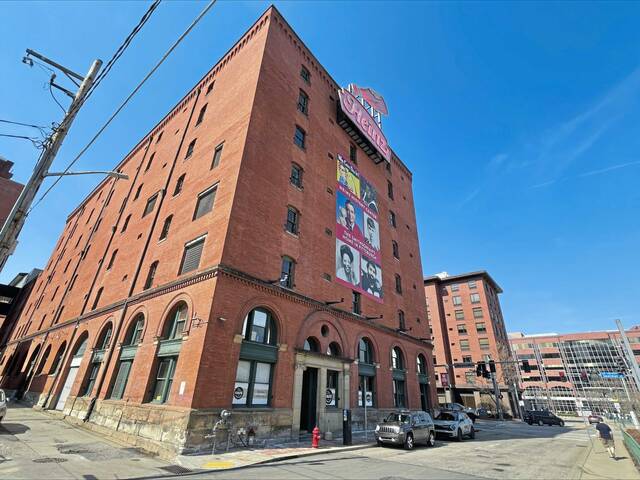
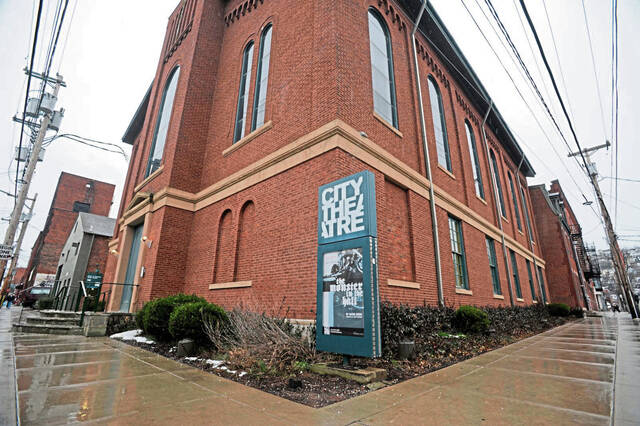
Jones said she hopes the play – written by Karuna Das and performed this month at the Madison Arts Center in the Upper Hill District – will bring new perspectives to her audience. The show opened April 14 and runs through April 30.
The two-act performance follows separate storylines with complementing themes. In the first act, the parallel lives of a corporate white woman and a Black homeless woman are set in 2012. Jones said the intention of the first half is to explore agriculture and climate change through the lens of race relations.
In the second act, the audience will be transported to a dismal 2036, a place where the United States is involved in a civil war and circumstances drive the main characters to smuggle Black people into Mexico to avoid racial persecution.
Amid the themes of social unrest, the director said this play intends to show the dangerous potential of inequality in hopes it inspires change.
“How we make change, what does it look like, what does it sound like? And then it begs the true question: what is real change, and can a play do it?” Jones said.
Actor Cynthia Caul, who plays two of the lead characters, Farrah and Cassie, said she hopes the story can guide the audience to be reflective and thoughtful about racial injustice.
“Particularly as it relates to my character Farrah, (who) is kind of ‘for’ white folks, reflecting on these assumptions we may hold or biases we may hold and not even realize how they do harm or perpetuate white supremacy in spite of our best intentions. I hope that is clear and then also a pathway forward that is hopeful,” Caul said.
Given the heavy plot, the play is not meant to comfort the audience, Jones said.
“Hopefully the audience will be shocked and say, ‘I don’t want to ever be in that situation where I am having to defend Black people like this and be this sort of ally’ or ‘I’m a Black person where I’m fighting for my life as if I were enslaved at the turn of the 20th century,’” she said.
Still, the story aims at a hopeful message.
“The thing that the play tries to leave us with is hope,” Jones said. “We have not been able to explore the full dramaturgy of what does it mean, what does hope truly mean, what does it truly mean to be free in the second half of the second act.”
Caul agreed that the show strives for hope, but is still evolving and has room to develop.
“It’s still very much a workshop and I think there are places for it to grow,” Caul said. “The director has really led us in creating a production with such clear storytelling that I think will leave an impact on the audience and elicit meaningful reflection and discussion about race.”
The play draws from real circumstances, like the fight against racial injustice and the Black Lives Matter movement to make the story more powerful, Jones said. She was able to draw some of the tone from real life, which she hopes the audience will relate to.
“I hope that they can see themselves reflected in both Farrah in 2012 before George Floyd got killed and, as Cassie in 2036, post George Floyd’s death. Who you were and who you could become… I hope that the audience sees themselves in these characters,” she said.
The company wanted to do the themes justice, so they dedicated ample time to workshopping how it came across. Jones said the process called for many rewrites so they could explore and strengthen all perspectives.
“In the (rehearsal room we discovered and explored the truth of all of these situations and all we did was try to get closer and closer to the truth and that’s where the tedious rigor came in. It was aiming for the truth with the actors and the playwriter,” Jones said. “I can only hope we told his story as clearly as possible.”
Bringing the play to life was a labor of introspection for the company. Jones said their efforts to tell the truth helped the team to grow artistically, professionally, and as people.
“The process of what happened in the rehearsal room, that’s the real play,” she said. “It has been illuminating … and triggering at best.”
To tell a story with such complex themes, Das requested a Black female director, which is how Jones became involved with the production. She was able to use her perspective and lived experiences to bring something new to the story.
Having many perspectives workshopping the show brought the play’s meaning to life, Caul said.
“I think having black women’s voices in the space to speak forward their own lived experiences, trying to center that in the script has been the process that they have significantly contributed to,” she added.
Jones added that the show’s framing, set design, and tech work seamlessly with the story concepts, which she attributed to the efforts of the cast and crew.
“It does bring rigor to the thinking of how we can definitely make sure we never end up in that space,” Jones said.
Ember Duke is a contributing writer and Duquesne University student.