
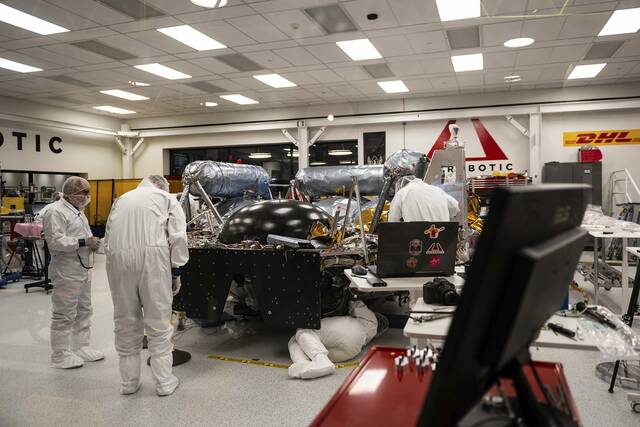


Pittsburgh’s Astrobotic is closing in on the launch of its Griffin-1 lander, a 15-footwide spacecraft that will deliver two state-of-the-art rovers to the moon.
CEO John Thornton said Wednesday the lander is nearing completion and should be ready for takeoff on a SpaceX rocket by the end of the year. Pinning down an exact launch date is difficult, though.
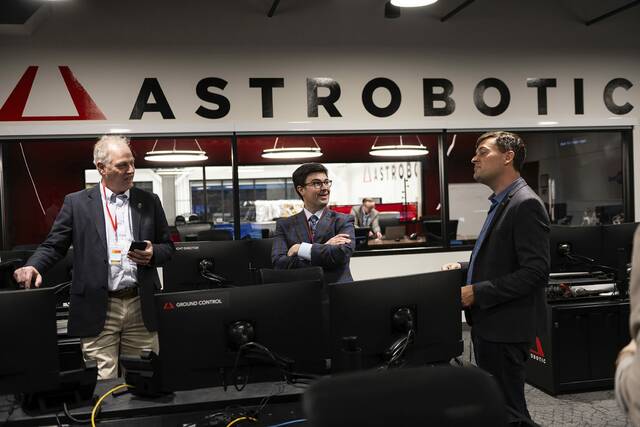
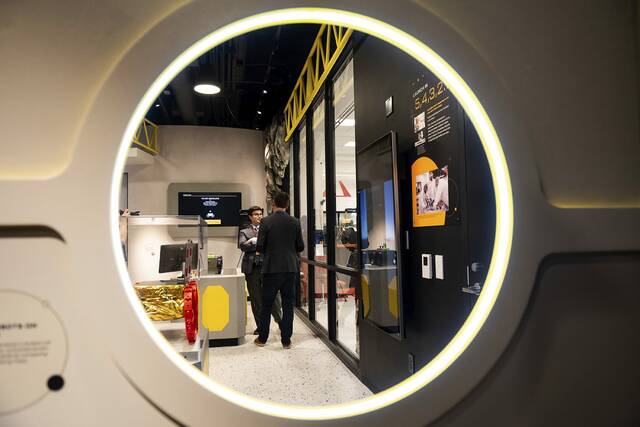
“All of the pieces have to all line up in order for it to work,” Thornton said after giving Pittsburgh Mayor Corey O’Connor a tour of the company’s corporate headquarters and laboratory in the North Side.
Astrobotic has about 180 employees there and another 100 or so in Mojave, Calif. The company is expanding, and O’Connor said the city could help support that by connecting them with grants or smoothing out permitting processes.
Scientists still have to install solar panels and landing gear on Griffin-1, which will travel by flatbed truck to an undisclosed testing location. The lander will have to withstand a shaker table, which simulates a bumpy rocket ride, as well as a chamber that recreates the vacuum conditions, extreme temperatures and high radiation levels found in space.
If Griffin-1 clears the testing protocol easily, it will be sent to Cape Canaveral in Florida near the end of the summer to prepare for launch.
Astrobotic’s Peregrine lander set off toward the moon in 2024 but never touched down due to a fuel leak.
Even then, the timing for Griffin-1 departure will be uncertain. High winds, lighting and thick clouds can all postpone a rocket launch.
Griffin-1 will carry precious cargo.
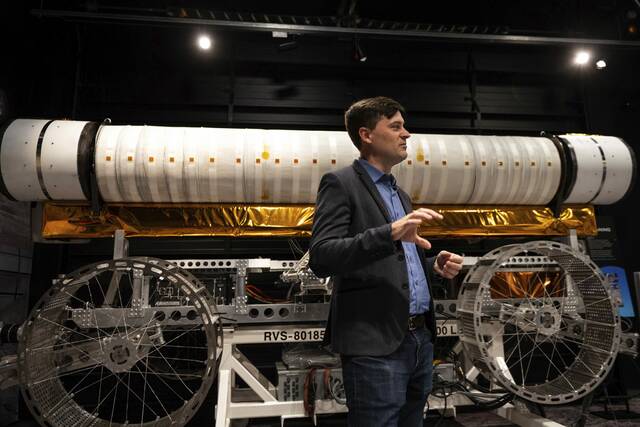
The primary payload is the FLIP rover, a four-wheeled machine the size of a golf cart built by the Los Angeles area’s Astrolab. Astrobotic is hitching on a small rover of its own as well some NASA and commercially owned technologies.
These rovers can carry out experiments and haul equipment around the moon’s rocky surface.
Artemis program
As Astrobotic showed off its progress Wednesday, NASA was preparing for its biggest launch in years.
Artemis II, the first mission to take humans close to the moon since 1972, blasted off Wednesday evening.
Artemis III is slated to take flight in 2027 as a test run for Artemis IV, a 2028 mission that will see astronauts set foot on the moon.
As part of the Artemis initiative, Astrobotic is designing metal wheels for a mobile lunar outpost that will land in 2033. The challenge is to create wheels that are lightweight without sacrificing strength.
Astrobotic will likely have many more chances to work with NASA after the agency announced last week it’s doubling down on moon missions and needs the help of private companies to do so.
NASA is targeting lunar landings at least every six months following Artemis V, a second crewed flight planned for 2028.
“This is the dream we’ve always dreamed of, starting Astrobotic 19 years ago, and now it’s happening,” Thornton said.