
https://triblive.com/business/cmu-gives-rare-tour-of-autonomous-laboratory-near-bakery-square/
Pitt, CMU offer inside glimpse of Pittsburgh’s cutting-edge biotech hubs

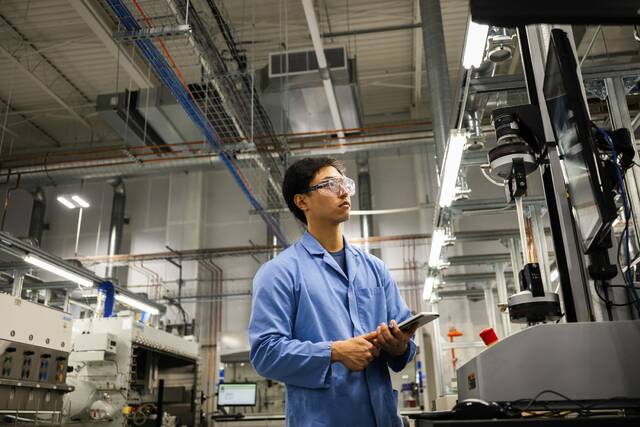
Carnegie Mellon University and the University of Pittsburgh offered rare looks Thursday into two cutting-edge research facilities during a showcase for the U.S. National Security Commission on Emerging Biotechnology.
Congress created the commission in 2022 to analyze the national security implications of novel biotechnologies, which manipulate cells and genetic material to spark advancements in medicine, agriculture and environmental science.
Pittsburgh is the latest stop in its cross-country tour of biotechnology hubs, reflecting the city’s prowess in the high-tech sector. This reputation could put Pittsburgh at the front of the line if Congress follows the commission’s April recommendation to invest $15 billion in biotechnology nationwide.
“Given the nature of how things are working in this particular part of the world where you’ve got academia, you’ve got business, you’ve got the state, you direct that money properly, you’re going to get a huge payback,” said Dov Zakheim, the biotechnology group’s commissioner.
One of the facilities toured Thursday had been up and running since 2024: the Carnegie Mellon University AI Science Foundry, a $50 million site in Pittsburgh’s Larimer neighborhood, next to Bakery Square along Penn Avenue.
The laboratory has all the traditional trappings: stark white walls, fluorescent lighting and expensive machinery. But it reflects a new vision of what science can look like when powered by artificial intelligence.
This so-called cloud lab can run autonomous experiments and even be controlled from halfway across the world.
U.S. Sen. John Fetterman, D-Braddock, is cosponsoring a bipartisan bill that would link six cloud labs across the country — including Pittsburgh’s — into a national network, reflecting their increasing popularity as a way to accelerate scientific discovery.
Despite its autonomous nature, humans still have an in-person role to play at the AI Science Foundry. Several researchers were hard at work Thursday, including Bingda Li, a fourth-year doctoral student and cofounder of startup Whelix.
Li can assign his AI-powered, almost entirely custom-made robotic cell culturing machine a task on a Friday afternoon. When he returns Monday morning, the analyses will be complete without any human intervention.
“It really liberates scientists,” he said.
BioForge
Pitt’s 185,000-square-foot BioForge building in Hazelwood, another stop during Thursday’s event, still has a ways to go before becoming operational.
Construction is expected to wrap up over the summer, but scientists with lead tenant ElevateBio won’t begin manufacturing cell and gene therapies as well as mRNA-based treatments and vaccines until early next year.
Right now, the space is a collection of empty rooms. A striking double-helix chandelier hanging in the lobby, however, hints at the pioneering work to come. ElevateBio will work with biotechnology companies of all sizes to make their medicines at scale.
“The barrier to entry, the investment to build a facility like this and to hire the workforce to run it is so high,” said Katherine Shannon, the head of ElevateBio’s Pittsburgh facility, which is one of just a handful of its kind in the U.S.
She continued: “So that’s really where Elevate can provide a huge advantage for companies who can come to us instead of needing to solve for that burden themselves.”
ElevateBio’s BioForge operations, which stand where Jones and Laughlin and later Ling-Tecmo-Vought (LTV) fired metallurgical coke for decades, will create more than 170 full-time local jobs.
The company also has a flagship plant and corporate headquarters in Massachusetts, while its research and development efforts are based out of North Carolina.
Construction of the $250 million BioForge facility is primarily funded by a $120 million contribution from Pitt and a $100 million grant from the Richard King Mellon Foundation. The university is also borrowing funds through a federal tax credit program.
Zakheim spoke glowingly of the city’s prolific public-private cooperation in high-tech ventures. He noted these partnerships will be crucial to outpacing China — a primary objective behind the commission’s founding.
“Everybody is interlocking (in Pittsburgh),” Zakheim. “That’s how we’re going to win.
“What we want to do is take this large test case called Pittsburgh and spread it all over this country,” he added.
Copyright ©2026— Trib Total Media, LLC (TribLIVE.com)