
https://triblive.com/business/cutting-edge-astrobotic-rocket-engine-could-fuel-more-efficient-moon-missions/
Cutting-edge Astrobotic rocket engine could fuel more efficient moon missions

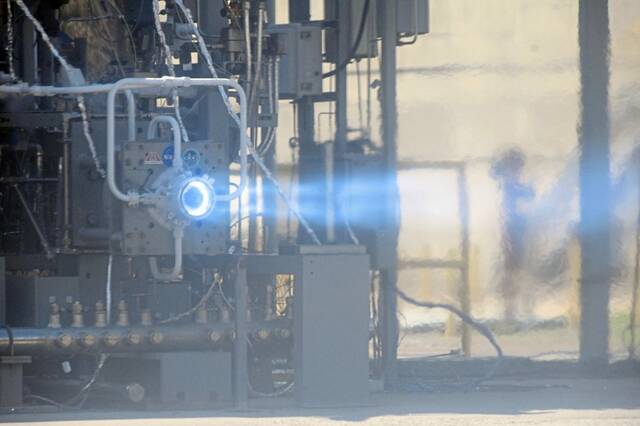
Pittsburgh-based aerospace company Astrobotic has made strides in developing an ultra-efficient rocket engine that could allow more cargo to reach the moon.
In a test last month at NASA’s Marshall Space Flight Center in Alabama, Astrobotic’s 5,000-pound rotating detonation engine prototype fired for five minutes straight. Several other companies have experimented with similar engines, but Astrobotic claims to be the first to run one for that long.
Rotating detonation engines use supersonic waves to burn fuel, generating 15% to 20% more power with the same amount of propellant compared to traditional rocket engines. With less fuel weighing it down, rockets could carry additional landers, scientific equipment and other payloads.
“Every gram, every ounce, every little bit of efficiency you can squeeze out of the engine, all of that counts,” Sean Bedford, senior director of business development for Astrobotic, told TribLive.
Following the successful test, Astrobotic engineers are looking for ways to make the engine lighter and improve the design of the nozzle and fuel pump.
Another trial will take place in August or September, either at the Marshall Space Flight Center or Astrobotic’s site in Mojave, Calif.
Bedford expects the engine will be powering spaceflight by the end of the decade.
“We’re off to a really promising start,” he said.
Astrobotic designed and built the prototype using less than $1.5 million in NASA funds — chump change in the pricey universe of space exploration.
The first four launches of the agency’s Artemis moon mission program will cost about $4 billion each. Artemis II completed a lunar flyby this month, taking humans near the moon for the first time in more than a half-century.
Artemis III is slated to take flight in 2027 as a test run for Artemis IV and Artemis V, a pair of 2028 missions that will see astronauts set foot on the moon. After that, NASA is targeting lunar landings at least every six months.
As the Artemis program matures toward the establishment of a U.S. moon base, where astronauts will need supplies to live and carry out experiments, Astrobotic anticipates its engine technology will be in high demand.
Founded in 2008, Astrobotic is best known for building lunar landers. The company’s Griffin-1 lander is set to deliver two state-of-the-art rovers to the moon this year, offering something of a shot at redemption after its Peregrine-1 lander’s ill-fated journey in 2024.
Astrobotic employs about 300 people between its Mojave facility and headquarters on Pittsburgh’s North Side, where the rotating detonation engine prototype was partly built.
Copyright ©2026— Trib Total Media, LLC (TribLIVE.com)