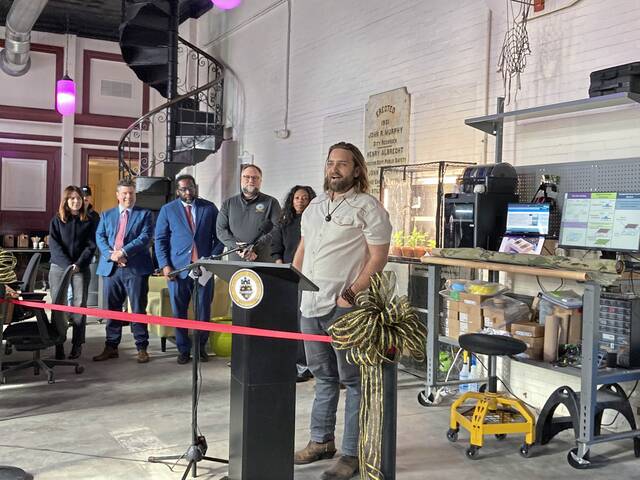


When Noah Snyder walks into his new office and laboratory space at a historic firehouse in Pittsburgh’s Troy Hill neighborhood, he’s met with a “whimsical” mix of old and new.
A fireman’s pole descends from a circular hole — now patched over with plywood — in the engraved black ceiling, once a quicker option for firefighters than the circular staircase on the other side of the room. A set of tall garage doors once let fire trucks come and go.
And then there are the workspaces covered with an eclectic array of sleek computer screens, safety goggles, camouflage fabrics — and a terrarium that houses about 500 silkworms.
Welcome to the home of BioInterphase, a bioengineering company whose cutting-edge science stands in contrast to its 125-year-old headquarters.
“We’re doing more and more work in the future, but we’re getting our buildings older and older,” Snyder, the company’s president and CEO, said Thursday, as local dignitaries gathered to celebrate the building’s redevelopment. “Had you told me I’d be in a firehouse 10 years later, I’d say, ‘I’d don’t think so.’”
Before moving to Troy Hill, BioInterphase had been in an old school building in nearby Etna.
Snyder, a University of Pittsburgh graduate, founded the bioengineering research and design company about a decade ago.
BioInterphase engineers textiles and coatings, focusing on designing “next-generation materials.” Among its projects: developing a coating that keeps barnacles out of cooling systems for the Navy and a material called Thermophase that improves thermal efficiency at power plants.
Currently, Snyder is working with silkworms, the caterpillars that produce silk, which is then used in a wide array of products, ranging from bed sheets to sutures.
Overseas silk production is often linked to poor working conditions, Snyder said. He’s hoping to find better ways to create silk products — starting in his Troy Hill lab.
BioInterphase once had more than 20 employees but was forced to scale back during the covid-19 pandemic, Snyder said. The company now employs three workers.
“We’re excited to grow here in Troy Hill,” Snyder said.
His firm occupies about 2,200 square feet of office and laboratory space in the repurposed fire house.
“It’s tapping into Pittsburgh’s history, while also looking towards the future,” Mayor Corey O’Connor said.
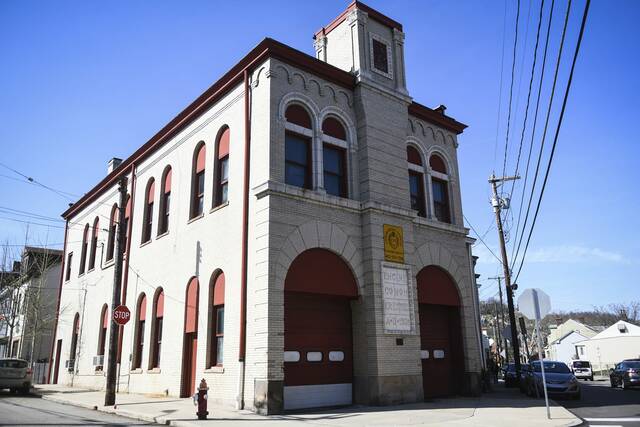
Built in 1901
Under a strip of purple lights, a display hanging on the wall shows a timeline of the firehouse, which was granted historic designation in 2022.
The first firehouse on the site dates to the 1850s. The existing building was constructed in 1901, partly on the original structure’s foundation.
The fire station initially was known as Fire Company No. 11, but later was renumbered as 51, then 39. It closed as a fire station in 2005 and was subsequently used as the city’s Commercial Vehicle Enforcement Office.
About five years ago, Pittsburgh’s Urban Redevelopment Authority started to explore options to repurpose the building, which was sitting empty.
A previous plan to convert the space into a community market, cafe and taproom fell through when potential tenants dropped out, citing feasibility concerns.
Snyder acknowledged his company wasn’t the “first pick” to move into the building, but he hopes the community “will be happy that we did.”
The authority sold the building for $150,000 to Troy Hill-based QGE Holdings, an arm of the local architectural firm Wildman and Chalmers.
The new owner undertook a $410,000 effort to revitalize the space, including fixing up brickwork and installing new windows before BioInterphase moved in.
Chad Chalmers, co-founder of Wildman and Chalmers, on Thursday said he was pleased to see a vacant building repurposed in a productive way that returns it to the tax rolls and brings jobs to Troy Hill.
Majestic Lane, deputy executive director and chief strategy officer at the URA, said the building holds significance as one of the city’s oldest fire houses. The new business that moved in showcases futuristic innovation, he added.
“It blends what we know is Pittsburgh’s past, present and future,” Lane said.