A six-figure expense is a big deal for a lot of businesses.
Less so for U.S. Steel, a massive manufacturer with more than $15 billion in annual revenue.
That’s why clean water advocates argue the Pennsylvania Department of Environmental Protection missed the mark last month by fining U.S. Steel $135,000 for repeatedly leaking oil into the Monongahela River.
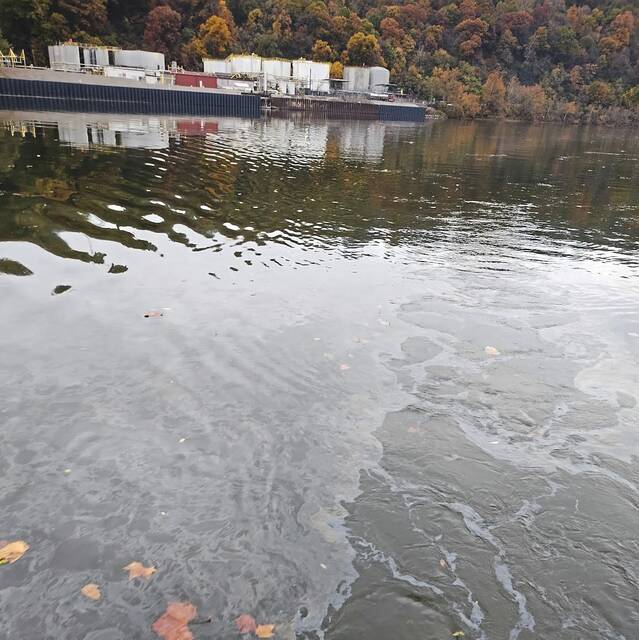
The DEP documented at least seven violations between August 2022 and April 2025, with oil sometimes spotted over a mile downriver.
“I almost fell out of my chair when I read the $135,000,” said Annie Quinn, founder and director of the Mon Water Project and a conservation biologist. She called it “laughable.”
The Nov. 20 consent order between the DEP and U.S. Steel also sets up recurring fines in the thousands of dollars for future violations. It also requires the firm to stop oil sheens from escaping its Irvin Works in West Mifflin.
Evan Clark, captain of local river monitoring and advocacy group Three Rivers Waterkeeper, welcomed state action. But he worried “fines this minor will not prevent polluters from violating our clean water laws in the future.”
Clark’s group has documented and reported numerous instances of thin, iridescent film appearing on the water near the 150-year-old steel processing facility.
DEP spokesperson Neil Shader declined to discuss specifics of the settlement negotiation as a matter of policy. He instead referred TribLive to guidelines within the state’s Clean Streams Law.
Anyone who violates the law faces a base fine between $100 and $10,000 per offense. Negligence raises the fine to a minimum of $2,500 and a maximum $25,000.
If the department finds the violation was intentional, it can set a penalty ranging from $5,000 to $50,000.
Regulators also look at how much material has been released and for how long as well as ongoing impacts, according to Laina Aquiline, another DEP spokesperson.
These factors help explain the disciplinary gap between the U.S. Steel settlement and another agreement reached just four days later over oil leakages at a site in Pittsburgh’s Lawrenceville neighborhood.
Sunoco parent company Energy Transfer and BP subsidiary Atlantic Richfield were fined $3.3 million for failing to fix the issue. Remediation efforts have been ongoing since 1977.
Neither the size nor revenues of violating companies are considered when setting fines, according to Aquiline. The law does not provide for it.
Still, the DEP may not be fully leveraging its power to impose financial consequences on firms that contaminate the state’s waterways.
In 2022, the federal Environmental Protection Agency audited the DEP’s fine calculations. It found the state agency often failed to consider the gravity of violations and benefits that a company gained by avoiding pollution control costs.
‘A cost of doing business’
The DEP has a continuum of enforcement options at its disposal, ranging from simple warnings all the way to a referral to the state Attorney General’s Office for criminal charges.
“The objective is to use the right combination of tools to get them to stop violating first, and then cleanup whatever needs to be cleaned up and prevented in the future,” said David Hess, DEP secretary from 2001 to 2003.
In 2023, the DEP followed up multiple notices of violation to U.S. Steel related to the oil sheens with a compliance order. It did not include any fines, only a demand to contain the oil and prevent further discharges.
Later investigations discovered continued violations. The consent order, with its monetary penalties, represents an escalation on the enforcement continuum.
As was the case in the two November consent orders, fines can be paired with agreements from violators to address the issue, often under the threat of additional costs.
U.S. Steel, for instance, has three months to complete a facilitywide investigation to identify all sources of oil and grease. From there, it will have 90 days to submit a mitigation plan to the state.
It will be fined $1,000 each day if it misses a deadline and $7,500 for each future leak once the mitigation plan goes into effect.
The company told TribLive in early December it’s committed to “environmental excellence” and regulatory compliance.
There are cases where the DEP’s enforcement efforts seem to do little to deter offenders.
By Hess’ count, Energy Transfer has been fined more than $48 million since 2018 related to the construction of the cross-state Mariner East Pipeline and the much smaller Revolution Pipeline.
In 2021, the oil and gas behemoth faced criminal charges related to the Mariner East Pipeline project, including a felony count of failing to report pollution. It was convicted the following year.
But by then, the pipelines were built. They continue to operate today.
“It’s a very frustrating thing, at times, if you have a company that just doesn’t want to comply,” Hess said. “Because they just view tens of millions of dollars as a cost of doing business.”
Small town troubles
The Allegheny and Monongahela Rivers fall outside the purview of the Mountain Watershed Association, which deals mainly with the Youghiogheny River and its tributaries.
But the group’s riverkeeper, Eric Harder, can relate to the frustrations of Quinn and Clark.
There are cases, he said, where the DEP takes it too easy on deep-pocketed polluters. Other times, the fines are actually too hard on small entities.
Harder pointed to Ohiopyle, the tiny Fayette County borough surrounded by a state park, as an example. As part of a 2019 consent order with the DEP, it was fined $10,000 for letting raw sewage leave the local treatment plant.
The payment essentially wiped out the borough’s income tax haul that year and made fixing the facility an even tougher financial proposition.
“It goes both ways,” Harder said. “Sometimes the penalties aren’t large enough and sometimes the penalties limit the operator, in this case Ohiopyle, from fixing the problem.”