

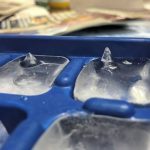
Every once in a while, you may pull an ice cube tray out of the freezer and see that one of those cubes has a strange little spike on it that appears to be defying gravity.
And the phenomenon that creates those spikes could be the sole reason for life on Earth, according to a Duquesne University science professor.
“Water is odd in that it expands when it turns into a solid,” said Patrick Cooper a string theorist and physics professor at Duquesne. “And usually, when things settle into their more-relaxed phases, they tend to shrink.”
But water’s ability to expand as it freezes, Cooper said, was a key factor in protecting life in the ocean when the Earth underwent multiple ice ages, hundreds of millions of years ago.
“The ice formed on the top of the ocean, protecting and insulating the water beneath,” he said. “And that’s extremely impactful to our whole ecosystem, and it’s the key feature here.”
As ice freezes, it doesn’t do so in a uniform way — little patches start to crystallize and freeze first — they are referred to as nucleation sites — and they begin to spread out along the top layer of the water. When other chemicals go from a liquid to a solid state, they tend to form heavier crystals that sink rather than float.
“Sometimes, those nucleation sites will enclose a little region of water,” Cooper said. And as the water in that hole starts to freeze, it expands. Since it’s got nowhere to go but that hole, it goes up.”
If the hole is the right size, it will freeze into a tiny spike atop an ice cube.
So, if you freeze a bigger ice cube, do you get a bigger spike? Not so, according to Jared McAllister, operations manager at DiMartino Ice in Jeannette.
“When we produce large blocks of ice for sculpting or for quenching metal fabrication, those blocks are frozen horizontally with about 40 to 50 gallons of water in each block,” McAllister said. “We use a circulating pump to ensure that it always freezes clear, and it freezes from the bottom up.”
But even if DiMartino was freezing giant blocks of ice the old-fashioned way, they would be unlikely to create big ice spikes, Cooper said.
“Water is pretty heavy, and maintaining a tall column of water requires a decent amount of pressure,” he said, “That pressure has to come from somewhere. Those holes will probably just freeze shut.”
Cooper said the way hydrogen and oxygen atoms join together to create water has given it some unique properties that merit study.
“There are some things about water that we still don’t fully understand,” he said.