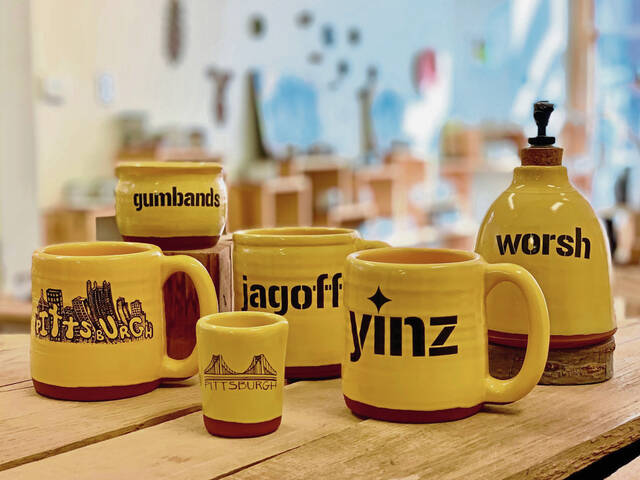
Whether it’s saying yinz for the plural of “you” or flattening vowels in words like “out” or “down,” Pittsburghers have a distinctive way of speaking.
But for us, it’s totally natural.
“That’s why you can pretty easily pick out a Pittsburgher,” said Brian Butko, director of publications at the Heinz History Center in the Strip District. “Yet in our mind, it sounds correct.”
Butko contributed to the History Center’s 2016 publication “Pittsburghese: From Ahrn to Yinz.”
You may meet a traveling Pittsburgher and immediately recognize their provenance or you might be surrounded by our strange slang while visiting. Our language may feel a little foreign, and for good reason: It does originate overseas.
“The first English-speaking settlers in the area were from Northern Ireland,” said Barbara Johnstone, professor emeritus of English and linguistics at Carnegie Mellon University. “Their ancestors came from Scotland. So they came to be known as Scotch-Irish.”
Those settlers spread west across Pennsylvania, and with the barrier of the Appalachian Mountains between Pittsburgh and the ocean, they remained isolated in the region for some time. Thus, the Scotch-Irish pronunciations and some of their words were integrated into Pittsburghers’ speech through the centuries.
The most common aspect of speech that makes the Pittsburgh accent recognizable is the flattening of rounder vowels, turning “downtown” into “dahntahn” and “out” into “aht.” There’s also the exclusion of the “to be” in phrases such as “the car needs to be washed.” Instead, we say “the car needs washed” (or, realistically, “warshed”).
“That’s why you can still sometimes hear, in this area, some words and phrases that you’d still hear in Northern Ireland and Scotland,” Johnstone said.
Her scholarly work “Speaking Pittsburghese: The Story of a Dialect” was published in 2013 by Oxford University Press.
Johnstone added that more recent immigrant groups, such as Italians, Germans and Eastern Europeans, had little influence on the accent because of a desire to assimilate by the first new generation of Pittsburghers born in the region.
Both Butko and Johnstone cited yinz as the most commonly known Pittsburghese word, and it comes from “you’uns.”
“Outsiders think it’s odd, but it has a perfectly normal meaning,” Butko said.
If you’re feeling a little bit of culture shock navigating the city, here’s a guide to some Pittsburghese words and phrases you’ll need to know.
Yinz
Substitute for “you all,” used to address or refer to a group of people. Example: “Yinz going dahntahn for the NFL Draft?”
·····
Jaggerbush
A thorny shrub that might cause you pain if you were to fall into it. Example: “That jaggerbush out front keeps scratching me every time I walk past.”
·····
Slippy
Slippery, but more efficient. Example: “It rained yesterday and froze overnight; my walk was slippy when I left for work this morning.”
·····
Gumband
A rubber band. Example: “You got a gumband in your junk drawer? I need to hold these papers together.”
·····
Redd up
To clean up or prepare a space. Example: “You better redd up your room before your grandparents come over and see a mess.”
·····
Buggy
A grocery store shopping cart. Example: “I got a buggy at Giant Eagle with a squeaky wheel and it drove me crazy.”
·····
Nebby
Nosy. Example: “I’m feeling nebby, I’m going to the North Shore to people-watch.”
·····
Pop
Regional term for soda. Example: “I’m going to get a pop with my Primanti’s sandwich instead of an I.C. Light because I have to drive home.”
·····
N’at
Short for “and that,” usually used at the end of a sentence. Example: “I’m headed to the South Side to visit the bars on East Carson Street n’at.”
·····
Stillers
The Pittsburgh professional football team, officially named the Steelers. Example: “The Stillers are going to win another Super Bowl next year!”