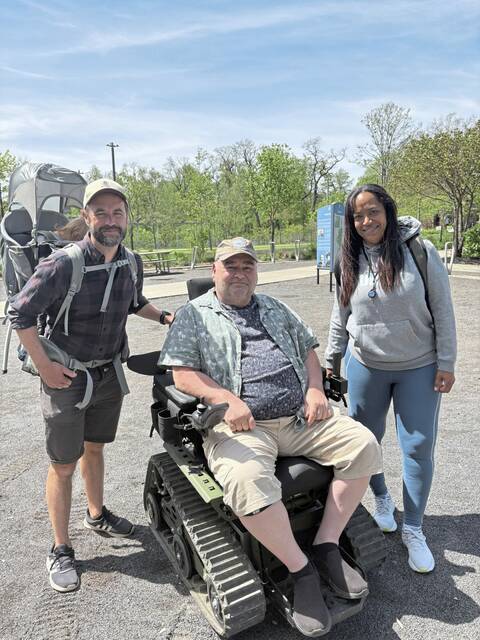
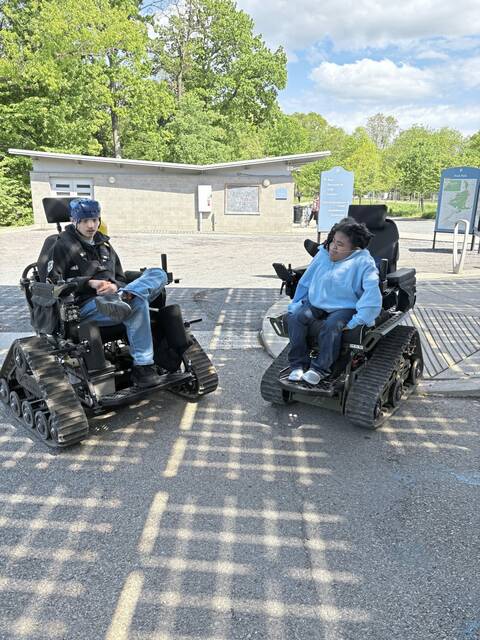
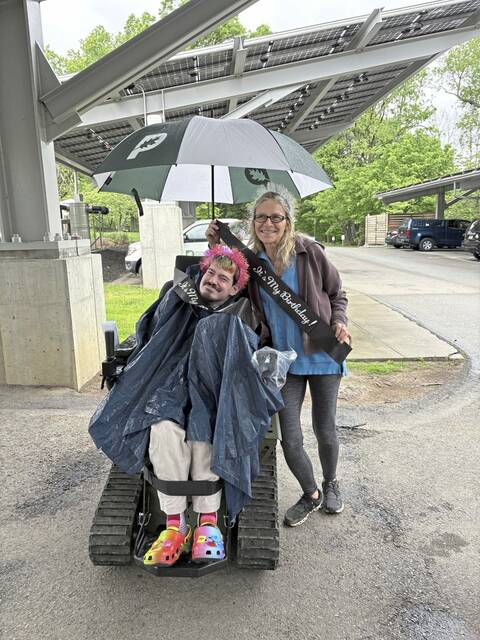


Tress Belesi in the last few weeks has watched a young wheelchair-user explore a park trail for the first time, a young couple with disabilities experience their first park date and a woman with limited mobility spot may apples in nature for the first time in more than a decade.
Such moments were made possible through the Pittsburgh Parks Conservancy’s new Trackchair program at Frick Park, an effort Belesi has helped launch as the nonprofit’s assistive resources and accessibility coordinator.
Trackchairs — all-terrain, electric-powered wheelchairs that Belesi describes as looking like “mini tanks” — now allow people with disabilities to explore five trails in Frick Park. The 644-acre greenspace spans Pittsburgh’s Squirrel Hill, Regent Square, Point Breeze and Swisshelm Park neighborhoods.
“This was a much-needed resource,” Belesi said of the all-terrain chairs.
They’re equipped with treads inspired by snowmobiles and accessories like oxygen tank holders. They can reach a speed of up to 4.5 miles per hour.
About 30 people between the ages of 6 and 82 tested the Trackchairs in a pilot program launched in the fall. More than 80 people signed up for a waitlist.
Testing the equipment
Laura Poskin, executive director of Age-Friendly Greater Pittsburgh, said some members of the group tested the chairs in advance of the official rollout this month. The organization advocates for making the region more inclusive for people of all ages.
“When we’re designing out communities, we have to be sure that everyone can participate because it’s better that way,” Poskin said. “We want everybody to be able to access their local parks.”
Poskin said Age-Friendly Greater Pittsburgh has been enthusiastic about the Trackchairs and other accessible amenities at Frick Park. When the organization has surveyed people about what assets they want to have in their community as they’re aging, parks tend to be at the top of the list.
Trackchair rentals at Frick Park opened to the public on May 1. In the first week, about 15 people used them — even though some had to dodge raindrops and one user encountered hail. Belesi said even inclement weather didn’t dampen enthusiasm about the new program.
People can sign up online to reserve a Trackchair. Volunteers join new users on their first excursion to teach people how to use the chairs safely.
Trackchair slots are already booked through May. Reservations for dates in June and July open May 29.
Parks can be hard for some people to navigate, Belesi said. Uneven terrain can make it impossible for wheelchair users to explore nature paths. Some greenspaces simply aren’t accessible for people with disabilities or seniors.
“Our natural spaces aren’t created with those people in mind,” Belesi said.
Belesi is aiming to change that. The Trackchair program — the first of its kind in Pennsylvania — is one piece in a broader effort to ensure Frick Park is welcoming for everybody.
The Pittsburgh Parks Conservancy last year opened the Outdoor Discovery Space and Sensory Nature Trail, an accessible 1/3-mile trail that has areas where people can rest or explore nature using various senses.
A recent renovation to the From Slavery to Freedom Garden includes garden beds at various heights that are reachable for people in wheelchairs, conservancy spokeswoman Alana Wenk said.
Work is expected to start next year on a project that will make the amphitheater space at Frick Park more accommodating for everyone, too, she said.
Different programs
New programs offer tailored experiences to groups who may sometimes struggle to enjoy parks fully. For example, Belesi said, the conservancy has offered birding programs for people who are blind, helping them identify birds based on their chirps and songs. They’re also experimenting with adaptive hearing aids that could help people who are hard of hearing experience birds’ calls.
Belesi said they’ve started piloting efforts to have Trackchair users join nature walks or other group programs.
Belesi is soliciting feedback from Trackchair users to fine-tune ideas for other programs using the chairs. Maybe there could be more educational programs for Trackchair users or even Trackchair sports, they said.
“Our hope is to expand into other parks,” Wenk added.
Daeja Baker, director of advocacy at the Pittsburgh Center for Disability Justice, said people with disabilities encounter an array of challenges navigating public spaces, from poorly maintained curb cuts to a lack of handicap-friendly trails in parks.
Efforts to make public spaces more welcoming for everybody, she said, provide greater opportunities for people who are too often left out.
“It makes it so we’re not an afterthought, so we are part of the society we are building,” Baker said. “I think it’s really important our communities don’t just survive but have joy.”