
https://triblive.com/local/allegheny-county-courtroom-clash-embroils-judge-public-defender/
Allegheny County courtroom clash embroils judge, public defender

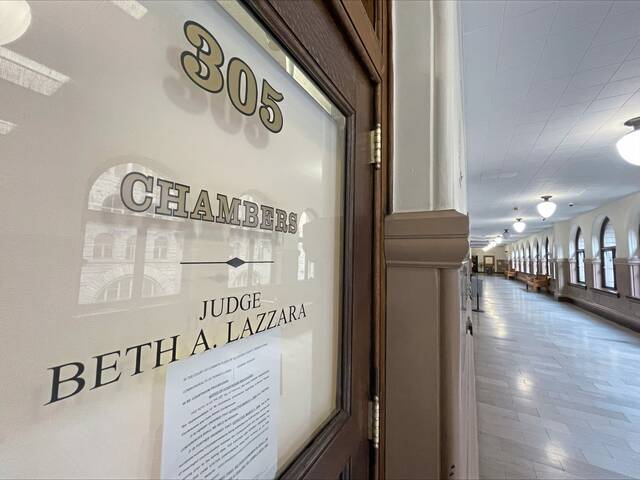
An Allegheny County judge who oversees hearings on people’s competency to stand trial has barred a public defender accused of unethical behavior from practicing before her — a controversial remedy several legal experts said is not within the judge’s authority.
The clash quietly playing out in the court system has created a power struggle between Common Pleas Judge Beth A. Lazzara and the county’s Office of the Public Defender, which represents impoverished clients.
Fundamentally, the dispute is over the limits of judicial authority: How much discretion does a judge have to dictate which attorneys appear before her, including — or especially — those facing allegations of misconduct?
Not much, according to experts.
“As long as an attorney is in good standing, a judge doesn’t get to refuse that lawyer in court,” said David A. Harris, a criminal law professor at the University of Pittsburgh. “You can’t have judges picking who the lawyers are.”
The controversy began last month when Lazzara, who presides over Competency Court, said Managing Attorney Samantha Sridaran — part of the team that helped create the specialized court — could not appear before her in competency cases.
The public defender’s office vigorously opposed the move and asked Lazzara to recuse herself from competency cases involving its lawyers.
Since then, a complaint has also been filed against Lazzara with the Judicial Conduct Board.
Lazzara refused to step down from the cases, leaving the matter at a standstill.
She and court administration declined comment about the friction.
Interim Chief Public Defender Andy Howard said Sridaran would not comment. He would not answer questions from TribLive but said in a statement his office allows only licensed attorneys in good standing to participate in court.
Experts said there is no authority for a judge in a situation like this to ban a licensed attorney from their courtroom. They also said defendants’ right to representation takes precedence over any dispute between a lawyer and judge.
“Judges have enormous discretion about how they handle things in their courtroom,” said Bruce Antkowiak, a former federal prosecutor who teaches criminal law at Saint Vincent College. “But you don’t get to pick and choose what attorneys walk through your courtroom door.
“If they are allowed to practice, they’re allowed in.”
Lack of trust
Allegheny County convened its first Competency Court session in July, with Lazzara assigned to oversee it. It operates six days per month, and there the judge presides over commitment hearings, placements to Torrance State Hospital, contested competency determinations, bail-related proceedings and review hearings.
Lazzara, who was first elected to the bench in 2005 and retained her seat twice, including this fall, was assigned to the criminal division in 2010. She also has presided over Mental Health Court since 2012.
Sridaran, a 2018 graduate of Case Western Reserve Law School, last year won the school’s Distinguished Recent Graduate Award, given to an alumnus “whose accomplishments enhance the perception of the profession and of the law school in the eyes of the community.”
As one of the public defender’s managing attorneys, Sridaran supervises the Special Representation Unit, which includes defending clients in competency matters in criminal court.
But, last month, Lazzara said she didn’t trust Sridaran and believed her conduct in a criminal case against Isreal Moseby was unethical.
Sridaran ran afoul of the court earlier this year when she was accused of judge-shopping and trying to manipulate the legal system in her representation of Moseby.
Moseby was 19 in 2023 when, prosecutors say, he stabbed a woman in the throat. Questions arose after Moseby’s arrest about whether he was mentally competent to stand trial.
Sridaran was assigned to be his lawyer and lobbied for Moseby to be released from jail.
Her efforts were rejected four times by a veteran criminal court judge who deemed Moseby to be dangerous.
But Sridaran continued to fight, taking the case to a judge in the county’s Orphans’ Court division who had no criminal case experience. She asked him to free Moseby on bond, and, in December 2024, that judge granted her motion.
Moseby was released to an unsecured community facility, from which, police say, he absconded and fatally shot a woman in June.
A TribLive investigation revealed flaws in the handling of Moseby’s bail request and the hearing that followed.
Given the details about the Moseby case, Lazzara said she did not believe Sridaran was the proper person to represent the public defender’s office in Competency Court.
The judge has banished the lawyer from appearing before her on those cases until state disciplinary allegations against Sridaran stemming from the Moseby case have been resolved.
‘I am your biggest problem’
According to court records, the conflict between Lazzara and the public defender’s office began in October when Sridaran, who had been on maternity leave, returned to work and appeared before Lazzara in a competency hearing.
Sridaran’s return prompted Lazzara to call Howard, the lawyer’s boss, on Oct. 20.
During the 45-minute phone call, Lazzara asked Howard to assign lawyers other than Sridaran to her courtroom, according to a motion by the public defender’s office.
Howard wrote that he asked for a meeting and thought everything had been resolved until he and Lazzara could meet in person.
The next day, Sridaran handled cases in Competency Court. Late that afternoon, though, Lazzara texted Howard to reiterate she wanted Sridaran out.
“‘I am your biggest problem,’” Lazzara texted, according to Howard’s motion. “‘If I can’t trust her, I can’t work with her. I was being generous saying that you guys could come over and try to talk, but I quite frankly don’t know that there is anything that can be said that will make me or anyone else in the team trust her. That is the problem that you have.’”
On Nov. 5, Howard wrote in his motion asking Lazzara to recuse, the judge texted him again to say Sridaran, who managed the attorneys doing competency work, was not welcome in her courtroom.
“‘Please do not send her tomorrow or in the future,’” Lazzara wrote. “‘She also should not be training anyone for this job. The trust issue is insurmountable at this time. Thank you.’”
Within two weeks, Howard filed the recusal motion. He called Sridaran “integral” to representing clients in competency cases.
During a hearing Nov. 18, Lazzara read aloud her text exchange with Howard. She referenced the Moseby case, calling it a “major issue, an ethical issue, involving Ms. Sridaran.”
“She can practice law,” Lazzara said. “She can’t practice law in here.”
Client abandonment?
A few days later, the public defender’s office filed motions to withdraw from six pending competency cases, suggesting the Office of Conflict Counsel — which provides indigent defense in cases where there is a conflict of interest with the public defender — could take over.
At a hearing on that issue, Brandon Herring, who heads the conflict counsel office, was irate.
“My office was never envisioned to take on an entire new docket,” Herring said.
Herring was particularly mad at how, he said, the public defender’s office reacted when they thought they’d be removed from the Competency Court cases.
“Virtually everyone said they were gloating about the fact we were being appointed,” he said. “I find that despicable, your honor.”
Herring said the public defender’s actions constituted client abandonment.
Lazzara ruled the public defender could not show good cause for withdrawing and denied their motion.
Experts weigh in
Bruce Green, who directs the Center for Law and Ethics at Fordham University’s Law School, said the underlying issues in the Moseby case were the fault of the Orphans’ Court judge who issued the order granting Moseby’s release — not Sridaran.
“Part of what lawyers do is exploit the process lawfully to assist their clients,” Green said. “That’s called clever lawyering.
“In some ways, you want to say kudos to the public defender.”
He called Lazzara’s decision to ban Sridaran inappropriate.
Green said there’s no authority to ban a lawyer without following proper procedures — for example, issuing a rule to show cause and holding a hearing on the matter. Although, he continued, “in a certain sense, it’s a blessing not to appear before a judge who hates you.”
St. Vincent College’s Antkowiak said there have been a handful of occasions locally when judges have banned attorneys from practicing before them.
In Allegheny County Common Pleas Court, it has happened with both prosecutors and defense attorneys. And beginning in 2010, a judge in federal court refused to hear any cases involving the federal public defender’s office.
But, Antkowiak said, those are instances where the judge and attorney have actively had a conflict with each other.
In this case, he noted, the conduct in question occurred before a judge in a different division.
In the past when a judge has banished an attorney, Antkowiak said, the situation is usually handled by that lawyer’s supervisor.
They realize, he continued, “it’s doing our side no good to have this person in that room, and they put someone else there.
“The judgment has to be made by the person assigning.”
Antkowiak said the chief public defender gets to assign the staff the way he sees fit.
“I don’t know that anyone outside of their office has the authority to tell them otherwise,” Antkowiak said.
Sara Jacobson, the executive director of the Public Defender Association of Pennsylvania, said the public defender’s office is best suited to represent clients in Competency Court because of its expertise in addressing mental health needs.
“Although disagreements between judges and individual attorneys happen, it is crucial for public defender offices to maintain independence from judicial influence,” Jacobson said. “For the system to function fairly, judges cannot and should not select who appears before them.”
Harris, the Pitt professor, said the uproar highlights the difficulties that exist in problem-solving courts where the parties — the judge, prosecutor, defense lawyer, probation and others — are expected to work as a team.
“Our system is not set up to work as team,” Harris said.
The criminal justice system is designed to be adversarial — for the defense attorney to look out for the best interest of their clients.
“They can work toward the same goal, but that won’t always be the case,” Harris said. “At some point, the judge has to hold her nose.”
Judges have broad authority to run their courtrooms, he continued. They can yell at attorneys, and on occasion, even hold them in contempt or make disciplinary referrals.
“Sometimes, it is the job of a lawyer to do something the judge doesn’t like,” he said.
Locking horns
Witold Walczak, the legal director for the American Civil Liberties Union of Pennsylvania, said it is inappropriate for a judge to interfere with a client’s right to counsel.
“The judge is supposed to be a neutral here,” he said. “If they can’t handle the case with that particular attorney, they have to recuse.”
The ACLU has been advocating on behalf of the public defender’s office for nearly 30 years, including filing a federal lawsuit against the county in 1996 over inadequate representation for indigent defendants.
Walczak said the public defender’s office is acting appropriately by zealously defending clients — even if the judge doesn’t like how they’re doing it.
Whatever happened in the Moseby case, he continued, “there was not any demonstrable misconduct by the public defender — and certainly nothing to justify excluding her from being able to practice in the court she’s been assigned to.”
“If and when there’s a disciplinary finding, you could potentially revisit that,” he said.
Until then, Walczak said, Sridaran has more expertise to handle those cases.
“So if you take her out of the equation, you’re harming their constitutional duty to fulfill their responsibilities,” he said.
All of the experts suggested the way to handle the dispute is through mediation — possibly with court administration.
Harris noted it might be more difficult now to talk things out.
“They locked horns,” he said, “and nobody can back away.”
Copyright ©2026— Trib Total Media, LLC (TribLIVE.com)