
https://triblive.com/local/budget-unbalance-how-can-different-mayors-be-40m-apart-on-pittsburghs-spending-plan/
Budget unbalance: How can different mayors be $40M apart on Pittsburgh’s spending plan?

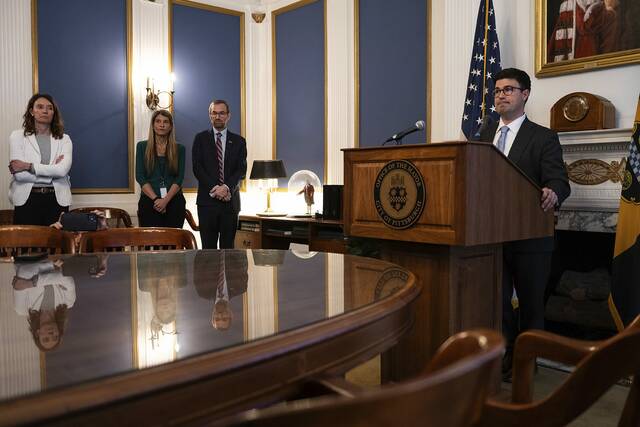
Pittsburgh’s new mayor says the 2026 budget he inherited might have a $40 million hole that must be plugged.
The architect of the previous administration maintains it doesn’t.
Who’s right?
The answer remained in dispute Friday, a day after Mayor Corey O’Connor warned that his predecessor, Ed Gainey, had left him saddled with a projected shortfall of between $30 million and $40 million.
Part of the different takes on the city’s fiscal health might come down to dueling philosophies.
Mayor Corey O’Connor on Thursday said Gainey’s administration used “a lot of false assumptions” and left the city in a financial position that is “much worse than we thought.”
But Jake Pawlak, Gainey’s director of the Office of Management and Budget, denied there was any mismanagement.
“From what I gather, from what the mayor has said, they’re taking a more fiscally conservative approach, which is their prerogative,” Pawlak told Triblive. “It is a question of differing philosophy, not one of mismanagement.”
O’Connor’s chief of staff, Dan Gilman, would not provide TribLive with an itemized list of expenses used by the mayor’s office to determine the size of the budget gap.
Examples provided by the mayor Thursday at a news conference totaled over $20 million.
His spokeswoman, Molly Onufer, said other expenses the O’Connor administration was taking into account included costs associated with lawsuits and union negotiations.
Gilman said officials are still finalizing the figures but he did not expect any more “big surprises.”
Officials Friday were continuing to analyze the budget, gather lists of outstanding invoices and chart year-to-year comparisons.
One thing both Gilman and Pawlak agreed on: there’s not $40 million in unpaid bills.
Rather the eight-figure bombshell O’Connor dropped Thursday represents a combination of expenses.
There are concrete costs, such as invoices that are due on vehicle maintenance or water bills. And there are projected needs, such as extra funding to cover unanticipated expenses like overtime or clearing the streets from January’s snowstorm, which cost about $2 million.
Freedom from debt
The disconnect over how to view the city’s budget is not new.
The Gainey administration was often at odds with council members and Pittsburgh Controller Rachael Heisler about whether the budget was realistic, how dire the city’s financial situation was and what should be done to resolve it.
Pawlak acknowledged the budget he crafted relied on money from trust funds — pots of city money set aside for specific purposes — and included jobs funded by grants that will eventually dry up.
That means the city will need to find new revenue streams to support them.
Pawlak said the intention was to rely on those tactics as a stopgap effort this year to balance the budget.
Next year, Pawlak said, the city’s finances will look a little better as Pittsburgh goes over what officials call the “debt cliff.”
At that point, its debt payments will decrease by about $30 million, freeing up that money to go to other expenses.
“I wouldn’t describe that as uncommon or certainly not as any kind of budgetary malpractice,” Pawlak said of efforts to plug holes with trust fund money or grants until then.
“It’s not fair or accurate to say that it was an omission or an error or something irresponsible on our part. It was a strategic choice.”
Gilman said such approaches are “not strong financial practices.”
“I think a lot of it is going to come down to how you want to run your city and if you want to pay your bills on time,” said Peter McDevitt, who served as City Council’s budget director during this year’s budget process and now is the deputy controller.
Buffer zone
Councilwoman Erika Strassburger, D-Squirrel Hill, said she believed a “combination of factors” led to the budget battle now bubbling to the surface at City Hall.
“One is that there was and remains, clearly, a difference in opinion as to what constitutes a balanced budget between the last mayoral administration and council,” said Strassburger, who is chair of council’s finance committe.
“It strikes me that this new administration is factoring in many, many more guardrails and accounting for the needs for more guardrails — and therefore more dollars — to, for instance, create the buffers necessary in case of emergency, to fully fund our settlement line item in the law department.”
Strassburger said she is not comfortable “crossing our fingers” and hoping the existing budget holds up.
She agrees with O’Connor that officials need to scrape together between $30 and $40 million to ensure the city can cover its costs, set itself up for a strong financial position in the coming years and be prepared in case of emergencies, from landslides to public safety crises.
“I will stand with the mayor and his team that we need to aim to fill that gap,” she told TribLive. “That is what we need to do.”
Cost containment
Even after council last year revamped Gainey’s budget proposal — tacking on a 20% property tax hike that should bring in about $28 million in additional revenue this year — O’Connor is looking to trim spending so he can afford to pay for a range of expenses, from fuel to bridge repairs.
The O’Connor administration also wants to move away from some budgeting practices the Gainey administration had employed, like raiding trust funds, using temporary grant money to fund salaries and yanking money from the reserve day fund, which shrunk by $44 million last year.
Heisler, the controller, said the city’s baseline problem is that the city is spending more money than it brings in.
“Spending is outpacing revenue. Period,” Heisler said. “That has been a trend, and it will continue to be a trend. We need to focus on cost containment, we need to figure out how to grow, and we need to focus on the basics.”
Copyright ©2026— Trib Total Media, LLC (TribLIVE.com)