
https://triblive.com/local/carlynton/identification-of-wwii-airman-sidney-burkes-remains-was-82-years-in-the-making-nephew-says/
Identification of WWII airman Sidney Burke’s remains was ‘82 years in the making,’ nephew says

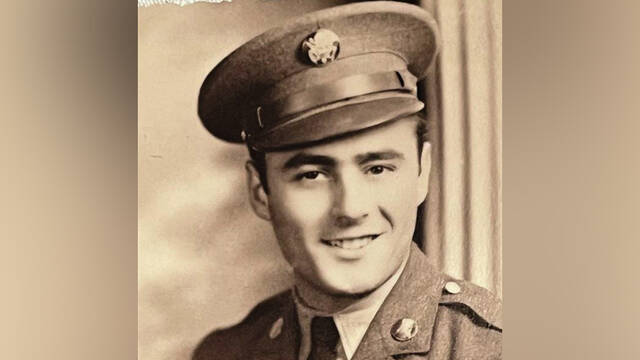
For almost all of Paul Hankin’s life, the circumstances surrounding the death of his uncle, Sidney Burke, who was killed while serving in World War II, were a mystery.
“We thought we would never find out what had happened,” said Hankin, 83, of Bethel Park. “I had his picture hanging on the wall of my game room with his original Purple Heart medal given to my mom in 1953.”
Now, after more than eight decades, the family knows. The Defense POW/MIA Accounting Agency announced last month that U.S. Army Air Forces Sgt. Sidney Burke had been identified in April.
“It was fantastic,” Hankin said. “We were all amazed by the level of detail and everything that was involved. His case worker and an active duty master sergeant came to our house and provided us with all kinds of detail of what had transpired.
“It was 82 years in the making.”
Burke was the only son of Alexander and Fannie Burke and grew up alongside two sisters, Irene Kopelman and Helen Hankin, in what is now known as the Upper Hill District in Pittsburgh, Hankin said.
Burke graduated from Fifth Avenue High School and, when his parents divorced, moved to Gary, Ind., Hankin said.
Burke enlisted at Fort Benjamin Harrison in Indianapolis. In 1943, he was a member of the 22nd Bombardment Squadron, 341st Bombardment Group, 10th Air Force during World War II.
On Aug. 3, while serving as the Armor-Gunner of a B-25C “Mitchell” bomber on a low-altitude bombing raid in Meiktila, Burma, his aircraft crashed. Four of the six service members aboard the aircraft, including Burke, were killed. Two survived and were captured by Japanese forces.
Burke was 22 when he died. Hankin was 10 months old at the time.
“My parents did not know what had happened to him,” Hankin said. “They knew he was missing and killed in action in Burma.”
In 1947, the American Grave Registration Service recovered four sets of remains, later designated X-282A-D, from a common grave near the village of Kyunpobin, Burma. Local villagers had buried the crash victims, Hankin said.
At the time, the remains could not be identified and were interred as unknowns in the National Memorial Cemetery of the Pacific, also known as the Punchbowl, in Hawaii.
“The ironic part is we had visited the Punchbowl several times on vacation, but we never knew he was there,” Hankin said.
Hankin said he was first notified by the federal government about 10 years ago that Burke was believed to be in a group of people they were trying to identify.
“They sent me his Army files at the time,” Hankin said. “I didn’t hear anything until five years ago. They asked my cousin and I for DNA samples.”
In January 2022, all four sets of remains were exhumed from the Punchbowl and taken to a laboratory for analysis, according to the government.
Scientists used dental, anthropological and isotope analysis to identify Burke’s remains. The Armed Forces Medical Examiner System used mitochondrial DNA analysis and mitochondrial genome sequencing data to positively identify Burke.
He was buried in Section 8 at the National Cemetery of the Alleghenies in Bridgeville on Sept. 29.
“It was very nice,” Hankin said. “He was buried with full military honors.”
Burke’s name, along with others missing from World War II, is recorded on the Walls of the Missing at the Manila American Cemetery and Memorial, an American Battle Monuments Commission site in the Philippines. A rosette, which indicates he has been accounted for, will be placed next to his name.
Copyright ©2026— Trib Total Media, LLC (TribLIVE.com)