
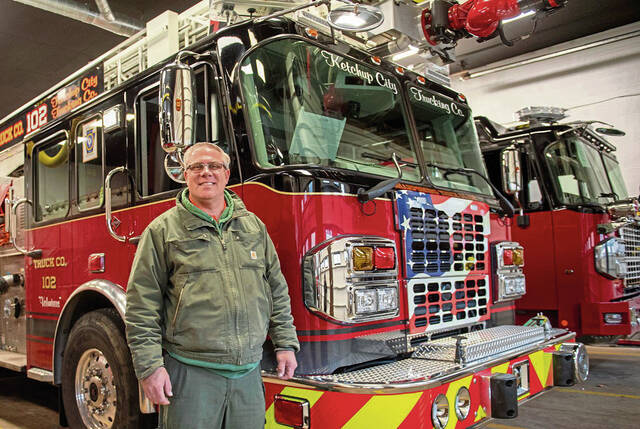
Soot-covered fire gear is no longer a badge of honor for emergency responders.
Research by the National Institute for Occupational Safety and Health shows firefighters stand a higher chance of developing cancer even after minimal contact with smoke particles and fire toxins.
Locally, emergency service personnel are taking steps to reduce the health risks.
Southern Allegheny Valley Emergency Services, comprised of Sharpsburg and Aspinwall, is embarking on an upgrade to the station restrooms as part of protective initiatives.
“As a part of the department’s cancer prevention program, we will add showers for members to decontaminate prior to returning home to their families from fires,” Chief Mike Daniher said. “We want to protect members and their families from exposure to carcinogens.”
Firefighter decontamination, or the process of ridding hazardous contaminants from skin and gear, is becoming standard procedure.
As building materials evolved to include synthetics, the smoke has become more toxic, according to the Centers for Disease Control. Even after the fire is doused, gear can hold volatile organic compounds that pose inhalation hazards, according to the CDC.
Studies show that the gear can continue to release contaminants for at least two hours after exposure. Efforts as simple as using soap and water at the scene can reduce surface contaminants by up to 85%, according to the CDC website.
A 2015 study by NIOSH reviewed data from nearly 30,000 firefighters and found that compared to the number of cancers expected using U.S. population rates, firefighters had a 9% increase in cancer diagnoses and a 14% increase in cancer-related deaths. Mesothelioma, multiple myeloma, non-Hodgkin lymphoma and bladder and prostate cancers topped the list.
Decontamination efforts have ramped up in the years following the study. Practices to diminish cancer-causing materials can include scrubbing gear at the scene, placing equipment into sealed bags to avoid contaminating trucks and stations, showering within an hour, and using wipes to clean exposed skin before returning to the station.
Departments are also investing in clean gear storage and separate airflow systems in-station.
In the future, technology might include ozone-based gear sanitizing chambers and sensor-equipped turnout gear that could detect exposure levels in real time.
The department, which merged in 2023, will pay for the project with help from a recently awarded grant. SAVES received $75,000 through the Redevelopment Authority of Allegheny County. Specifically, money will be made available through the Gaming Economic Development Tourism Fund.
The grant will pay for restroom upgrades, a new roof and kitchen renovations.