
https://triblive.com/local/north-allegheny-graduate-travels-to-hawaii-as-part-of-effort-to-better-predict-severity-timing-of-volcanic-eruptions/
North Allegheny graduate travels to Hawaii as part of effort to better predict severity, timing of volcanic eruptions

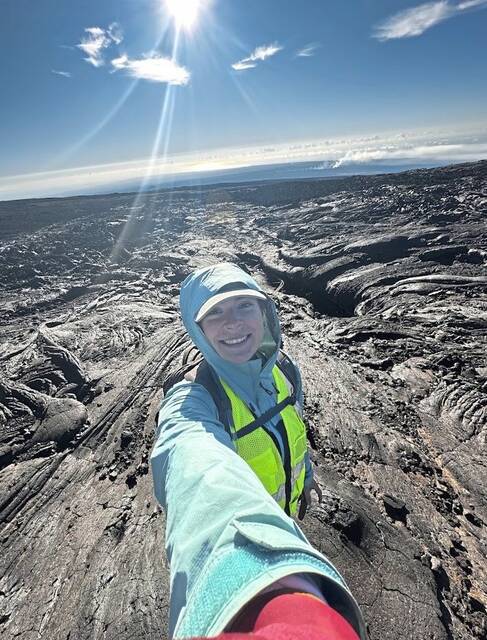
A North Allegheny graduate is participating in an effort at the University of Rhode Island aimed at predicting volcanic eruptions sooner and more accurately.
Eleanor Martin, who graduated from North Allegheny in 2021, is working on a doctorate degree in marine geology and geophysics. She joined students researching two active Hawaiian volcanoes, Mauna Loa and Kilauea, and traveled to the Big Island in early October.
While Hawaii is known for being warm, Martin, 22, found it quite cold when she was 13,000 feet above sea level on Mauna Loa. She and other students were taken up there by helicopter, where Martin took a photo of herself standing on hardened magma.
While some trees and small brush were attempting to grow, there was no wildlife.
“On top of the volcano, it was super quiet. You didn’t hear a single thing,” she said. “It was cold. The air was definitely thin. There was a smell of sulfur where fumes were coming up from the volcano. For the most part, it was just really quiet. You just hear the wind.”
Students from the University of Rhode Island’s Graduate School of Oceanography are studying the rift zones of Kilauea and Mauna Loa, two of the most active volcanoes in the world.
A volcanic rift zone is a linear area of weakness on a volcano, often a set of parallel cracks on its flanks that allow magma to rise to the surface, leading to eruptions and volcanic activity. Rift zones often form due to internal stress from magma pushing the volcano’s flanks apart.
“We’re mapping the volcanoes’ hidden fine structures and how the big regional forces shape and refresh the structures — that combination largely determines where magma goes, how often it gets out and how big eruptions can be,” said Zhangbao Cheng, a geophysical oceanography doctorate student from Wuhan, China.
Results from the study, begun in 2024, will enable the development of new volcano monitoring capabilities and allow communities in Hawaii to be better prepared for volcanic activity.
The study is funded by the National Science Foundation. Students and scientists from the University of Hawaii and the University of Utah have assisted with fieldwork and data analysis.
Martin said she jumped at the opportunity to visit Hawaii for the first time when her advisor asked if she’d want to go. During her week there, she was part of two trips to Mauna Loa to retrieve hundreds of seismic sensors that had been deployed in August. Researchers will analyze the data they collected.
While Kilauea is currently erupting, Mauna Loa is not, Martin said. There is a theory that they are connected, so when one is erupting the other does not, she said.
“In general, the main goal of seismology is to always better predict and better warn when eruptions are going to happen,” Martin said. “We’ve definitely come a long way in terms of technology. It’s still not a perfect science.”
Martin now lives in Narragansett, R.I. Her parents, Rob and Wendy, recently moved from Franklin Park to Kansas. She has a younger brother, Bruno, 21.
After North Allegheny, Martin went to Jacksonville University in Florida, she said, to “flee the nest” and be somewhere warm. This spring, she earned bachelor degrees there in marine science and physics.
She went to Rhode Island because she wanted to come back north and be closer to home — which, since her parents moved, didn’t work out as planned. She started her studies, which she anticipates will take five years, in September.
“They’re a really good research institution, and I wanted to be in a place for my Ph.D. that had a strong research foundation,” she said.
Martin’s career goal is to be a researcher for NASA.
“I’m really interested in studying other plants and moons. It would be really interesting to study the quakes on Mars,” she said. “Europa, one of Jupiter’s moons, has a subsurface ocean. It would be really good to use seismology to map that and study that.”
For students at North Allegheny now, Martin said her advice is to “just go for it.”
“Growing up in Pittsburgh, I think I’d been to the ocean once. So it’s kind of like crazy how I ended up majoring in something that centers around the ocean,” she said. “Don’t limit your options to what they teach you in high school, too. There’s so much more out there in the world.”
Martin is hopeful of returning to Hawaii, and a trip to the Galapagos Islands also is possible.
“I don’t want to get my hopes too high for that one,” she said.
Copyright ©2026— Trib Total Media, LLC (TribLIVE.com)