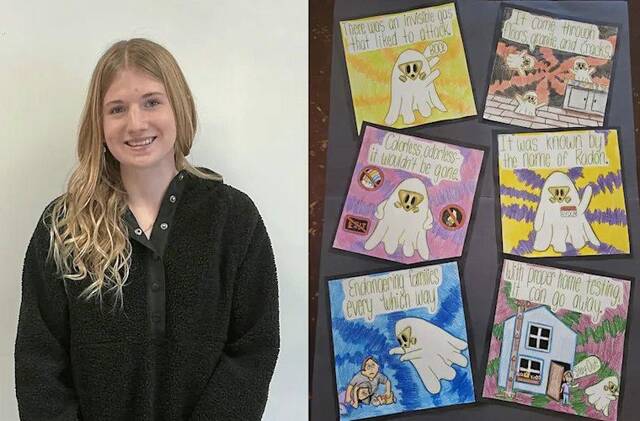
A North Hills Middle School student won first place in an annual national poster contest aimed at increasing awareness of the health risks of radon gas and the importance of home testing.
Eighth grader Regan Schall won a $1,000 scholarship for her 2026 first-place entry, “Boo to Radon.”
Regan, 14, of Ross is the daughter of Melissa and Jonathan Schall.
The contest is sponsored by the American Lung Association and the Conference of Radiation Control Program Directors.
Regan advanced to the national level after winning first place in the Pennsylvania Radon Poster Contest. It was the second year in a row she has been recognized at the state level.
“We’re especially proud that this year’s first-place poster winner comes from right here in Pennsylvania,” said Caroline Hutchinson, executive director of the American Lung Association in Pennsylvania. “Youth like Regan Schall are helping to highlight a serious issue in our state. With high levels of radon found in nearly 40% of Pennsylvania homes, increasing awareness is critical. We hope this recognition inspires more families to take action. Testing your home for radon is simple, inexpensive and one of the most important steps you can take to protect your family’s health.”
Radon is a naturally occurring radioactive gas emitted from the soil that can accumulate indoors to hazardous levels. Colorless, odorless and tasteless, radon can enter a home through cracks and openings in walls, basements, floors and foundations.
Radon exposure has no immediate symptoms, irritating effects or warning signs. The only way to detect radon in a home is to test for it.
Exposure to radon is the second leading cause of lung cancer in the United States, and the No. 1 cause of lung cancer in people who have never smoked.
“Radon is an invisible danger, responsible for an estimated 21,000 deaths each year in the United States,” said Harold Wimmer, president and CEO of the American Lung Association. “We are proud to support CRCPD’s annual National Radon Poster and Video Contest. It is part of a vital public health effort to engage communities nationwide and raise awareness of both radon’s health risks and the importance of home testing, which is easy, inexpensive and can save lives.”