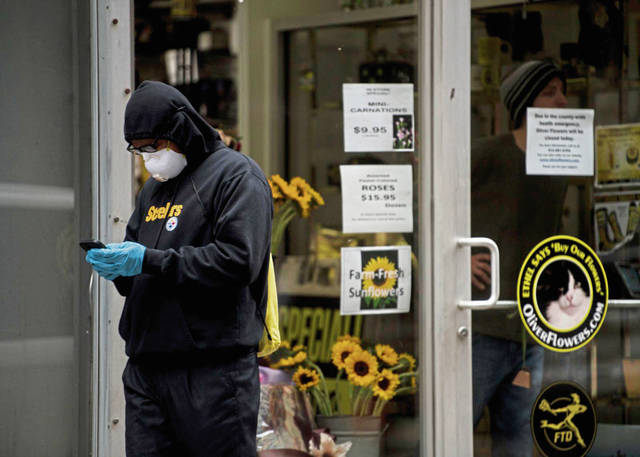


Government directives to close businesses and restrict people’s activities in an effort to stem the spread of coronavirus infections and deaths will impact more than a half-million workers in the Pittsburgh region, a top local economist predicts.
And the pain will be spread across virtually all industries in the seven-county region.
“Many of the most vulnerable industries will likely be laying off workers without pay,” leading to a “significant increase in the number of unemployed workers,” said Christopher Briem, a research economist with the University of Pittsburgh’s Center for Social & Urban Research.
The latest jobless rate of 4.6% is expected to increase significantly when March figures are released in April.
Briem estimated that about 515,000, or 46%, of the 1.3 million workers in the Pittsburgh region — Allegheny, Armstrong, Beaver, Butler, Fayette, Washington and Westmoreland counties — will be directly impacted by the closings of nonessential and non-life-sustaining businesses, as ordered last week by Pennsylvania Gov. Tom Wolf. That estimate, however, is “likely the low end of the range of the cumulative impacts” on the region’s economy, he added.
Unlike in the last century when the region rode the fortunes of manufacturing and mining, “Pittsburgh is very much tied to what is happening in the nation,” Briem said.
Wolf on Thursday ordered all non-life-sustaining businesses to close. This followed his earlier directive to close nonessential businesses, including bars and state liquor stories, and to curtail restaurants to take-out or delivery only.
Other states have taken similar measures.
“I think there is a high probability that this will slam the brakes on the economic growth” that the country has experienced, said Gary Quinlivan, an economist and dean of the Alex McKenna School of Business at Saint Vincent College near Latrobe. “In the short term, it will be a lot of hassle. If people act responsibly and shelter in place, then we might get through this” with minimal damage to the economy.
What could be a good sign for future economic recovery is the reopening of Chinese manufacturers, which were shuttered for about two months, said Quinlivan, who traveled extensively in China.
Prior to the governor ordering more businesses to close, Frank Gamrat, executive director of the Allegheny Institute for Public Policy in Castle Shannon, predicted the region’s economy would go through a “mini dip.”
Whether a coronavirus-driven dip turns into a recession depends on how long activities are restricted, said Gamrat, who oversees a conservative think tank that researches economic development and local policy issues. The longer the clampdown on economic activity goes, the greater the economic impact will be, he said.
The governor’s order to temporarily close schools affected more than 90,000 workers, Gamrat said.
Another sector of the economy that is being slammed is the leisure and hospitality industry, the three economists agreed.
Briem estimated that 60,200 of the accommodation and food service businesses in the region are directly impacted by the restrictions on restaurants. Many have closed. Those remaining open have furloughed some workers and slashed hours for others.
The leisure and hospitality sector had been a bright spot in the region’s economy, Gamrat said. In December, it accounted for 119,600 jobs — nearly 11% of all private-sector jobs, according to the state’s Center for Workforce Information and Analysis.
The light at the end of this dark tunnel is the likelihood that people will spend money when business restrictions are lifted, Gamrat said.
“You will see a little bit of pent-up frustration” in people spending their money, he said.