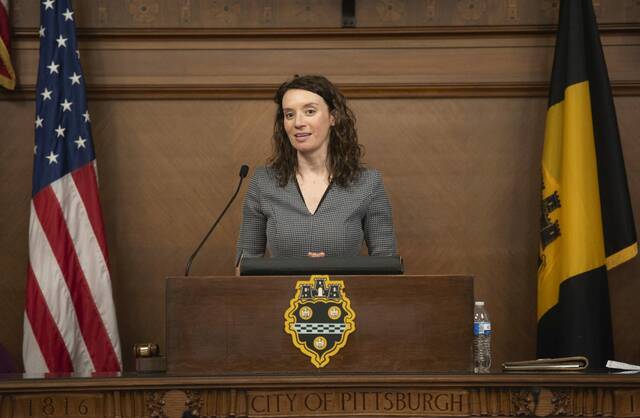
Pittsburgh Controller Rachael Heisler on Friday said the city’s finances are in a “delicate position,” echoing warnings that the city must rein in spending and grow its revenues.
The controller’s 2025 Annual Comprehensive Financial Report showed the city spent nearly $45 million more than it brought in, with revenues reaching around $687 million and expenses coming in at $732 million.
Heisler’s report comes on the heels of sweeping budget amendments Mayor Corey O’Connor introduced shortly after taking office this year. The new mayor, worried the 2026 budget failed to properly account for millions in expenses, added $28 million in additional spending to cover what he saw as gaping holes in the spending plan.
The $335 million in federal covid-19 relief money that has been propping up the city’s budget since the pandemic masked serious financial issues, Heisler said.
“The mask is off,” she told reporters Friday. “We are spending more than we are bringing in.”
If not for the covid relief money, the city would’ve ended 2023 and 2024 with deficits, she said. The city did record a deficit last year.
Pittsburgh has about $12.3 million left in federal covid relief money to spend by the end of the year, according to the controller.
Heisler also reiterated her concerns with the city’s longstanding practice of not counting all of its expenses. Some are labeled in the budget as transfers and not counted towards the city’s expenses, though they pay for a variety of costs, ranging from employee salaries to grants for local nonprofits.
According to the financial report, the city spent more than $90 million on transfers out of the budget last year.
“They can deplete the fund balance,” she said.
The fund balance — often called the rainy day fund — is shrinking. It dropped from around $200 million in 2024 to about $166 million at the end of last year. Projections show it will continue to decrease in the coming years.
Heisler also used her platform on Friday to again raise concerns about the city’s overtime spending, which went over budget by nearly $21 million last year, and the costs of maintaining an aging vehicle fleet, which totals about $1 million monthly.
“This isn’t all doom and gloom,” Heisler said, pointing to some “bright spots” in the financial report.
For example, the city brought in about $6.4 million more in earned income tax in 2025 compared to the year prior. And deed transfer tax revenue jumped by about $4 million last year.
Other promising points include parking and amusement tax revenue, which have fully rebounded from the covid-19 pandemic.
Voluntary payments to the city from nonprofits — including a recent $10 million contribution from UPMC to pay for ambulances — help the city keep afloat, Heisler said. She urged officials to continue working to ink long-term deals with major nonprofits and foundations to support the city budget, a tactic O’Connor has employed to secure funding for a variety of priorities, from snowplows to baseball field upgrades.
Long-term, Heisler said, the city needs to focus on attracting more residents and businesses to grow Pittsburgh’s tax base.
“We need to prioritize growth,” the controller said.
Heisler on Friday also presented preliminary financial information for the first quarter of this year. The city has spent about $39 million more in the first quarter of 2026 than it had up to that point last year.
Heisler said that’s largely because the city spent $5.5 million paying off a water bill that was left unpaid last year, $4.4 million more than expected responding to a massive January snowstorm, $1.4 million paying past-due vehicle fleet costs and $10 million to replace old, breakdown-prone vehicles.
A 20% real estate tax increase City Council authorized for this year already has generated an extra $21 million in revenue in the first quarter, which is when much of that tax is collected, Heisler said.
The city in the first quarter of this year brought in about $1.5 million more in parking tax compared to this time last year. Earned income tax is outperforming last year by about $4 million, while deed transfer tax has brought in about $6 million more so far this year compared to the same timeframe in 2025.