
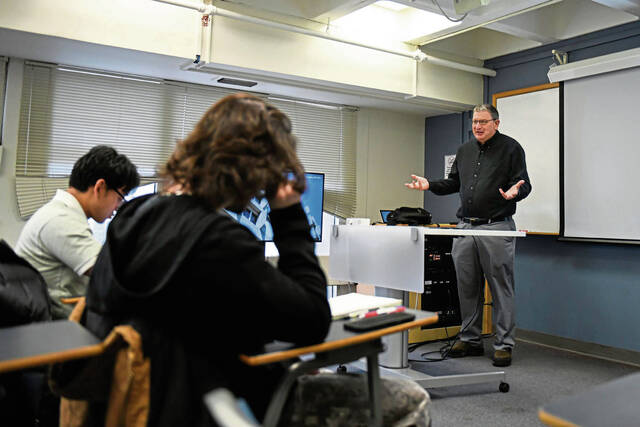
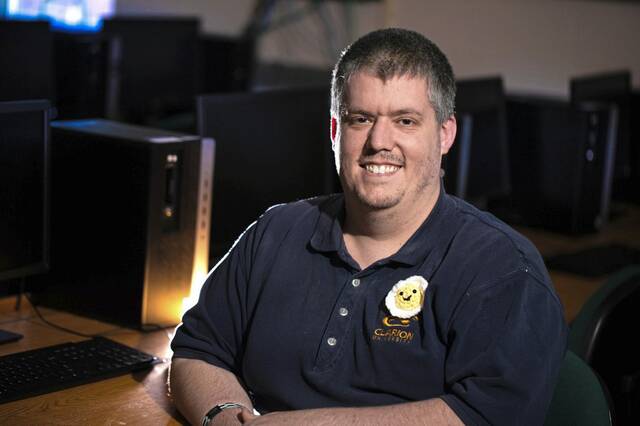




These are not your father’s computer science students.
And for good reason.
To find a job in the fast-growing, fast-moving field, college graduates are required to possess more than simple coding skills and the ability to troubleshoot.
Artificial intelligence is driving a demand for a more advanced, polished graduate who is ready to step into a job that transcends entry-level requirements.
“Thirty years ago, if you had computer skills, that was considered a bonus. Now it’s the standard,” said Brandon Packard, professor of computing and engineering technology at Pennsylvania Western University. “Ten years ago, if you had Microsoft Word skills, that was considered a bonus, and now it’s the standard.”
He predicts the same when it comes to computer science students and AI.
Growing industry
Employment in computer and information technology jobs is projected to grow faster than the average for all occupations between 2024 and 2034, according to the U.S. Bureau of Labor Statistics.
About 318,000 openings are projected each year, on average, in those occupations because of employment growth and the need to replace workers.
The median annual wage for computer and information technology employees was nearly $106,000 in May 2024, according to the bureau.
A graduate’s job prospects could largely depend on whether they have the AI skills employers are looking for.
Gone are the days where just a simple interest in computers and technology could get a graduate’s foot in the door. Graduates need to be “fluent in the vernacular of AI,” said Michael Mattarock, a Carnegie Mellon University professor and associate director of its Information Networking Institute. They also need to understand core engineering, business, policy and finance, depending on what industry they want to break into.
“Most employers are past step one,” he said. “Their expectation is having candidates that can actually think about engaging these technologies. It’s not always about technologies but how to solve the problem.”
Employers want AI used when appropriate, and they expect employees to know how to get the job done, said Shreyash Ranjan, 21, of Lansdale, a student at the University of Pittsburgh. Ranjan has held internships at data integration company Palantir; investment agency Vanguard; and Lockheed Martin, a global security and defense contractor.
“The role changes,” Ranjan said of entry-level jobs. “The bar is raised. As a junior engineer, there’s more expected of you.”
Ranjan, who started at Pitt three years ago and is president of the computer science club, said he has heard anxiety among computer science majors about how their degrees will play out in the job market. But he remains optimistic.
“[AI] will replace junior-level work and how we do that work, but I don’t see it taking over computer science jobs,” he said. “It makes computer science majors more powerful, and it demonstrates the power of computer science.”
Packard has heard the same. He doesn’t see any hesitancy from prospective or current students obtaining computer science degrees.
“With AI becoming so common, we need people to build and create these tools,” Packard said. “It’s actually exciting people. There are positions for computer science degrees everywhere. There’s positions for AI everywhere. Within the tech field, it’s created a lot of new positions.”
Even if AI takes the place of entry-level computer science jobs, a computer science degree is still sustainable and even popular, students and professors said.
Growth industry
New student enrollment increased by 9.9% across computer science, computer engineering and information fields among colleges that reported data in the 2022-23 and 2023-24 academic years, according to the Computing Research Association.
Pitt’s computer science club is one of the largest student organizations at the university, Ranjan said. A fall meeting attracted 400 students, he said, and computer science graduates have landed jobs at Google, Amazon, Meta and Roblox, to name a few.
The basics remain the same. Despite the wide possibilities of AI, graduates still are expected to be able to manage baseline tasks. Students still need to know how to debug and analyze programs, said Adriana Kovashka, chair of Pitt’s Department of Computer Science.
“My perspective is, we probably should teach students how to work with AI, but we probably still need to teach them essentially all the things that we teach them anyway,” she said. “If they use AI to help them, they still need to be able to understand the mistakes that AI makes and when AI is making a mistake.”
Packard agrees.
“In order to program AI, and even in order to use AI tools for programming and use them well, you have to understand how to program yourself,” Packard said.
Computer science programs are incorporating more courses teaching AI, machine learning or cybersecurity, he said.
“AI and machine learning is definitely a big topic today, but our field is always evolving anyway, and part of working in the field is being able to keep up with changes and trends throughout one’s career,” Packard said.
Having AI as part of a student’s learning experience is critical, said Joey Hou, a third-year doctorate student at Pitt in computer science.
“From the experience of people working in the computer science industry, they use AI tools extensively,” Hou said. “Having skills to use them is something we need to have current undergraduates know.”
“There are demands of people entering the field of computer science,” he added. “Companies are automating a lot of coding, but getting things working is a different type of skill than getting the code running.”
Even for non-computer science majors, knowledge of AI is becoming more important, Mattarock said. He cited the human resources field, which historically has not been heavy in technology, as increasingly growing with AI through data systems, sets and programs.
“It’s important to equip a workforce that knows AI,” he said.
Pitt has seen growth among students interested in computer science from non-STEM backgrounds, students and professors say.
“It is going to be the frontier of things,” Ranjan said. “Technology is one of those majors where you need to be adaptable. If you’re not embracing it, you’re going to put yourself behind.”