Two astronomical phenomena — a supermoon and a meteor shower — will collide in Western Pennsylvania skies Saturday.
Supermoons occur between three and four times per year and meteor showers grace skies about six times annually, said Daniel Vanden Berk, director of Saint Vincent College’s Angelo J. Taiani Planetarium.
But it is much more rare — once every couple of years, Vanden Berk estimates — that the two overlap.
Meteor showers take place when a stream of space debris enters the Earth’s atmosphere at high speeds, according to London-based Royal Astronomical Society. The meteors, which can range from the size of a grain of sand to a marble, can travel up to 157,000 mph.
The Quadrantid meteor shower, slated for this weekend, is among the strongest and most consistent types of showers that occur each year, according to Royal Museums Greenwich. This year, it is estimated to take place through Jan. 12 with a max rate of 120 meteors per night with clear skies.
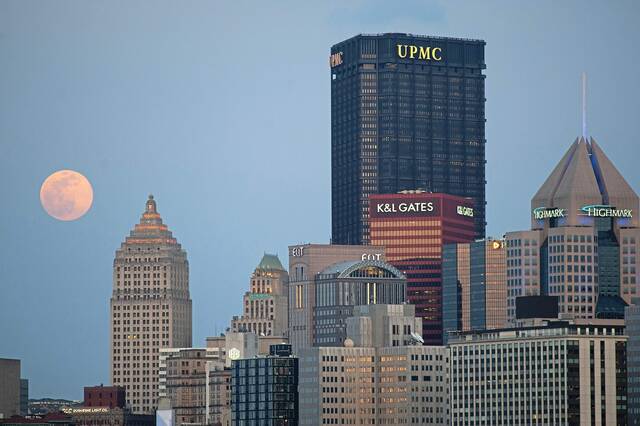
A supermoon, Vanden Berk said, occurs when there is a full moon while the moon is closest to Earth.
“The moon goes around the Earth, not in a perfect circle, but in an ellipse,” he said. “So sometimes, it’s a little bit closer. Sometimes, it’s a little bit farther.
“This full moon just happens when the moon will be a little bit closer to the Earth than average, so it will appear brighter than it usually does.”
The coinciding cosmic action may not appear as interestingly as it sounds, Vanden Berk said.
“You really don’t want to have a meteor shower during a full moon,” he said, “because the full moon makes the sky quite a bit brighter and it makes it more difficult to actually see the meteors.”
But Vanden Berk does not discourage Western Pennsylvanians from taking to the outdoors Saturday night to attempt a look.
“It’s probably going to be pretty cold,” he said with a laugh, “but you can sit outside and if you have nice, clear skies, you’re likely to see at least a few (meteors) per hour.”
The supermoon will peak around 5 a.m. Saturday and the meteor shower will be most visible sometime overnight between Saturday and Sunday, Vanden Berk said.
Binoculars or telescopes are not needed to view the meteor shower, according to Royal Museums Greenwich — which recommends finding a location away from street lights with an open view of the sky.
Phone cameras are unlikely to be able to capture the meteor shower, according to the Royal Astronomical Society.