Passover, or “Pesach” in Hebrew, begins this week, marking one of the most widely observed holidays in Judaism. Here is what to know about the tradition, its meaning and how it’s celebrated.
What is the story of Passover?
Passover is a major Jewish holiday that commemorates the biblical story of the Exodus, when the Israelites were freed from slavery in ancient Egypt.
According to the story, God sent a series of plagues upon Egypt. Before the final plague, Israelites were instructed to mark their doorposts with lamb’s blood so they would be spared. The name “Passover” comes from the belief that the Angel of Death “passed over” those homes.
“Jewish holidays are all about freedom,” said Rabbi Lenny Sarko of Congregation Emanu-El Israel in Greensburg.
How is Passover celebrated?
Passover began Wednesday night and can last seven or eight days.
It is a family-oriented holiday typically celebrated at home, Sarko said.
On the first one or two nights of the holiday, a ritual-filled Jewish Passover feast is held, called a Seder.
While the exact nature of a Seder varies, many Jews traditionally read from a book known as the Haggadah, or “telling” in Hebrew, before eating a festive meal.
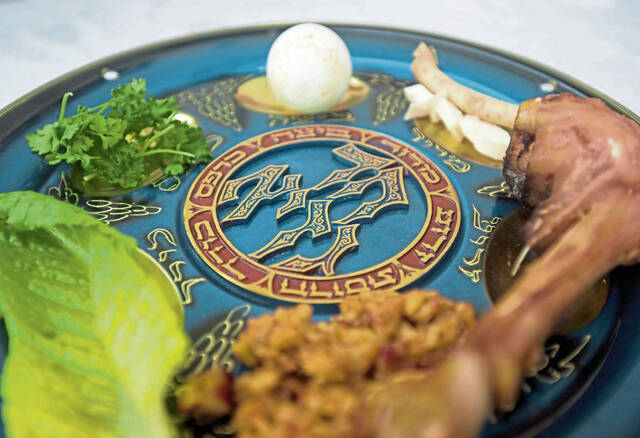
Several common traditions include a Seder plate with symbolic foods, the reading of the “four questions” to explain Passover, and a children’s search for a hidden afikoman — a broken piece of matzah, the unleavened bread eaten during the holiday.
“We left Egypt in haste and the bread didn’t have time to rise,” Sarko said, explaining the symbolism behind the tradition.
In addition to matzah, some traditional Seder foods include zeroa, a piece of roasted meat representing the paschal sacrifice before the Exodus; beitzah, a hard-boiled egg symbolizing festival offerings; and maror and chazeret, bitter herbs representing the harshness of slavery, as described by the organization Chabad-Lubavitch.
How do you greet someone on Passover?
It is customary to exchange holiday greetings with friends, family, colleagues and others during the days leading up to Passover and throughout the holiday.
While it is appropriate to wish someone a “Happy Passover,” there are also several traditional greetings across different Jewish languages that are specifically used during Passover, says the nonprofit Jewish Learning.
A few of these greetings include:
- Chag Sameach — pronounced as “Chahg Sa-MAY-Ach,” a general Hebrew expression that literally translates to “happy holiday” and is typically used for any celebratory Jewish observance.
- A Koshern un Freilichen Pesach — pronounced as “ah KUH-sher-in OON FRAY-lekh-in PAY-sakh,” a Yiddish greeting commonly used by Hasidic Jews to convey wishes for a “kosher and happy Passover.”
- Pesach Alegre — pronounced as “Pay-SAKH AH-lay-greh,” this is a Ladino expression translating to “Merry Passover.”
How many people in the United States celebrate Passover?
Passover is the most celebrated of Jewish holidays.
More than 70% of Jewish Americans take part in the Passover Seder, as calculated by the Pew Research Center.
“There is no Jew of any denomination I’m aware of that does not celebrate,” Sarko said.
He said the holiday’s immense popularity is because freedom is at the foundation of the Jewish religion.
“We don’t believe you can really be Jewish unless you are free,” Sarko said.