
https://triblive.com/local/regional/ice-dams-can-build-as-temperatures-rise-putting-homes-at-risk-for-water-leaks/
Ice dams can build as temperatures rise, putting homes at risk for water leaks

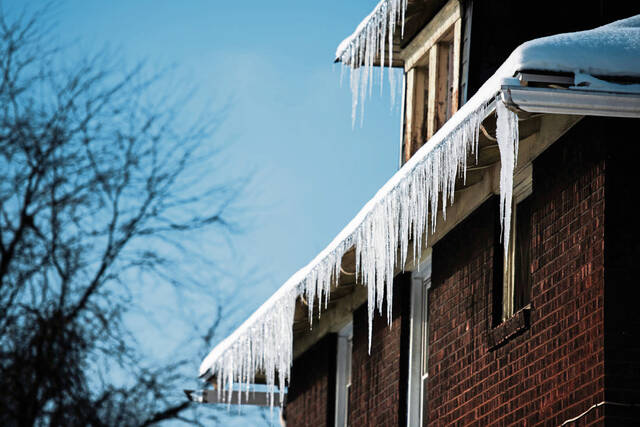
Roof repair and replacement company Roof Gutter Now keeps busy in the winter, fielding 60 to 80 calls a day to melt piles of snow, ice and water sitting on top of homeowners’ rooftops.
But owner Nathaniel Davis says the calls should pick up even more on Tuesday as warmer temperatures trigger melting snow, stubborn ice dams and fresh problems for homeowners.
Ice dams form when heat escapes from the top of a building, causing snow to melt on the roof.
Once the water melts, it begins to run down to the colder overhang where it refreezes and creates a wall of ice that prevents proper drainage, said Davis, whose company has crews in Westmoreland and Allegheny counties.
The thawing forms what Masters Insurance Services Owner Ben Johnston describes as “basically just a pond on the roof,” and can become an issue when the water begins to leak through the ceiling.
Ice dams sometimes form after a sudden change in temperatures after heavy snowfall.
“Western Pennsylvania’s frequent freeze-thaw cycles make Pittsburgh, Dublin, Westerville, and surrounding areas particularly susceptible to ice dam formation,” Roof Gutter Now’s website said.
Temperatures could reach 50 degrees Tuesday before dropping again overnight, the National Weather Service said.
The brief warm-up follows nearly three weeks of record-low temperatures across the region.
When homeowners crank up the thermostat to stay warm, the added heat warms the attic, ceiling and roof, Davis said. As snow melts, water can pool behind an ice dam, seeping under roof shingles and eventually into insulation, walls and ceilings.
Keep an eye on the ice
Johnston, whose insurance agency is located in Forest Hills, said his office has already seen an influx of claims coming in due to water damage from ice dams.
He warns people should “keep an eye on where the ice is forming.”
Older homes with roofs that have not been replaced in the last 10-12 years might not have the proper insulation needed to keep heat from rapidly escaping, Johnston said.
Newer homes or buildings with recent roof replacements often have an ice guard, which Johnston said is similar to a giant sticker designed to keep liquids from seeping into the home.
He suggests anyone who has noticed giant ice walls forming to seek a professional rather than waiting for the ice to naturally thaw. Once water leaks into the ceiling, homeowners will have to pay for a deductible as well as deal with possible mold and inconvenient repair as crews replace the dry wall.
How to stay safe
Cassandra Kovatch, a spokeswoman for Westmoreland County Public Safety, had some suggestions on how pedestrians and homeowners should navigate the freezing and thawing.
“In addition to the more commonly known safety tips such as avoiding walking beneath gutters or roof edges where icicles may form, it is important to remind residents not to go onto their roofs to remove icicles. Roof surfaces can be extremely slippery during these conditions,” Kovatch said in a statement.
While some residents may want to deal with the ice themselves, both Kovatch and Davis advise against it.
Davis said it is important for a professional to thaw the ice using an arctic steamer, which allows for removal of ice from roofs, ice from downspouts and gutters by heating to 302 degrees and fires 2½ gallons per minute.
“Residents should also avoid using heat guns, torches or open flames to melt ice, as these actions frequently result in house fires,” Kovatch said.
Copyright ©2026— Trib Total Media, LLC (TribLIVE.com)