
https://triblive.com/local/regional/local-farmers-skeptical-about-impact-of-bridge-payments-on-bottom-line/
Local farmers skeptical about impact of ‘bridge payments’ on bottom line

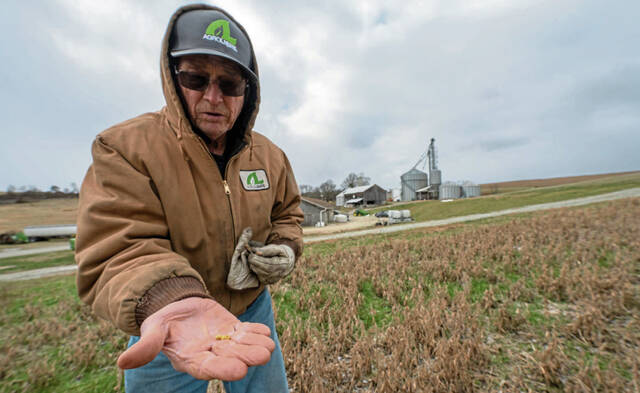
New Alexandria’s Fred Slezak said many farmers like him have a strong independent streak.
“We don’t particularly care to get payments from the government,” said Slezak, 71, owner and operator at Lone Maple Farms off Route 119. “But there’s just a whole host of struggles that we’re battling out here.”
In light of those struggles, the U.S. Department of Agriculture has proposed distributing $12 billion in “bridge payments” to American farmers, in response to “temporary trade market disruptions and increased production costs that are still impacting farmers,” according to a USDA news release.
Some local farmers are viewing the program with skeptical eyes. Slezak said he thinks the bridge payments will be a temporary fix at best.
“It’ll help keep the lights on,” Slezak said. “One issue we have locally is the overpopulation of deer and the impact they have on our crops. But the real thing is the overproduction of commodities around the world. It’s sad to say, but a major drought might be the only way we can get some relief from these low commodity prices. But that means farmers elsewhere in the world have to suffer.”
President Donald Trump’s first trade war resulted in China accelerating a diversion of its supply chain away from the U.S. to places such as South America. U.S. farmers have since lost crucial market share to competitors, particularly Brazil.
“Forty years ago, we didn’t have South America as a competitor,” Slezak said. “That adds to the problem. To have a healthy agricultural economy, we have to have export markets — almost a third of what we produce in this country has to be exported.”
Subsidies not always embraced
Not all farms qualify, as the bridge payments cover row crops such as soybeans, barley, chickpeas, corn, cotton, lentils, oats, peanuts, peas, rice, sorghum, wheat, canola, crambe, flax, mustard, rapeseed, safflower, sesame and sunflower.
Kevin Jarosinski’s Sarver farm, where he raises chickens, beef, pork and lamb, is not eligible for the payments.
Jarosinski said he wouldn’t want them anyway.
“We’re an old-school, non-subsidy farm,” he said. “A lot of places, really, are government-funded farms. We got a little help during covid through one of the federal programs, but once you take from the government, it’s hard to stop doing it. If I’m a farmer who’s trying to support myself through capitalism, and I’m depending on the government for a check? It just doesn’t make sense.”
Adam Mason, who owns and operates HEAL Farms in Allegheny Township, said he thinks federal agricultural programs tend to favor those who don’t necessarily deserve the help.
“They tend to reward the people who’ve been doing it incorrectly for so many years, to try and convert them to something like what we’re already doing,” he said.
Mason practices regenerative farming, working within nature rather than trying to force nature to bend to his will. It is a a conservation approach with the goals of enhancing natural resources, focusing on improving soil health, biodiversity and water cycles through practices including cover cropping, reduced tillage, composting and integrating livestock, ultimately building more resilient and productive farms while potentially sequestering carbon and reducing chemical dependence.
Just two days after announcing the bridge payments, USDA officials also unveiled a $700 million regenerative pilot program to try to help lower farmers’ production costs.
“I don’t quite know the specifics yet, but I’m planning to reach out to my National Resources Conservation Service agent at the USDA to ask about it,” Mason said. “I’d say get rid of all subsidies, but if you’re going to continue with them, give them to the people who’ve been doing things right.”
Seeking clarity on aid breakdown
Growers are seeking clarity on how much they might get from the bailout, as the announcement by Trump on Monday didn’t include crop-specific breakdowns for aid. Analyst and trader Ken Morrison estimated payments could be as much as roughly $50 per acre for farmers of crops such as soybeans, cotton and sorghum.
“That’s substantial and would be enough to matter and help out cash flow,” said Ryan Wagner, a South Dakota grains grower. “As far as whether or not that’s enough to compensate for lost export business and a damaged reputation as a reliable trade partner, that’s another question entirely.”
Stress has been particularly acute among soybean farmers after China, the world’s top importer, avoided buying U.S. supplies this year to gain leverage in trade talks. Though China has resumed purchases following recent diplomatic agreements, its commitment has yet to fully pan out.
U.S. Agriculture Secretary Brooke Rollins and Trump have both blamed domestic farmers’ difficulties on “four years of disastrous Biden Administration policies.” However during Joe Biden’s presidency, his administration largely continued Trump’s own agricultural policies, extending the programs in the 2018 farm bill developed during Trump’s first term.
White House Press Secretary Karoline Leavitt insisted Tuesday that Trump had persuaded Chinese President Xi Jinping to resume purchasing American soybeans, “which is something China wasn’t doing under the last administration because they had no respect for President Biden or the country at the time.”
Figures from the USDA paint a different picture.
They show that China was far and away the biggest market for U.S. soybeans during Biden’s final year as president in 2024 — interestingly enough, to the tune of a little more than $12 billion, the exact amount of the recently announced bridge payments. China only ceased buying American soybeans in May 2025, about a month after Trump announced the imposition of massive worldwide tariffs.
Farmers who are able to enroll in the Farmer Bridge Assistance Program can expect payments to be released by Feb. 28. Commodity-specific payment rates will be released by the end of December.
Copyright ©2026— Trib Total Media, LLC (TribLIVE.com)