
https://triblive.com/local/regional/robotic-assisted-technology-diagnoses-lung-cancer-more-quickly/
Robotic-assisted technology diagnoses lung cancer more quickly

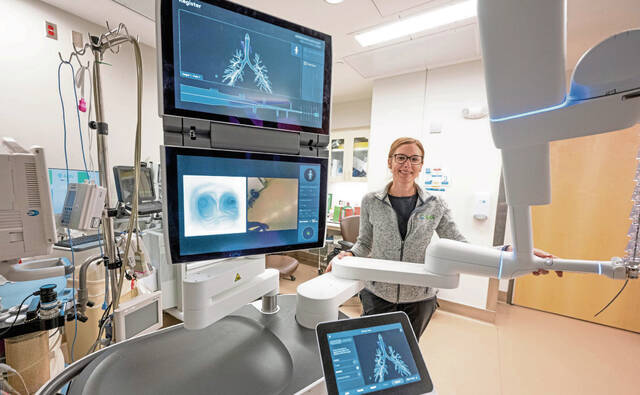
When Leslie Keebler contracted the flu last winter, early-stage lung cancer was not on her radar.
The 62-year-old from Munhall, a former smoker, underwent breathing treatments and a round of steroids before a lung scan revealed a suspicious spot.
Her physicians at Allegheny General Hospital on Pittsburgh’s North Side recommended a robotic-assisted bronchoscopy, which is technology that enables surgeons to reach small peripheral nodules that were previously inaccessible.
The Ion system, by Intuitive Surgical, provides physicians with laser-like precision to retrieve hard-to-reach tissue samples in the lung’s outer airways.
“With confidence, it allows us to get patients diagnosed more quickly,” said Dr. Stephanie Baltaji, Allegheny Health Network interventional pulmonologist.
“We can diagnose early-stage lung cancer a lot more accurately than before.”
The ultra-thin design allows easier access to the outer lung and provides a more efficient path to diagnosis, said Dr. Tariq Cheema, division director of pulmonary, critical care, sleep and allergy at AHN.
Traditional lung biopsy methods can hinder effective navigation because of narrow airways. That can mean multiple biopsies — which delays crucial time to develop a treatment plan and gives cancer the opportunity to spread.
“I didn’t know all about this robot,” said Keebler, a Mt. Lebanon native and retired thoracic nurse. “But I know, had this been 10 years prior and the technology wasn’t available, it would’ve had a much different outcome.”
Baltaji said the Ion is minimally invasive and enables complete staging during one procedure with less risks than traditional through-the-chest-wall biopsies.
Most importantly, it leads to improved outcomes, she said.
About 227,000 people are diagnosed with lung cancer each year in the U.S., according to the World Health Organization.
It’s the leading cause of cancer deaths worldwide. But early detection can be a game-changer, the group’s website says.
Despite this, only about 28% of cases are caught early because 4 out of 5 eligible people aren’t getting screened, the American Lung Association reports.
AHN recently marked its 1,000th robotic-assisted bronchoscopy. The health system has completed more Ion biopsy procedures than any other in Pennsylvania.
Equipped with shape-sensing navigational bronchoscopy and intraprocedural 3D imaging, the technology is set to get an artificial intelligence upgrade.
In October, Intuitive Surgical received Food and Drug Administration clearance for software that integrates AI to improve imaging capabilities.
The AI enhancement addresses challenges that might happen when a lung nodule shifts to a different location than pictured in the pre-procedure CT scan. Comparing the images, the system will adjust direction.
Intuitive is expected to do a limited launch of the software ahead of a broader roll-out next year.
There are currently more than 900 Ion systems in hospitals across 10 countries.
Keebler is now living cancer-free after surgery in late September to remove a small tumor.
Because the cancer was so quickly identified, she required no follow-up care.
“It was overwhelming to hear that it was cancer,” she said. “I knew the risks of smoking, but I never thought it would happen. It was sad.
”
Keebler believes her outcome would have been more dire without the Ion-enabled bronchoscopy.
“That tumor absolutely would’ve been larger if they would have had to do the biopsy the old way,” she said. “I’m very appreciative. I have a whole new outlook.”
Copyright ©2026— Trib Total Media, LLC (TribLIVE.com)