
https://triblive.com/local/regional/study-favors-medication-stents-over-major-surgery-for-clogged-neck-arteries/
Study favors medication, stents over major surgery for clogged neck arteries

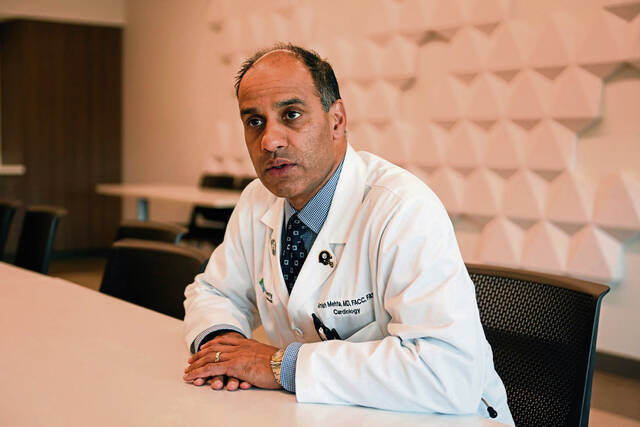
Pennsylvania heart specialists welcomed the results of a decade-long study reinforcing their belief in minimally invasive techniques to treat clogged neck arteries versus major surgery.
Researchers examined nearly 2,500 patients across five countries and 155 medical centers, including several UPMC hospitals and the Veterans Affairs Pittsburgh Healthcare System.
The patients hadn’t experienced a stroke but were at risk of one because of severe blockages of a carotid artery, large vessels on each side of the neck shuttling blood from the heart to the brain.
About 400,000 people are diagnosed with carotid artery disease each year in the U.S., and the condition causes 1 in 3 strokes, according to data cited by Allegheny Health Network.
Roughly half the patients got either medical therapy — a combination of drugs and lifestyle management — or medical therapy plus a plaque removal surgery known as an endarterectomy. The procedure appeared to do little to lower the risk of stroke or death over a four-year period compared with medical therapy.
The other half received medical therapy and a stent, a small device to prop open the artery, or just medical therapy. The stented patients were half as likely to have a stroke or die over the four years versus those just taking the drugs.
The results, eagerly awaited by cardiologists and vascular surgeons worldwide, were published last month in the New England Journal of Medicine.
Main takeaways varied among local medical professionals, who say they remain confident in their current practices.
To Dr. Amish Mehta, a cardiologist at AHN’s Jefferson Hospital, the study confirmed his sense that modern medications do a great job preventing strokes.
Doctors are able to reduce clotting, lower blood pressure and limit cholesterol levels using various drugs. Most of these weren’t available in the 1990s, when researchers last compared medical therapy and surgery in such a rigorous way.
Management of diet and exercise as well as smoking cessation techniques have also improved over the years, Mehta noted, further bolstering the medical therapy route.
The stent still performed better in the trial, resulting in a stroke or death rate just under 3% versus 6% with medication and lifestyle changes. But the gap “doesn’t translate into a major difference in how patients do,” Mehta said.
Dr. Thomas Simone, a vascular surgeon at St. Clair Hospital, agreed, adding patient preferences should be considered alongside the data.
“Some patients might be scared of surgery,” Simone said. “Other people are like, ‘I can’t live like this. I have a bomb in my neck.’”
Measuring stroke rates
Dr. William Bachinsky, a UPMC interventional cardiologist based in Central Pennsylvania, said it’s hard to ignore the case for stenting in asymptomatic but severe carotid artery disease cases.
The procedure, which uses a small incision in the groin to thread the stent into the carotid artery, does carry some risks up front. In the study, the stent group saw seven strokes and one death in the 44 days post-operation. All medical therapy patients, in contrast, were fine.
But stroke rates were much higher in the latter group after that. The cumulative benefits over the four-year period are worth it for many people, in the view of Bachinsky.
He’s performed the procedure as part of clinical trials more than 1,500 times since 2000 and was the principal investigator for the stenting trial at UPMC’s Harrisburg and West Shore hospitals.
“What we’ve seen time and time again is that if patients are selected properly, they’re done by experienced operators … carotid artery stenting has similar if not better outcomes than an endarterectomy, mainly because it’s less invasive,” he said.
Endarterectomies involve an incision into the carotid artery, which allows the surgeon to pull out the plaque. The procedure is typically done under general anesthesia. Most people go home within a day or two.
The study’s results have no bearing on the surgery’s efficacy in treating patients who’ve had a stroke.
A hybrid procedure where surgeons place a stent using a more direct route emerged over the course of the study and therefore was not included.
This newer operation has promise in terms of reducing stroke or death during or shortly after surgery, according to Dr. Elizabeth Detschelt, a vascular surgeon at Independence Health System.
Carotid artery disease is brought on by the accumulation of plaque, a sticky mix of fat, cholesterol, calcium and other substances that stiffen arterial walls and eventually limits blood flow, according to Cleveland Clinic.
Most people don’t know they have a serious buildup of plaque until they have a heart attack, stroke or major issue with their cardiovascular system, Cleveland Clinic notes.
However, doctors may be able to detect it using a stethoscope by listening for a bruit, a distinctive swooshing sound caused by narrowing of the carotid artery. Mehta said the disease is also sometimes caught during unrelated head and neck imaging.
Risk factors include age, high cholesterol and triglyceride levels, use of tobacco products, high blood pressure, diabetes, lack of exercise, poor diet and a family history of early heart disease.
Copyright ©2026— Trib Total Media, LLC (TribLIVE.com)