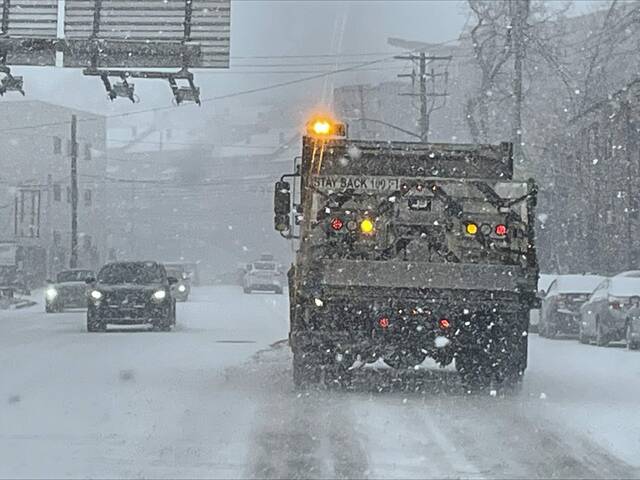
Rock salt, or sodium chloride, is widely used to prevent ice and reduce winter driving accidents, but scientists warn that its excessive application is causing environmental damage and contaminating drinking water in parts of Southwestern Pennsylvania.
A study conducted by the Stroud Water Research Center, a Chester County nonprofit, revealed Washington County had several freshwater streams with levels of sodium chloride either well above the federal drinking standard or teetering on the edge.
From early to mid October, the nonprofit in partnership with community groups conducted its largest salt study to date, sampling 1,200 bodies of groundwater across Pennsylvania, Delaware and New York.
On Monday, John Jackson, an environmental scientist and the Stroud Center’s senior researcher, said high salt levels in Washington County could be indicative that bodies of water in neighboring Allegheny County may be suffering as well.
According to the U.S. Environmental Protection Agency, national regulations limit sodium chloride in drinking water to below 250 milligrams per liter.
Jackson said this is because of salt contamination, which can throw aquatic ecosystems out of balance and cause potential health risks for people required to limit their sodium intake.
Salt pollution happens when municipalities and private landowners try to get ahead of the snowy season by throwing large amounts of salt everywhere, he said. The salt then either runs off into streams and rivers after the snow and ice melt or seeps into the ground.
“I’ve heard people say, ‘Well, it can’t be a problem. It goes away because the salt dissolves.’ But what they don’t realize is that a part of that salt is going into the ground, which means the environment is having to deal with it … months after it’s been applied,” Jackson said.
Results of the study found that areas surrounding Chartiers Creek in Washington County had anywhere from 145 to 302 milligrams per liter of chloride in the water.
“It does affect water quality … if you were on a low-sodium diet, it might be of concern, because remember, rock salt – road salt – is sodium and chloride, same as table salt,” Jackson said.
While the Stroud Center was unable to test water in Allegheny County due to a lack of volunteers from the area, Jackson said similar contamination is likely due to Chartiers Creek flowing through both counties and connecting with the Ohio River.
In March and August, Three Rivers Waterkeeper, an environmental group, conducted a separate study, testing about 20 streams in the Allegheny County area for the presence of salt, said Heather Hulton VanTassel, the group’s executive director.
In the spring, test results ranged anywhere from untraceable amounts of salt to 432 milligrams per liter — well above the EPA limit — with an average of about 240 mg/L.
Summer results were lower and below the drinking water cutoff.
“It (salt) can … kill aquatic insects, fish and amphibians, and it can disrupt food webs. It can reduce the ability for some plants to grow,” VanTassel said. “It also can encourage the growth of sometimes invasive species, or it can alter the ecology of those freshwater systems, impacting the native plants and animals.”
While it is unclear if these levels are unusual for the area because the studies are the first conducted in Allegheny County by Three Rivers Waterkeeper, Van Tassel said the group plans on testing the area again next year.
According to the Pennsylvania Department of Transportation website, District 11, which covers Allegheny, Beaver and Lawrence counties, used just over 48,60o tons of salt during the 2024-25 winter season. District 12, made up of Fayette, Greene, Washington and Westmoreland counties, used over 61,5oo tons of salt.
PennDOT did not respond to requests for a county-by-county breakdown of salt use last winter.