Beechview resident Orlando Aguilar remembers waking about 2 a.m. to frantic text messages from his friends in Venezuela.
The messages described the sound of explosions, during what Aguilar would later realize was the beginning of Operation Absolute Resolve, a United States operation to attack Venezuela and capture President Nicolás Maduro and his wife Cilia Flores.
“They were afraid the windows would break,” Aguilar, 40, told TribLive through an interpreter Tuesday.
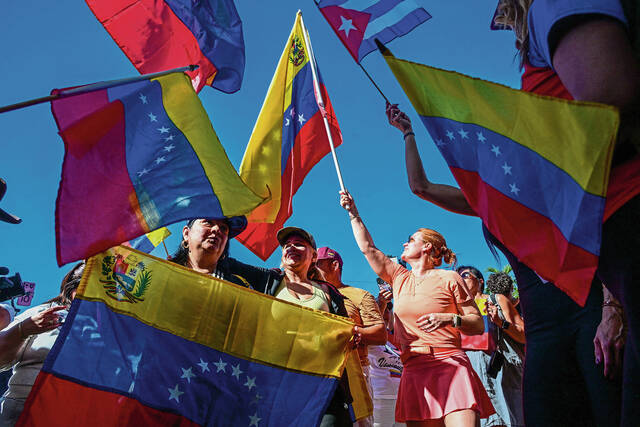
Public opinion regarding the United States’ involvement has been divided, as roughly 200 Pittsburgh residents gathered to protest the attack Saturday. The local Venezuelan community described more complex feelings after Maduro’s capture.
‘A very complicated, old mess’
Alexandra Hidalgo, a Venezuelan-American writer, filmmaker and associate professor of English at the University of Pittsburgh, stressed the operation’s success has not created a clear outcome but rather a situation full of unknowns.
“Maduro was not somebody that was legitimately in power, or that was doing the best for the Venezuelan people,” Hidalgo said. “But it’s also not a legal thing to just come in and take somebody’s president.”
Maduro first took office in 2013.
Protests broke out in Venezuela over his razor-thin election victory over opponent Henrique Capriles, whose supporters demanded a recount and alleged fraud, leading to clashes with government forces, street barricades and accusations of violence, as reported by the New York Times.
Since then, according to the Associated Press, more than 7 million people have left the country amid a political, economic and humanitarian crisis during Maduro’s government.
“We had a terrible person in charge, and that terrible person was taken away in a terrible way. And it doesn’t look like the plan for finding his replacement is going to be democratic,” Hidalgo said.
She believes it will take decades before the repercussions of Maduro’s capture will begin to come to light.
She said the impact of the Chavismo regime is still unfolding, saying Venezuela’s history is “a very complicated, old mess.”
Loretta Fernandez, an associate professor of Practice at University of Pittsburgh, grew up in Caracas until moving to Italy due to the political instability in the country. However, she still has extended family in Venezuela.
She shared a similar sentiment as Hidalgo.
“This moment represents a fragile possibility that Venezuela might one day move away from authoritarian rule and begin a long, difficult return to democratic governance. It raises the hope that I may eventually be able to enter my country freely, regardless of the passport I hold, bring my children with me without fear, and leave again without the anxiety of arbitrary restrictions,” Fernandez said in a statement to TribLive.
Fernandez compared the U.S. involvement in Venezuela to the Trump administration’s ongoing efforts to acquire Greenland.
“I am deeply troubled by the broader implications of this action. I fear that it may be used as a precedent or justification for interventions in other countries,” she said. “This possibility fills me with concern about the direction of international power and its consequences for national sovereignty.”
The monster
Arianny Rodriguez, 38, of Castle Shannon moved from the city of Acarigua with her family in May 2023.
She told TribLive she could not believe the news when she first heard it.
“Inside the country, we did everything to be free,” Rodriguez said through an interpreter.
Rodriguez said failed efforts from the Venezuelan people left them waiting for international intervention.
Aguilar, who moved to the U.S. from Caracas, Venezuela’s capital with his family in August 2024, said, after verifying Maduro’s capture on Trump’s social media platform Truth Social, he wanted to run outside and onto the street to celebrate.
Rodriguez and Aguilar said they do not know what would happen in Venezuela now.
While Maduro faces charges in New York, the country is led by interim President Delcy Rodríguez, who has served as Maduro’s vice president since 2018.
Despite the power change, Arianny Rodriguez said her family in Venezuela is afraid. She said her relatives have needed to be careful to remain quiet inside their households and not show any sign of happiness for fear of attack from pro-government armed militia groups called “colectivos.”
Rodriguez compared Maduro’s capture to the story of the Hydra, a serpentine lake monster in Greek mythology and Roman mythology. She explained Maduro’s capture is like cutting off the head of a monster only to discover Maduro’s supporters, or “more heads,” have grown in its place.
Oil of no benefit
Aguilar said there is a lot of tension surrounding the power dynamic in Venezuela at the moment as it remains unclear whether or not Delcy Rodríguez will cooperate with the U.S.
While the U.S. has interest in Venezuela’s resources, Aguilar said the oil in the country has not been used to benefit the Venezuelan people, but rather sold to countries with a history of communism such as Cuba, Russia and China.
“Sadly it was the only way to take Maduro out of the country,” Aguilar said. “That is the price any Venezuelan has to pay.”