
https://triblive.com/local/regional/what-to-know-about-police-cooperation-with-ice-in-pennsylvania/
What to know about police cooperation with ICE in Pennsylvania

Jaime Martinez has mourned with Pittsburgh’s immigrant community since he saw 14 people arrested at a Mexican restaurant in Marshall.
Since those June arrests, he has witnessed four additional detainments by U.S. Immigration and Customs Enforcement. As executive director of the immigrant advocacy group Frontline Dignity, he’s seen tensions escalate over partnerships between ICE and local law enforcement agencies.
Such an agreement is called 287(g) and allows police departments to aid ICE in immigration enforcement. The partnership is not a contract but rather an agreement into which law enforcement can enter by submitting an application online.
Fifty-three law enforcement agencies across Pennsylvania have active partnerships with ICE — 20 in Western Pennsylvania, according to the ICE website as of Friday afternoon.
In Allegheny County, three law enforcement entities have partnerships: Monroeville 6th Ward constable, Springdale Borough Police Department and Stowe Township Police Department.
On Jan. 15, Coraopolis council voted 4-3 to end its partnership after public pushback. Coraopolis Council President Mike Harris said in a statement to TribLive that the agreement had been approved in December.
Frontline Dignity posted a video on TikTok from the council meeting in which community members are seen telling council that the borough did not need officers operating under ICE’s guidelines.
“I had asked our representatives to gather feedback from their constituents beforehand so we could make an informed decision. In my opinion, each council member worked diligently to represent their community’s interests,” Harris, who voted to terminate the agreement, said in the statement to TribLive.
Records show Robinson police Chief Timothy Westwood signed an agreement with ICE in July. However, the township was no longer listed on ICE’s list of participating agencies by December.
In Westmoreland County, three local agencies are partnered with ICE: Unity Township constable, Lower Burrell 4th Ward constable and Westmoreland County Sheriff’s Office.
Each has had agreements since last year. Lower Burrell 4th Ward constable joined in May, followed by Unity Township constable, which joined in July, and Westmoreland County Sheriff’s Office, which joined in October.
What do these agreements mean?
ICE operates four types of partnership models.
• The first is the Jail Enforcement Model, which is designed to “identify and process removable aliens — with criminal or pending criminal charges — who are arrested by state or local law enforcement agencies,” according to ICE’s website.
The Westmoreland County Sheriff’s Office operates under the Jail Enforcement Model.
Jennifer Shipley, chief deputy of Westmoreland County Sheriff’s Office, did not respond to a request for comment.
• The second — and most common in Pennsylvania — is the Task Force Model, which allows law enforcement agencies to enforce limited immigration authority with ICE oversight during routine police duties.
Springdale Borough police, Stowe police, and constables in Monroeville’s 6th Ward, Lower Burrell’s 4th Ward and Unity operate under the Task Force Model.
• Third is the Tribal Task Force Model. Similar to the Task Force Model, it also serves as an extension of ICE but works specifically with public safety bodies serving Native American reservations to enforce limited immigration authority.
Pennsylvania does not have federally recognized Native American Reservations and does not have any law enforcement agencies listed as operating under this model.
• Fourth is the Warrant Service Officer program. This allows ICE to “train, certify and authorize state and local law enforcement officers to serve and execute administrative warrants on aliens in their agency’s jail,” according to ICE’s website.
Law enforcement departments in Bradford and Cambria counties have partnerships with this model.
TribLive attempted to reach ICE Public Affairs Officer Jason Koontz for comment on how these partnerships function day-to-day and why they are beneficial to ICE, but did not receive a response.
TribLive also reached out to police chiefs, council members, county commissioners and mayors from Allegheny and Westmoreland municipalities that have a law enforcement agency in partnership with ICE for comment but received little to no response.
Melissa Melewsky, law counsel for Pennsylvania NewsMedia Association, said it is not unusual that local officials would avoid answering questions from reporters on controversial issues; however, it does remove a level of transparency.
Any situation involving the signing of a document between two parties— such as an 287(g) — needs to be approved during a meeting where the public can comment, she said.
In November, TribLive reported that Springdale Borough police discreetly signed a deal to partner with ICE agents without placing it on an agenda for a public vote.
The decision sparked backlash from the community.
Perception of power and pressure on local officials
Partnerships between ICE and police departments have become a polarizing topic, as protests came to a head on Jan. 7 when Renee Good, a 37-year-old American citizen, was fatally shot by an ICE agent in Minneapolis.
Tensions were further exacerbated 17 days later when federal Border Patrol agents shot and killed a 37-year-oldMinneapolis resident, Alex Pretti. Pretti was an intensive care nurse for the U.S. Department of Veterans Affairs.
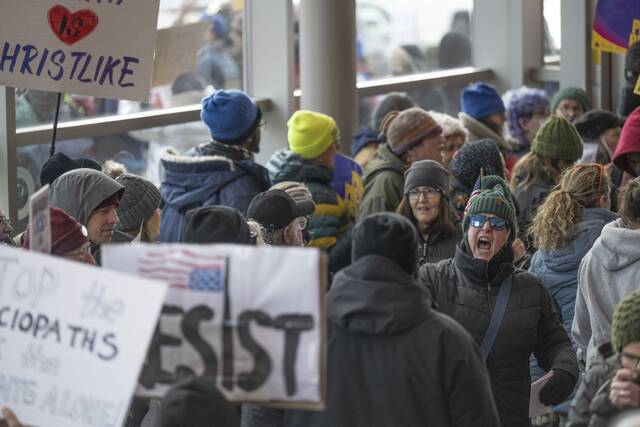
Good and Pretti’s deaths inspired a surge of anti-ICE protests nationwide.
Demonstrations locally have taken place at Schenley Plaza in Oakland, East Liberty Presbyterian Church in East Liberty and outside of U.S. Sen. John Fetterman’s Pittsburgh office.
Sunrise Movement Pittsburgh Coordinator MacKenzie MacFarland, who attended the Schenley Plaza protest, said demonstrators have demands at both a city and county level.
Organizers want Allegheny County Executive Sara Innamorato to organize a meeting with municipal police departments to discourage them from signing ICE partnerships and to encourage enrolled agencies to exit their partnerships, McFarland said.
Abigail Gardner, an Allegheny County spokeswoman, said Innamorato does not have jurisdiction over municipal police departments. She did say signing a partnership could expose municipalities to legal liability.
The county executive’s office had not received the list of demands or direct communication from the protest organizers as of Jan. 22, Gardner said.
“What we have seen is that ICE is routinely rounding up U.S. citizens, infringing people’s rights and causing unnecessary and unprovoked harm,” Gardner said in a statement to TribLive.
Gardner said homicides and other violent crimes hit record lows in Allegheny County last year. “There is no justification for flooding the area with unnecessary law enforcement that will only disrupt and terrorize people with no value to public safety,” Gardner said.
The immigrant community also has requests for Pittsburgh Mayor Corey O’Connor, including additional cultural sensitivity training for police officers and an increased budget dedicated to building community trust, Martinez said.
Molly Onufer, spokeswoman for O’Connor, said while the mayor’s office has no control over where ICE operates, the city’s officials are working closely with community groups to help residents feel safe.
In the past, O’Connor has been outspoken vowing Pittsburgh won’t cooperate with ICE.
Onufer reaffirmed on Friday that O’Connor’s stance had not changed.
“They (Pittsburgh Police) won’t be cooperating with ICE,” she said.
As tensions continue, the Greater Pittsburgh community continues to hold anti-ICE events, protests and provide resources to residents.
Frontline Dignity hosted a response training program at Shadyside Presbyterian Church on Jan. 20 that drew about 600 people, Martinez said. The goal was to equip the community with information about how to safely interact with law enforcement and ICE.
On Wednesday, Pittsburgh City Council questioned acting police chief Jason Lando under oath. During the meeting Councilwoman Barb Warwick, D-Greenfield, referenced anti-ICE community gatherings, saying that city officials and the police department needed to manufacture an ICE response plan to help residents be safe.
Lando said he would explore the city’s existing policies but said he was hesitant to be too vocal about his opposition to ICE. He feared speaking out could bring ICE agents to Pittsburgh for the kind of large-scale operation now underway in Minneapolis.
American Civil Liberties Union Attorney Ari Shapell said he finds the partnerships problematic because it “deputizes local law enforcement” to act on the behalf of ICE rather than allowing police to focus on their communities.
On Tuesday, six Allegheny County Council members introduced a measure to bar the county from cooperating with ICE, by prohibiting ICE or Border Patrol from housing immigrant detainees at the Allegheny County Jail and stop the county from transferring anyone from the jail into ICE’s custody without a judicial warrant.
In March, the Allegheny County Jail revised its policies to say the jail “will not detain any inmate and will not delay the otherwise authorized release of any inmate” due to detainer requests or arrest warrants from ICE.
It was unclear Wednesday how the council’s bill and the jail’s existing policy will interact with one another.
Gardner said the council’s bill is being reviewed by the Allegheny County Solicitor’s Office and declined to provide further comment.
Copyright ©2026— Trib Total Media, LLC (TribLIVE.com)