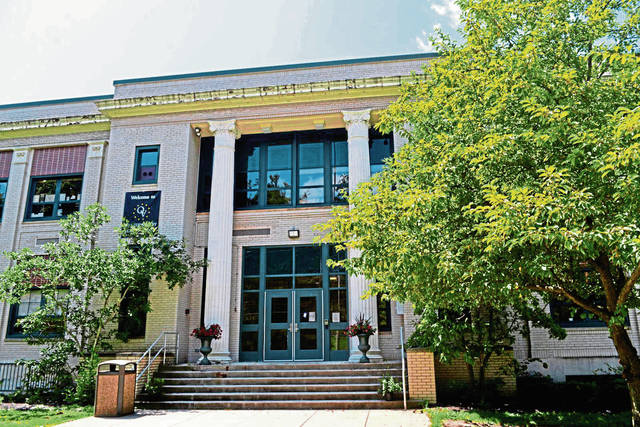
The existing high school at 625 Beaver St. has seen 95 years of service and the school board of the Quaker Valley School District has decided that we need a new high school. With the help of their consultants, they determined that floor area needs to be increased by approximately one-third and completely reconfigured to better house the future educational program they foresee for the district. As a parent of two QV high school graduates, I’m in complete agreement with them on this point: let’s build a new school – but where?
The school board decided that the present site was not acceptable for a number of reasons and purchased 128.7 acres of steeply sloped, largely undeveloped land which lies entirely within an area of moderate to severe susceptibility to landslides, according to the U.S. Geological Survey. I am not at all convinced that this is the best way forward and would like to lay out my thinking for why this is so.
In the Questions and Answers section of the Blueprint QV: New High School Project on the QVSD website, several reasons are given for rejecting the existing 625 Beaver St. location for a new high school. The board’s first reason is given as follows: “The Pennsylvania Department of Education recommends that 42 acres of land is optimum for QVHS but the parcel where the current high school sits is just 14 acres.”
In fact, however, there is no such requirement or recommendation from the Pennsylvania Department of Education. In a Pennsylvania Department of Education website entitled “Frequently Asked Questions – Reimbursable Projects,” one of the questions asked is whether there is a minimum or maximum acreage required for a school site. The answer is unequivocal: “No. The PDE acreage allowances are used solely to calculate state reimbursement for any property to be acquired as part of a PlanCon project. The actual amount of land needed to support a district’s educational and athletic programs, as well as the local community, must be determined by the local school board.”
In the same response the board gives a second reason as follows:
“Even that 14-acre size is misleading. Roughly 70% of it lies within a floodplain of the Ohio River.”
This is factually correct: the lower parking lot, the football field and track and the tennis courts are located in what is a 100-year flood plain – and so are the Quaker Village Shopping Center, the Leetsdale U.S. Post Office and half of the Leetsdale Industrial Park. If a new high school were to be built on the existing site, the most logical location would be more or less where the present one is located – and out of the flood plain.
There are two other considerations given. In 2013, Garvin, Boward, Beitko Engineering submitted an excellent report on the site conditions at 625 Beaver St. which would impact on construction. They mentioned groundwater, which has indeed been a nuisance at the existing school, the limitations imposed by the flood plain and the expenses involved with expanding the building pad to accommodate a larger school.
These are valid concerns, but none of them necessarily mean that this site should be rejected out of hand. It would be possible, for example, to extend the building footprint south by 100’ and end up with a 225’ x 400’ footprint which gives you 90,000 square feet per floor – easily exceeding the desired 168,000 square feet and still be entirely outside of the 100-year flood plain.
In the GBBE report, the consultant looked at the cost of expanding developable area by building a mechanically stabilized earth wall and estimated the cost for 1,000 feet of this wall to be around $5 to $6 million. In the scheme I just mentioned, there would only 500 feet of MSE wall, presumably with a proportional reduction in cost.
There still remains one serious issue and that is how to manage schooling and construction. When QVSD renovated the Osborne and Edgeworth Elementary Schools, they relocated students to Anthony Wayne E.S.
I would think that finding alternate locations would still be a possibility.
A second option would be phased construction with school and construction going on concurrently. This is commonly done in school construction projects; I have personally been professionally involved in both grade school and high school projects where this was successfully and safely done.
In short, building at 625 Beaver St. is far from impossible. It is not without issues but should certainly not be rejected out of hand.
The school board has already bought 128.7 acres of steeply sloped, largely undeveloped land which lies entirely within an area of moderate to severe susceptibility to landslides according, to the U.S. Geological Survey.
In October of 2020, Thomas & Williams, the project management firm hired by the school board, issued a site plan with the stamp of the engineer. The proposed site is a 3,000 foot long, spoon-shaped site that is bounded by its two access roadways. The usable site is approximately 28 acres with eight or so of those acres used for access roadways and parking lots. It is clear that somewhere between rejecting 625 Beaver as being too small and looking at the realities of mountaintop removal, the acreage requirement got lost.
In the Facilities Committee Presentation of May 12, 2020, the cost of site development is given as $18,722,315 to which must be added the $7,500,000 spent to buy the property. Alternates add an additional $1,692,911 to bring the total site cost to $27,915,226 – approximately one-third of the total project cost.
In rough numbers, then, the school board is planning on spending $1,000,000 per acre for a site that decreases the area allotted to athletic playing fields compared to 625 Beaver St., pretty much eliminates the possibility of walking to and from school, and beats the existing site only in overflow parking spaces, which, as we all know, are not needed at 625 Beaver St. where on-street and shopping center parking are available.
During my career in engineering, I have designed, managed construction and commissioned the construction of HVAC systems for the entire gamut of school types, from pre-school through college. One thing I know is that every dollar spent on facilities is a dollar that is not being spent on educating children. This site drains far too many dollars away from the real purpose of our school system, educating and nurturing our children, for far too little gain.
I know from experience that there are times in design when you simply arrive at what appears to be a dead end. When this happens, you must resist the temptation to dig in and double down; you must also resist the temptation to cut and run – at least just yet.
The site preferred by the school board is a feasible option. The 625 Beaver St. site is also a feasible option and potentially a much cheaper one. The district owns at least 36 acres in Belle Acres that is currently being used for several baseball diamonds. This site, like 625 Beaver St., has been rejected by the board as a potential site, quite possibly with good reasons – but what are those reasons? Should this site be reconsidered as well?
Finally, on a beautiful day in June of 2018, I walked the length of the site. Walking along the spine of the mountain, I was under a canopy of mature hardwoods, tulip trees, maples and oaks. I saw deer grazing nonchalantly, turkey tracks and a hawk made her presence known. Aside from the occasional birdcall and the rustling of the leaves overhead, there was no sound. As a person who became an engineer out of environmental concerns and who has designed or commissioned 22 LEED-certified projects, the thought of seeing this pristine site scraped off the mountain is jarring and disappointing.
I think we can do better. Let’s take another look.