Nearly 2½ years after Robert Bowers was condemned to die for killing 11 worshippers at a Pittsburgh synagogue, his attorneys have appealed the death sentence and are seeking a new sentencing hearing.
Bowers’ lawyers raised 16 claims throughout a nearly 500-page legal brief filed earlier this month with the 3rd U.S. Circuit Court of Appeals.
The brief acknowledged Bowers’ guilt before accusing the federal government of “overreach” during trial — and the trial court of allowing prosecutors’ conduct — which led to a sentence of death instead of life imprisonment.
Defense lawyers said evidence was presented about Bowers’ troubled background and “psychological impairments” to support a life sentence. They claimed, however, “the jury could not fairly consider that evidence …”
Among the defense’s claims are: perceived errors in jury selection; admission of evidence surrounding historic antisemitism that the defense called unnecessary; and the decision to place Bowers in shackles midway through a hearing without an in-depth explanation.
“Bowers’ trial was compromised by constitutional and statutory failures in charging, jury selection and sentencing procedure,” the appeal says. “As a result, it lacked the accuracy, reliability and fairness that the death penalty demands, requiring resentencing or remand for further proceedings.”
The Jewish Federation of Greater Pittsburgh weighed in Monday on Bowers’ appeal.
“We will forever stand with the families and survivors of the Tree of Life building attack,” the federation said in a statement. “The jury verdict and sentencing reflected the gravity of this horrific crime, and we believe justice was served. We have full confidence in the prosecution team and the judicial system as this process moves forward.”
First appeal denied
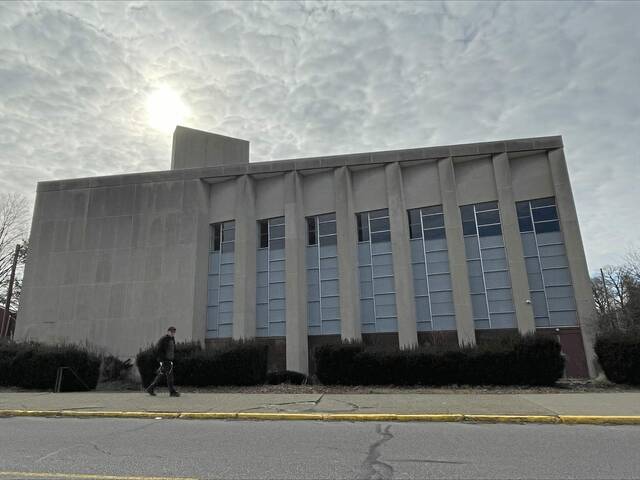
Bowers, 53, of Baldwin was convicted of killing 11 Jewish congregants during his attack at the Tree of Life synagogue on Oct. 27, 2018.
The victims, who ranged in age from 54 to 97, were members of the Tree of Life-Or L’Simcha, Dor Hadash and New Light congregations, all of which worshipped at the Squirrel Hill synagogue.
Killed were Rose Mallinger, 97; Bernice Simon, 84, and her husband, Sylvan Simon, 86; brothers David Rosenthal, 54, and Cecil Rosenthal, 59; Dan Stein, 71; Irving Younger, 69; Jerry Rabinowitz, 66; Joyce Fienberg, 75; Melvin Wax, 87; and Richard Gottfried, 65.
Jurors in June 2023 found Bowers guilty of all 63 counts against him and, the next month, said he was eligible for a possible death sentence. Bowers was sentenced to death in August 2023. He arrived on death row at the U.S. Penitentiary in Terre Haute, Ind. a few weeks later.
Bowers’ attorneys filed a separate appeal in the fall of 2023. It was denied in May 2024 by Judge Robert J. Colville.
Jury selection issues
The latest appeal, filed Dec. 18, argues that a former Chinese government official should not have been permitted as a juror, according to court documents.
The juror worked as a lawyer for the Chinese government in 1983 “reviewing death sentences and supervising executions,” the appeal says.
“She opined that life imprisonment is an insufficient punishment for murder because prisoners enjoy luxuries and burden taxpayers, that life sentences are not really lifelong and that individuals cannot be redeemed by life imprisonment if they are over 50 years old,” the appeal says.
Bowers was 51 at the time, according to the appeal.
Bowers’ attorneys challenged selection of this juror, but the motion was denied.
The defense also took issue with the lack of racial diversity among the jury and the striking of two jurors who expressed reservations about the death penalty.
The prosecution struck all but one juror of color, including every African American and Hispanic juror, according to the appeal.
The defense had 90 minutes to review “thousands of pages of voir dire transcripts and questionnaires” and respond to the jury decisions made by the prosecution — who had seven days to consider their strikes, the appeal says.
Objection to leg shackles
Bowers’ attorneys claim that an expert witness who testified about antisemitism was unnecessary to the case.
William Braniff, director of the Center for Prevention Programs and Partnerships at the U.S. Department of Homeland Security, testified as an expert on white supremacist and neo-Nazi ideologies. The defense argued in the appeal that Bowers’ intent and antisemitic motivation were clear from his own statements.
Bowers’ attorneys also took issue with the defendant being shackled with leg chains midway through the fifth day of the eligibility trial, the appeal says.
The U.S. Marshals Service, which said only that an unknown security threat had been identified, did not provide a more detailed explanation until a month later, according to the appeal.
The defense argued that the visible restraints harmed Bowers’ ability to participate in the trial. The court denied the claim, and the shackles remained in place for a total of 20 days.
The appeal also mentioned that Bowers indicated as early as February 2019, that he would plead guilty in exchange for life in prison without the possibility of release.
The prosecution rejected this offer on two separate occasions, according to the appeal.