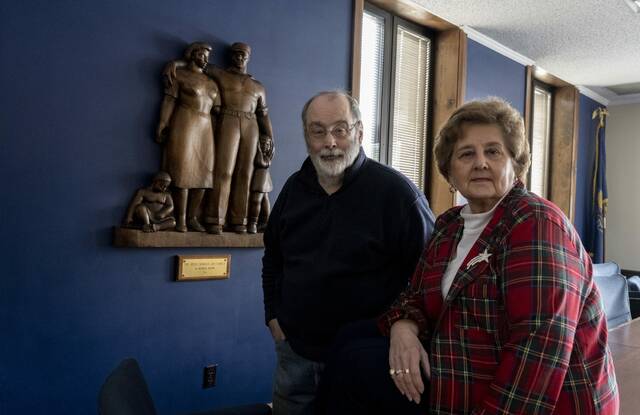
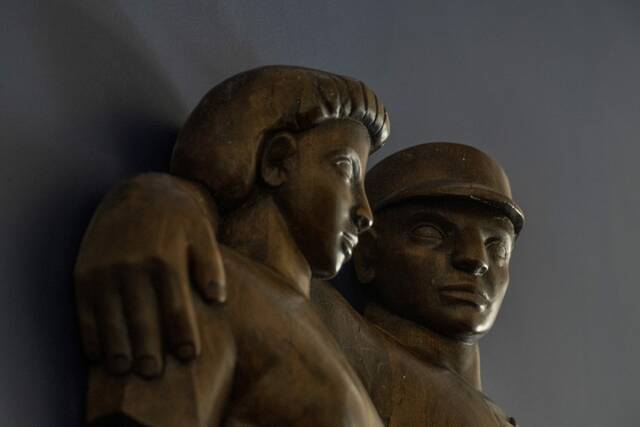
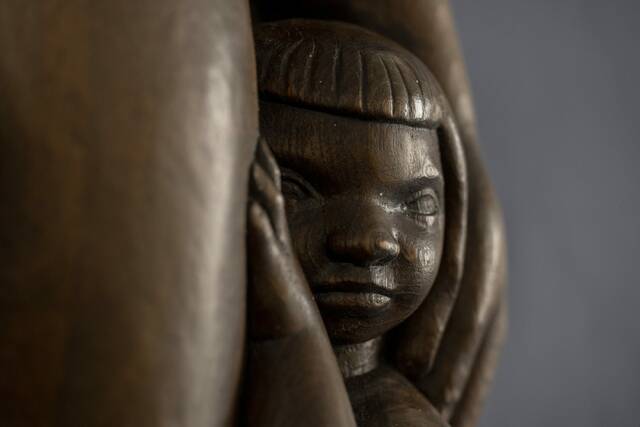
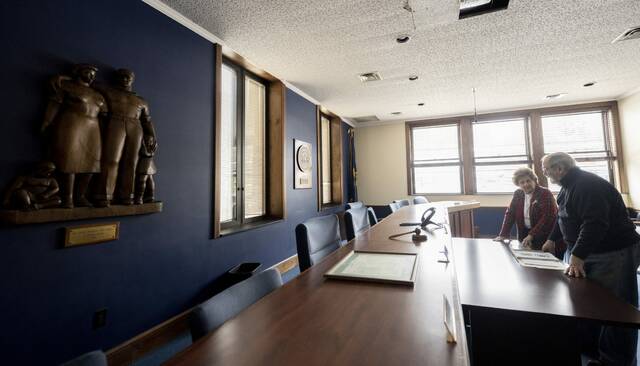
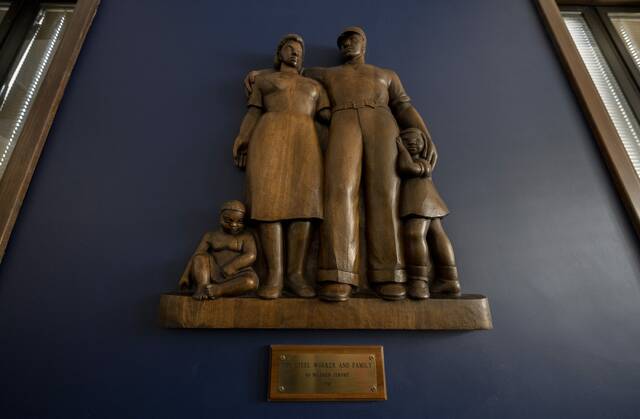
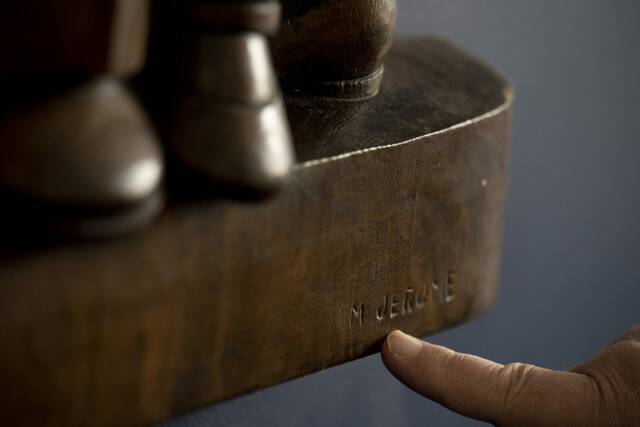

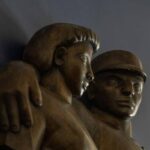
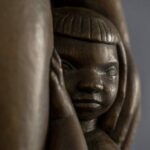

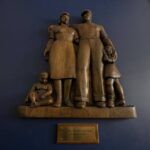
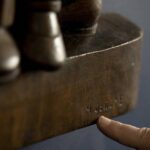
A wooden sculpture titled “The Steelworker and Family” has long been the symbol of Blawnox, but only recently has the artwork’s backstory come to light.
Historian and author Tom Powers said the sculpture is enjoying renewed interest after he chose it to adorn the cover of the borough’s recent centennial book.
“The mystery that accompanied the sculpture is the result of a lack of information about the artist,” Powers said.
Multiple marriages and moves across the globe left an incomplete trail on Oregon artist Mildred Jerome.
Her wood relief depicting a mill worker was commissioned by the Treasury Department as part of the New Deal Works of Art during the Roosevelt era. In the years following the Great Depression, there was a push to showcase public art to uplift spirits by illustrating familiar, positive subjects.
Council President Debbie Laskey said “The Steelworker and Family” perfectly represented the borough’s grit and growth in the early 1940s — and to this day.
“The mill worker and his family are what brought the town to life,” Laskey said. “Blawnox is one big family unit. This is who we are — a community family.”
Mill workers who labored at the borough’s namesake manufacturing facility, Blaw-Knox Co., faced extreme conditions to forge a better life for their family, Laskey said.
“They hoped for a better life for their children and their children’s children, all in a country-like setting,” she said. “I believe those first families that came to Hoboken (the original name of Blawnox) in the early years would be extremely proud that the town survived when the mills closed and that Blawnox remained a quaint, small, folksy town with many grand years ahead.
“The family sculpture will continue to remain the strength of our community.”
Jerome, the artist, was born in Atlanta, Ga., before spending her school-age years in Portland, Ore. She left her first husband, a publishing agent, in 1931 for ambitions to study art in Italy.
After returning to the U.S., Jerome attended the Art Students League in New York City and taught sculpture for several years.
She later became a supervisor for the Federal Art Project and completed three bas-relief sculptures for the Treasury Department. They included “The Post” in 1938 for the former post office in New Milford, Conn., and “Treaty of William Penn and the Indians” in 1939 for the post office in Turtle Creek, which remains on display.
The Blawnox-based sculpture, which stands several feet tall, was showcased in the former borough post office along Freeport Road from 1941 to 1984, when the facility closed.
“Someone saw that it was going to be tossed or destroyed and salvaged it,” Powers said.
“It was placed in borough council chambers, where it got some prominence and where it remains to this day.”
Powers’ choice to highlight “The Steelworker and Family” wasn’t the first time the piece of art has been published.
It appeared in Evert and Gay’s “Discovering Pittsburgh’s Sculpture” book in 1983 and is featured on websites such as “Living New Deal,” “New Deal/WPA Art in Pennsylvania” and “List of New Deal Sculpture.”
“When researching the sculpture, it’s sometimes listed as missing,” Powers said. “But it’s been in Blawnox all along.”
Briefly, during the 1970s, the wood sculpture was washed with a coat of silver paint. “Thankfully, that has been removed,” Powers said.
Blawnox historical committee member Angi Yucas said the sculpture was the obvious choice for the borough’s centennial book cover.
There were several contenders, but Yucas said the team wanted something that represented the community in broad terms.
“Our monthly meetings were held in the borough building, in council chambers where the family sculpture was on display,” she said. “We had been looking at the obvious choice all along. It is historical and reflects our strong community spirit.”