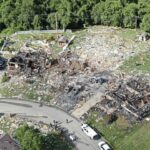




A private consulting firm’s report for a Delmont energy company being sued over a 2023 fatal house explosion in Plum has determined Penneco Oil Co. was not responsible — a conclusion sure to be challenged in court.
Penneco and Peoples Gas were among those sued for negligence and wrongful death in July by the victims’ survivors. Six people died as a result of the explosion.
The suits accuse the companies of failing to repair a pipeline leak that allowed flammable natural gas to migrate underground into the basement of Heather and Paul Oravitz’s home in the Rustic Ridge subdivision, where it ignited Aug. 12, 2023.
The 240-page report by consultant Woodard & Curran, which was obtained by TribLive, relied on analyzing natural gas found in soil samples from the site of the explosion and a Penneco well.
Woodard & Curran wrote the natural gas found in the soil under the site of the explosion is “distinctly different” than the gas flowing through Penneco’s Szitas No. 2 well and therefore could not have caused the disaster.
“As documented in this closure report, multiple lines of evidence demonstrate that there was no gas migration incident, and the home explosion was not associated with Penneco’s oil and gas operations,” the report concluded.
The Gas Migration Investigation Report was submitted Oct. 24, 2024, to Pennsylvania’s Department of Environmental Protection, as required by state law following such an event.
Peoples also produced a report but refused to provide it to TribLive, citing pending litigation.
The consultant’s report on Penneco’s behalf included detailed information about well site inspections, flow-line pressure tests, soil surveys and mechanical integrity assessments.
Attorney Ben Baer, who represents the Oravitz family, said Penneco’s report is self-serving.
“We believe the Penneco analysis is deeply flawed, as it was bought and paid for,” Baer said.
Independent government investigators searched every potential source of gas in a 2,500-foot circle around the explosion site, and the Penneco line remains the only gas leak, he said.
“The fact remains that this was a substantial gas leak in close proximity to the explosion site that originated from a Penneco line,” Baer said.
Legal battles after the explosion
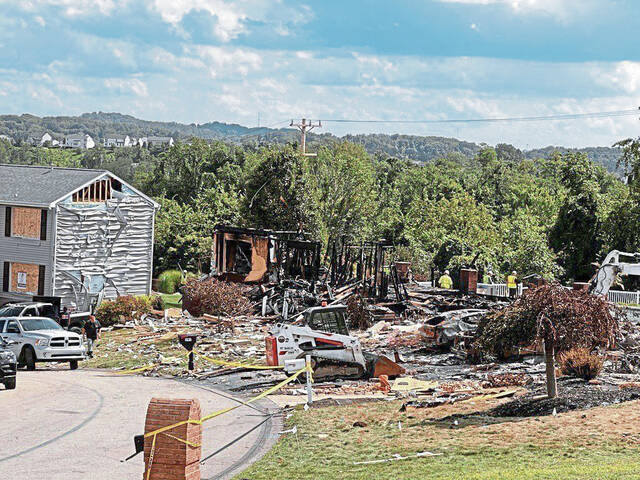
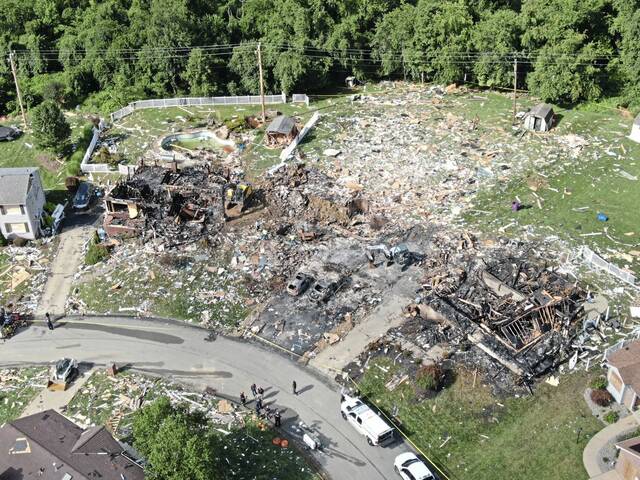
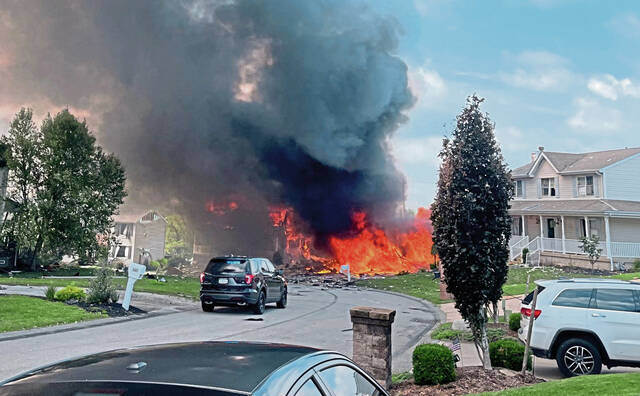
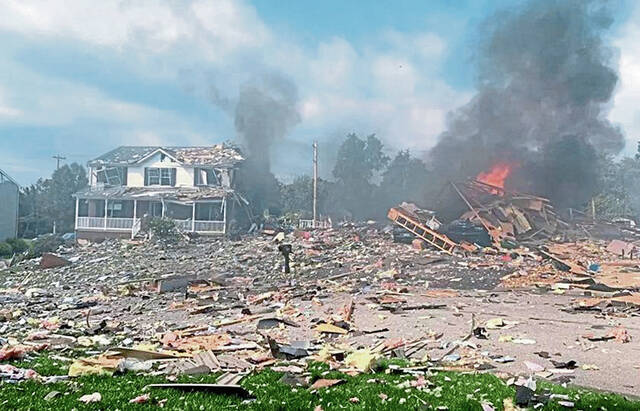
At 10:25 a.m Aug. 12, 2023, the house at 141 Rustic Ridge Drive exploded, ultimately killing six people: homeowners Heather Oravitz, Plum’s director of community development, and her husband, Paul, 56, an ultrasound sonographer; Michael Thomas, 57, Plum’s borough manager; Kevin Sebunia, 55, a sales consultant; and father and son Casey Clontz, 38, and Keegan Clontz, 12.
Three homes were destroyed, and a dozen more were damaged.
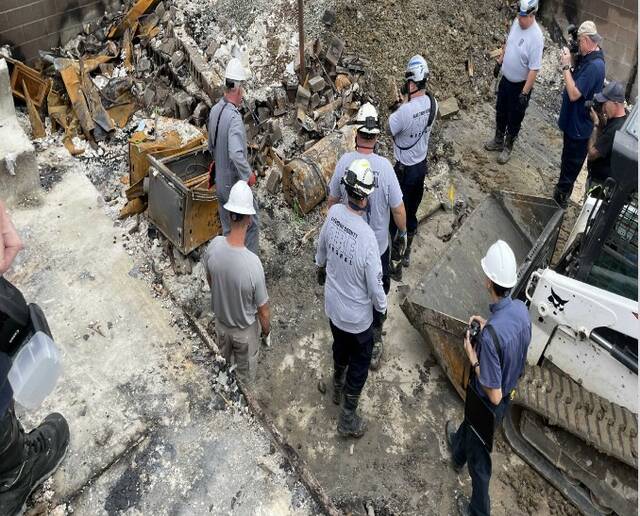
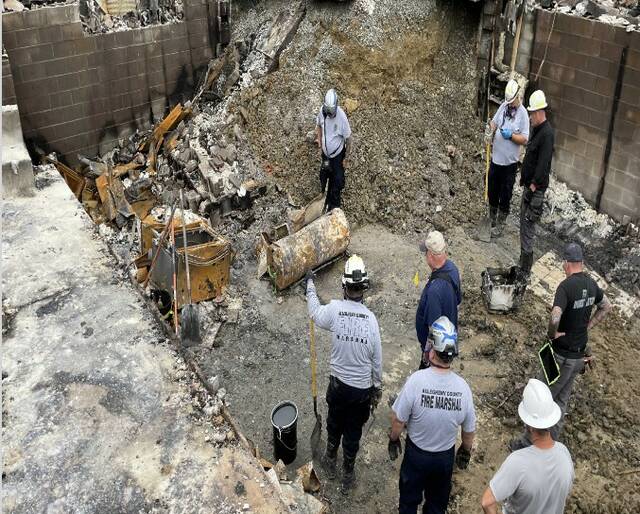
Federal, state and county agencies launched independent investigations.
The National Transportation Safety Board and the Pennsylvania Public Utility Commission found no evidence Penneco’s or Peoples’ lines were the source of the gas in the explosion.
The probe by the Allegheny County Fire Marshal, which remains open, pointed toward the house as the point of origin of the blast and away from “factors external to the home.”
In July, several lawsuits were filed in Allegheny County Common Pleas Court naming as defendants Penneco Oil Co., Peoples Gas, Grasinger Homes Inc. and A.O. Smith Corp., which manufactured a water heater that was being installed that day.
Among the claims in the lawsuits — which allege negligence and wrongful death — are assertions the explosion was caused by a Penneco pipeline leak that filled the family’s basement with natural gas that ignited.
The complaint also asserted that following the explosion, Penneco was issued a notice of violation by DEP.
According to that notice, Penneco’s Szitas Unit 2 Well — one of three operated by the company within about a half-mile of the Oravitz home — was inspected two days after the explosion. The inspection found there were no leaks detected at the well site.
However, a portion of line downhill and in an open field was inspected and “gas was detected in soils adjacent to the Penneco suction line in a few locations, and gas was detected in a gate valve enclosure in this area as well.”
The company received a notice of violation for “unlawful conduct — conducting a drilling or production activity in a manner that creates a public nuisance or adversely affects public health, safety, welfare or the environment.”
In an Aug. 17, 2023, email from Penneco to DEP, the company explained it had discovered a small leak in one of its lines.
According to the Penneco Gas Migration Investigation Report, the leak was from a 2½-inch crack in a buried 4-inch plastic suction line about 255 feet from the nearest foundation corner of the Oravitz home.
The leak rate was measured to be 156 standard cubic feet per hour. But once the pipe was removed and replaced, the report said, the flow rate in that segment was 3½ standard cubic feet per hour.
The report also concludes the natural gas found in the soil under the site of the explosion is “distinctly different” than what flows through the Szitas No. 2 well.
“Based on the information available to Penneco at the submission of this closure report and the following lines of evidence, there is no reason to believe that there was a gas migration incident related to Penneco’s Harris 1A, Szitas Unit 1, and Szitas Unit 2 natural gas wells or other assets located in Plum, Pennsylvania,” the report said.
DEP issued an approval of Penneco’s migration report on Feb. 25, 2025, but a DEP spokeswoman said last week that approval does not equate to being cleared of wrongdoing.
However, at the Sept. 5, 2023, meeting of DEP’s Oil and Gas Technical Advisory Board, Kurt Klapkowski, director of the agency’s Bureau of Oil and Gas Planning and Program Management, said DEP had examined seven wells and two gathering lines within 2,500 feet of the explosion, including Penneco’s.
At that point, Klapkowski told the meeting, they didn’t see anything that caused concern from a leaking well, although he acknowledged the leaking line.
“But the soil gas sampling that we did between the residence and the gathering line didn’t really indicate any kind of a particular issue or cause for concern with regard to that particular well,” he said during the meeting.
Theories on the cause of the blast
Robert Hall is the former director of the Office of Railroad, Pipeline and Hazardous Materials Investigations at the National Transportation Safety Board. He now serves as senior technical adviser to Pipeline Safety Trust, a national organization that promotes pipeline safety through education and advocacy.
Hall retired in 2023 after overseeing 28 major pipeline investigations. He was still at NTSB when the Rustic Ridge explosion occurred.
“We looked at it fairly hard the first day or two,” he said. “But there really wasn’t enough information to have jurisdiction.”
NTSB only oversees pipeline investigations if they involve the natural gas transportation lines.
Like the plaintiffs in the lawsuits, Hall believes there is a chance that an overpressurized line played a role in the explosion. The higher the pressure, Hall said, the faster the gas escapes from the leak.
“I think, potentially, that’s a factor in this accident,” he said.
Hall said the Rustic Ridge explosion reminded him of one in Colorado in April 2017. Two people were killed and two others injured when a house exploded in the town of Firestone about 30 miles north of Denver as a new water heater was being installed.
That explosion, investigators found, was caused by an uncapped flow line operated by a natural gas company.
According to the NTSB report in that case, excessive amounts of natural gas were found in the rear of the residence in the soil under the home’s concrete slab. The investigation showed it likely leaked from a nearby well and traveled through a 1-inch polyethylene pipe where it exited the severed end of the pipe — which had been cut during construction of the home two years earlier — and entered the basement.
Within a month of the explosion, Colorado’s governor called for a statewide review of oil and gas operations, and within two years, a number of new regulations were implemented. In 2020, Colorado’s Oil and Gas Conservation Commission imposed an $18.25 million fine on the company that owned the severed gas line.
The Colorado case led to extensive reform, but Hall said that’s not always the case.
“In some places, people don’t get any satisfaction at all,” he said. “It becomes the interplay between the regulator and the company and the community.”
Steven Nanney retired as a pipeline engineer after working in the industry for nearly 50 years. He previously worked as a senior technical adviser for the Pipeline and Hazardous Materials Safety Administration under the U.S. Department of Transportation.
Based in Houston, Nanney said he spent a lot of time working in Pennsylvania in the early parts of his career. After reviewing the Penneco gas migration investigation report, Nanney said he felt that it was thorough.
“Based on the tests they did, I didn’t see anything that made me think the wells were the cause, or the pipelines,” he said.
Nanney said that the leak — the 2½-inch crack in the pipeline — caused low-level gas detections, but they were a long distance from the home. It was a low-pressure pipeline, he said, that would not have caused the explosion.
“The line’s not that deep,” he said. “(The gas) is going to dissipate before it gets to that house, and it’s not running to that house. It’s not on their property.
“I think the odds of that being the case would be so slim.”
Regarding Penneco’s contention the chemical signatures of the gas at the house were different than that of the wells, Nanney said that could be the case.
After reviewing the NTSB findings and other reports, Nanney said he suspects the explosion was caused by something inside the home.
He speculated it could have been a pressure regulator that is designed to reduce the flow from the natural gas line into the house.
Court hearing approaching
The 12 lawsuits that have been filed in the case have been consolidated in Allegheny County Common Pleas Court.
Although the lawsuits are in their early stages, the defendants have filed answers to the claims, and some have filed preliminary objections hoping to get the cases dismissed.
In a court filing earlier this month, Peoples said the allegations refer to Penneco’s pipeline infrastructure and equipment, which Peoples bears no responsibility for.
In their preliminary objections, attorneys for A.O. Smith, the water heater manufacturer, said the plaintiffs failed to include in their complaints a single allegation the company’s conduct caused the explosion.
A hearing on the preliminary objections is scheduled for Dec. 12. Common Pleas Judge Philip A. Ignelzi, who is presiding over the consolidated cases, said the parties should plan to begin taking depositions in late January or early February.
In their answer to the lawsuit filed by Jennifer Clontz, Grasinger Homes said the statute of limitations on the construction of the Oravitz home has passed.
The home on Rustic Ridge Drive was completed by the company and turned over for occupancy on Oct. 15, 2008. Under Pennsylvania law, any claim in civil court for a construction project must be filed within 12 years of completion — or if a death occurs, within 14 years.
The explosion at the Oravitz home, the court filing said, occurred 14 years, nine months and 28 days after the occupancy permit was issued.
Further, Grasinger wrote in their response, the company did not purchase or install the water heater at the Oravitz home.
In Penneco’s answer, the company denied their pipeline, inlet, discharge pressure or regulator contributed to the explosion.