
https://triblive.com/local/valley-news-dispatch/interpretation-of-immigration-law-brings-ice-arrests-to-forefront-of-community-concerns-discussions/
Interpretation of immigration law brings ICE arrests to forefront of community concerns, discussions

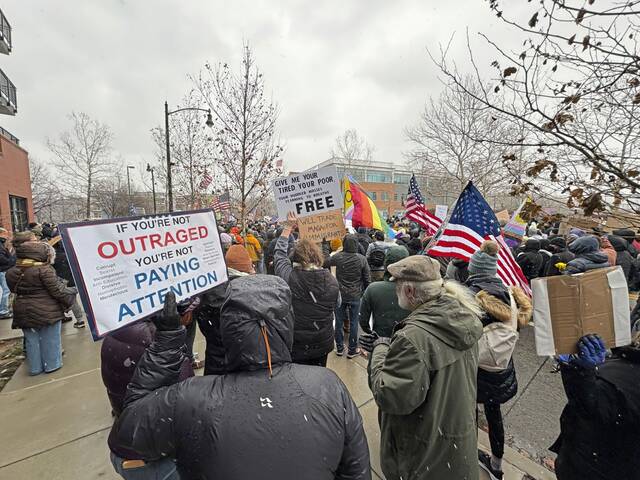
Recent arrests made in the region by Immigration and Customs Enforcement agents have captured headlines but are not new.
Immigration attorneys, though, say the arrests signal new interpretations of longstanding immigration laws as part of President Donald Trump’s push to step up deportations.
“Under recent actions of the Trump administration, we’ve been seeing a lot of people who would not have been a priority, historically, be detained,” said Keith Armstrong, an immigration attorney with the Pennsylvania ACLU.
Previously, according to Armstrong, ICE prioritized detentions for people if their underlying immigration status changed, they were convicted of criminal activity, they were issued a final order of removal, or there were procedural issues with the issuance of a work permit even though those policies didn’t necessarily reflect the letter of immigration laws.
“At this point, there are no enforcement priorities,” Armstrong said. “Anyone who ICE can detain becomes the priority.”
Pittsburgh immigration attorney Ellen Freeman called the arrests of at least three local men whose family members say were in this country legally and not charged with any crimes “low hanging fruit.”
“The line between legal and illegal, or authorized and unauthorized, has never been thinner than what the current (Department of Homeland Security) and the Trump administration has made it to be,” Freeman said.
Last May, senior White House adviser Stephen Miller told Fox News the Trump administration was looking to set a goal of at least 3,000 ICE arrests every day.
According to the Department of Homeland Security’s webpage, nearly 3 million unauthorized immigrants have left the country either through removals or self-deportation since Trump returned to office.
ICE and DHS did not respond to multiple TribLive requests for comments but released a statement that one of the men, arrested in Springdale, initially entered the country illegally before registering with authorities and requesting asylum.
ICE can detain people on the reasonable suspicion that someone does not have a permanent immigration status in the U.S., Armstrong said.
Crackdowns nothing new
Deportations under the Trump administration outpace those under former President Joe Biden, but they do not represent the largest deportation crackdown in recent history.
According to 2017 numbers from the Migration Policy Institute, total immigrant removals reached almost 900,000 under President Bill Clinton.
The same report shows about 2 million were removed under President George W. Bush’s administration.
Former President Barack Obama was famously labeled “Deporter in Chief” by critics in the immigrant-rights community.
The American Civil Liberties Union (ACLU) filed multiple lawsuits against the Obama administration regarding immigration policies, particularly in 2014-15, focusing on the detention of asylum-seeking families and due-process violations.
The suits included a class-action lawsuit challenging the detention of mothers and children as an “intimidation tactic” and lawsuits addressing detention without bond hearings, according to the ACLU.
According to the Migration Policy Institute, immigrant removals reached 3.3 million under the Obama administration.
Those numbers do not include immigrants turned away at the borders.
One thing that is new, however, is public outcry surrounding ICE raids and detainments.
Community outrage
The detainments of Maklim Gomez Escalante, 35; Randy Cordova-Flores, 36; and Jose Flores, 47, did not go unnoticed in their communities. Within a day of the news of their arrests, GoFundMe accounts were created to assist their families.
As of Friday, Feb. 13, nearly $15,000 has been raised for Gomez Escalante, more than $23,000 for Cordova-Flores and over $100,000 for Flores.
According to their families, all of the men have pending asylum applications, valid work permits, Social Security numbers and valid driver’s licenses. A TribLive search of state and federal court databases showed no criminal record or pending charges against the men.
In response to Flores’ detainment, the Riverview School District, where his daughter attends elementary school, passed a safety policy that defines steps for employees if any law enforcement agency inquires about a district student or staff member.
On Monday, Oakmont Council is expected to approve a resolution stating the borough will not assist in any ICE operations.
If the resolution passes, council will send a communication to ICE demanding answers about Flores’ arrest, Oakmont Mayor Sophia Facaros said.
In response to Flores’ arrest, the Penn Hills School Board also is considering a new safety protocol that would require a warrant, subpoena or court order for any law enforcement access to students and staff.
A protest to demand the release of Cordova-Flores is scheduled for Saturday in Springdale.
Legal implications
Immigration lawyers say another difference from previous administrations boils down to interpretations of existing law.
Freeman, the Pittsburgh immigration attorney, has been practicing immigration law for almost 27 years. She has operated her own practice in the Oakland neighborhood of Pittsburgh for the past seven.
“This is like a breakdown of the constitutional judicial system,” Freeman said.
The way the current administration interprets immigration law is strikingly different than during previous administrations, she said, and does not afford immigrants the rights they’ve had in the past.
“Under Biden’s administration, immigrants weren’t aliens. They were focused with being friendly, with producing benefits,” Freeman said. “With this administration, they say immigration is the benefit. You are not entitled to it. (The administration is saying) you’re basically all criminals in our eyes and you have to prove otherwise.”
In many cases, being present in the U.S. without proper documentation is considered a civil violation, not a criminal offense.
According to the U.S. Citizenship and Immigration Services webpage, a person can file an asylum application only if they are physically present in the United States and not a citizen.
Asylum applicants can include people who did not go to the American Embassy to be properly admitted to the U.S., Freeman said. They entered the United States, then declared to the appropriate government bodies they were here and began the asylum application process.
After beginning the process, applicants can apply for work permits that remain valid as long as they are employed and noncitizen Social Security numbers to pay taxes on money they make, and they can obtain Real IDs and driver’s licenses.
The administration’s argument, Freeman said, is that despite following the legal steps while working with their asylum application, these people are still unauthorized because they entered the U.S. illegally before applying for asylum.
Asylum seekers also can be granted humanitarian parole, allowing temporary entry for urgent, significant public benefit, even if they lack a visa. Parole can be granted by various parties, including customs and border patrol officers and the American Embassy.
Parole offers temporary legal presence and protection from deportation but does not grant permanent status. Parolees can still apply for asylum, typically within one year of arrival, and are eligible for work authorization.
The current administration also has interpreted existing laws to allow the removal of whole groups from some immigration programs.
At the end of 2025 and the beginning of this year, Secretary of Homeland Security Kristi Noem determined that Haiti, Burma, Somalia, Honduras, Nepal, Nicaragua, Ethiopia, South Sudan and Venezuela no longer met the conditions for their designation for Temporary Protected Status (TPS).
This leaves immigrants from those countries who have not been granted asylum or other form of residency vulnerable to deportation even if they haven’t broken U.S. laws or violated any stipulations regarding their status.
Those changes currently are facing court challenges in several states.
“ICE is now taking the position that all these people — millions of them in the U.S. — who were allowed to come and either apply for asylum or wait out (the emergency in their country), and basically deeming them illegal,” Freeman said.
Freeman said detainees are able to continue fighting their immigration cases while being detained or do so from their home country.
Armstrong, the ACLU attorney, said people fighting their cases from detention tend to have their cases heard sooner.
“Having a pending asylum case does not mean someone can’t be detained,” Armstrong said.
Based on past practices of ICE in pending asylum cases, he said, those who follow the law would not have been a priority for detention or enforcement.
With the culture shift in immigration enforcement, people who likely never would’ve come in contact with ICE are being detained, he said.
“But ICE is now just sweeping up whoever they can,” Armstrong said.
The moves have created increasing workloads in federal courts as immigrants seek release from detention facilities while their cases proceed.
Federal Chief United States District Judge Cathy Bissoon in Pittsburgh issued an order on Jan. 20 to transfer cases initially assigned to Judge Stephanie L. Haines in Johnstown to other judges.
According to the order, the amount of cases being filed in the Johnstown Division either by or on behalf of individuals detained at the Moshannon Valley Processing Center in Clearfield County regarding their detention caused emergency management issues.
The order assigns three federal judges from the Pittsburgh division to hear cases being filed by ICE detainees at Moshannon.
Copyright ©2026— Trib Total Media, LLC (TribLIVE.com)