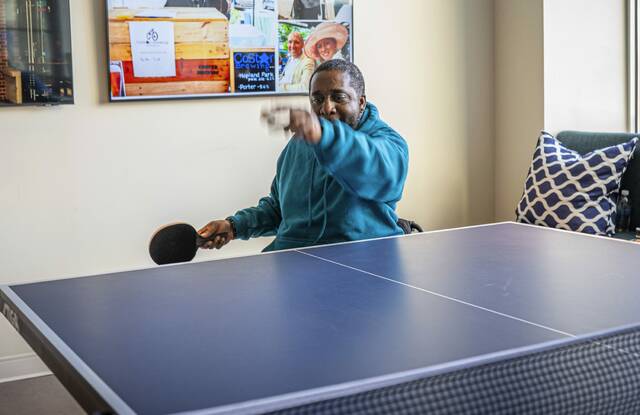
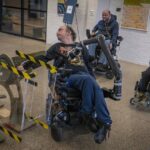
Lester L. Bennett’s goal for Friday was to go home with his neck feeling a little heavier.
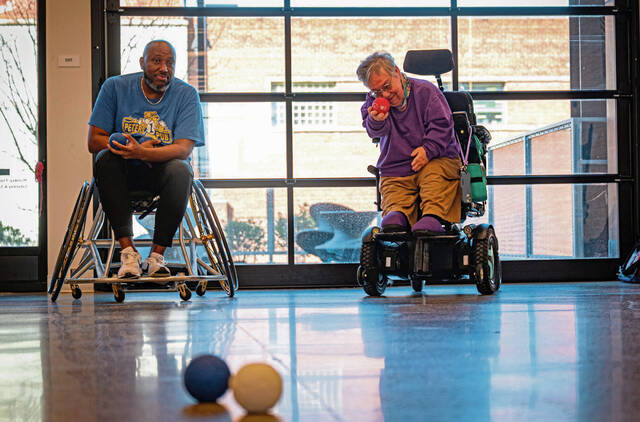
It was Bennett’s second year competing for medals in the Keystone Wheelchair Games.
“I’m here to kick everybody’s butts,” Bennett, 50, of Homestead said.
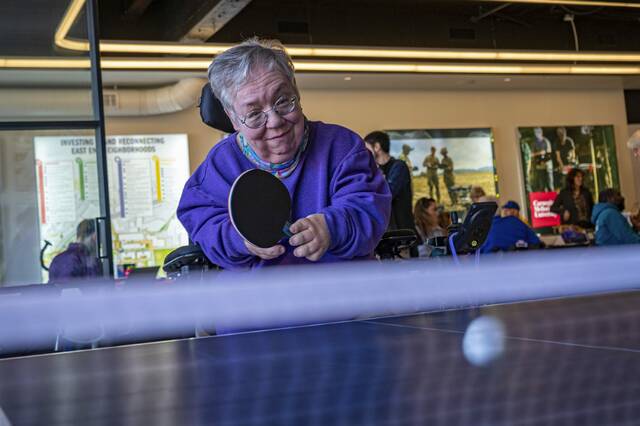
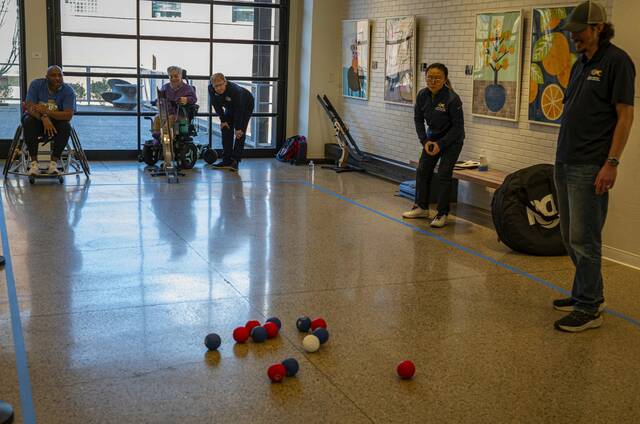
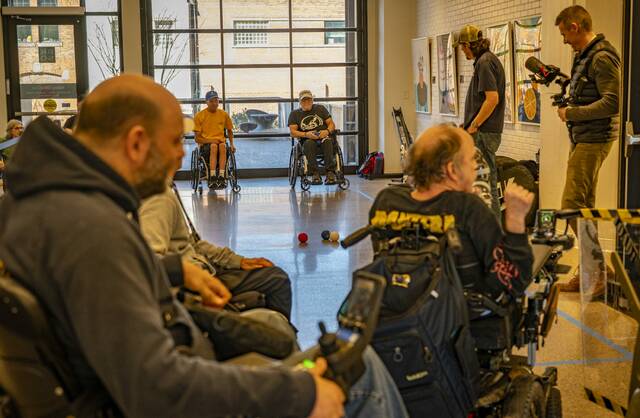
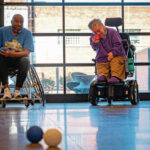
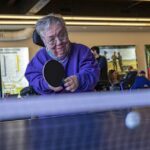
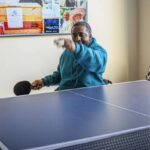
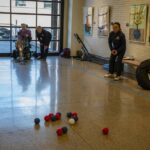
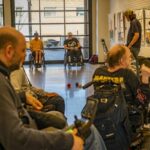
The games are an annual, winter-based adaptive sports competition held in Pittsburgh’s Bakery Square designed for para-athletes to compete in events including cornhole, boccia, table tennis and slalom. Hosted by the Human Engineering Research Laboratories, the games are meant to provide an environment for individuals to compete, socialize and learn new skills.
Easterseals Western and Central Pennsylvania is a co-host of the games and a community partner of the lab. Lori McCann, vice president of development and marketing for Easterseals, said the nonprofit was one of the major sponsors of the event.
Human Engineering Research Laboratories founder and director Rory Cooper, of West Deer, and his wife, Rosi, have both been members of the Easterseals board. McCann said the Coopers have been great friends of the nonprofit, and the lab and Easterseals have collaborated in the past.
Easterseals provides support for children and adults with disabilities. It has more than 13 programs and services across 47 counties in Pennsylvania.
Aside from his love for competition and desire to add some bling to his trophy case, Bennett said the community feel that the games provide keeps him coming back.
He has a degree in rehabilitation science from the University of Pittsburgh’s School of Health and Rehabilitation Sciences. Throughout his work and as a person with a disability, Bennett has interacted with many support groups that bond participants through shared trauma. The games, he said, do just the opposite.
“In this setting, (disabilities) are a footnote,” Bennett said. “We’re competing with one another and we’re screaming back and forth, but it’s a focus on the positives of our disabilities.”
While Bennett acknowledges he has barriers as a wheelchair user, the games help him celebrate the fact he overcame those barriers to be able to compete.
The games are open to manual, standing and power wheelchair users. Bennett said he likes not being separated based on the equipment the athletes use to help their mobility.
As a repeat competitor, he hopes to see more diverse competition in the future.
“I want women who are wheelchair users … and individuals who may feel like they have more severe disabilities, I want them to know that this is an event that is thinking about their needs also,” Bennett said.
In addition to building community, the games are also hosted to help support research at the lab, a joint research institute with the University of Pittsburgh and the U.S. Department of Veterans Affairs. The lab specializes in rehabilitation engineering, specifically advancing wheelchair technology, assistive robotics and intelligent seating systems.
Rory Cooper said students and workers at the lab are able to brainstorm different technologies that make sports more accessible to people with disabilities.
“It’s good for the (lab’s) students and my team to see the adaptations that people use for different sports as well,” Cooper said.
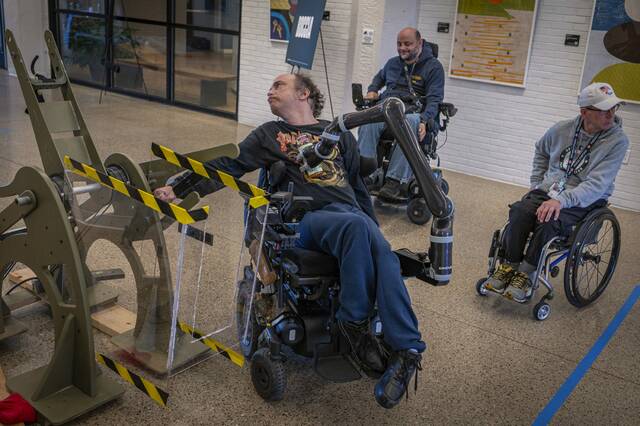
Technologies the lab created for the games include a trebochet device that launches cornhole beanbags for people who may not be able to throw themselves. The lab is also working on an adaptive rugby wheelchair, adaptive cross-country skis and adaptive putters for miniature golf.
The social interaction helps them learn what the lab should be working on to help people as best they can, Cooper said.
He competed Friday in the cornhole, slalom and table tennis events.
“It’s important that I participate and have a chance to talk and engage and be part of the group rather than only being seen as Dr. Cooper,” he said.
Cooper is a paralympic bronze medalist. He won a bronze medal at the 1988 Seoul Paralympics in the 4×400-meter wheelchair relay and took fourth place in the 10,000-meter wheelchair race.
In addition, he has accumulated more than 150 medals in the National Veterans Wheelchair Games. He serves on the U.S. Olympian and Paralympian Association Executive Committee.
Cooper moved the Pittsburgh area more than 30 years ago from California when Pitt and the VA recruited him to the area.
He started the games in 2025. Athletes invited to participate in the competition have been affiliated with the lab or its community partners. Cooper is hoping to host even more athletes at the games next year.
“(The games) get people to connect with one another and connect with other community resources,” Cooper said.