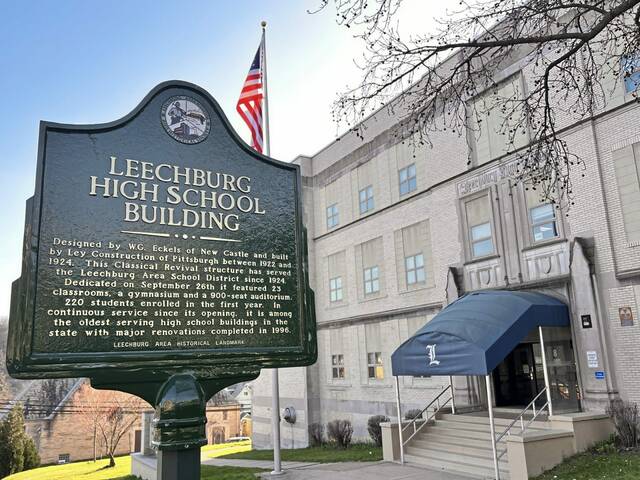
Leechburg Area is among four school districts that have filed a lawsuit against the state’s largest cyber charter school asking that tuition be dropped for local students.
The suit claims Commonwealth Charter Academy, as well as the state Department of Education through lack of sufficient oversight, fails to provide students with a thorough education, according to a petition filed Tuesday.
District officials at Leechburg Area, Pittsburgh Public Schools, Indiana Area and Ligonier Valley are asking the court to revoke CCA’s charter and dismiss tuition costs.
They leaned on data that showed only 9.1% of CCA students scored “proficient” or better on standardized testing, compared to the statewide average of 49.9%, according to WESA, a Pittsburgh-based NPR radio station.
In math, only 4.2% of CCA students were proficient in math compared to 41.7% of students statewide.
“Let’s put that into perspective,” Leechburg Area Superintendent David Keibler said. “Fewer than 10 kids out of 100 are passing ELA (standardized testing) and fewer than five are passing math.”
The suit also claims the state has allowed CCA to operate without a renewed charter since 2016.
Keibler said many students attend cyber charter schools “for excellent reasons,” but the schools have to be forthcoming about the actual costs of educating them.
“The fund balance for CCA has grown from $95 million a few years ago to $213 million at the end of last year, and they have additional funds in their capital reserves,” Keibler said. “They are taking local and state revenue from public schools and building a slush fund, which the cyber charter schools have abused.”
According to the lawsuit, Leechburg Area has paid CCA more than $580,000 since 2022 — about $105,000 in 2022-23, about $223,600 in 2023-24 and about $252,000 in 2024-20.
Keibler said the district is projected to pay more than $379,000 this school year.
The four districts combined paid CCA more than $12.5 million in 2024-25, according to the suit.
Pittsburgh Public Schools doled out the largest amount with $10.5 million, followed by Indiana Area with about $977,000 and Ligonier Valley with about $796,000.
Ira Weiss, Pittsburgh Public Schools solicitor and counsel for this case, said “$10.5 million in 2024-2025 for 458 students is a gross abuse of tax money, and this suit seeks to stop it.”
Gary Matta, solicitor for Ligonier Valley School District, said he hopes more will be revealed about CCA’s spending as the litigation proceeds.
“They don’t have the amount of staff that we have,” he said. “Money has to be going to something other than to educate children.
“We filed this lawsuit because we believe the charter schools are over-billing every district, not just our district.”
He pointed to low test scores as a sign that charter schools such as CCA are short-changing students.
“What they’re providing to students is not adequate,” Matta said. “They’re not providing the educational value that public schools do.
“This is something that is statewide and needs to be addressed. They’re just making money and not providing adequate service to these students.”
Commonwealth Charter Academy, based in Harrisburg, has more than 34,000 students from across the state.
It has experienced a 271% increase in enrollment from the four districts that filed the lawsuit since 2019, according to CCA officials.
Media contact Tim Eller said the cyber charter organization is disappointed with the direct attack on public cyber charter families “instead of an honest attempt to address why thousands of parents are leaving their schools.”
“We are a public school and a nonprofit organization, governed by state and federal laws since 2003. We file every required report with the Pennsylvania Department of Education (PDE) and the IRS,” he said. “Despite politically motivated attacks and unwarranted scrutiny, the Auditor General’s February 2025 performance audit found no financial mismanagement, waste, fraud, or abuse of taxpayer dollars.”
Pennsylvania law deems a charter valid until it is revoked. The Department of Education has never threatened that action against CCA, Eller said.
“On four occasions, (the state Education Department) initiated the charter renewal process with CCA, and during each process, CCA provided (the Education Department) with everything it requested,” he said. “On one occasion, (Education Department) officials verbally promised to renew CCA’s charter within a month. They reneged on that promise for no reason. “We have been prepared and continue to be prepared to engage in a fifth charter renewal process, and have inquired about when that might begin.”
Representatives at the state Education Department were not immediately available for comment.
Keibler said the state has allowed CCA to continue operating “like it was in the Wild West, with zero accountability to PDE, leading to issues such as unmonitored spending and a lack of student support.”
“Highlighting these oversight failures underscores the urgent need for stricter enforcement and consequences for non-compliance,” he said.
Weiss said the districts filing the suit are seeking a declaration that CCA is operating in violation of the Cyber Charter School Law and because of this, districts should not have to pay public tax funds to them.
Further, Weiss said, the districts believe the Department of Education should not redirect subsidy payments to CCA when districts do not pay.
“This charter school was last renewed in 2011 and was not renewed when that charter expired in 2016,” Weiss said. “It has over $500 million in a budget surplus and capital reserve fund when these cyber charter schools are not permitted to have brick-and-mortar schools.
“The student performance falls far below the state average and these students are being deprived of the public education they are entitled to under the PA Constitution. The school is operating as a for-profit business in violation of the law. All of these claims will be presented to Commonwealth Court.”