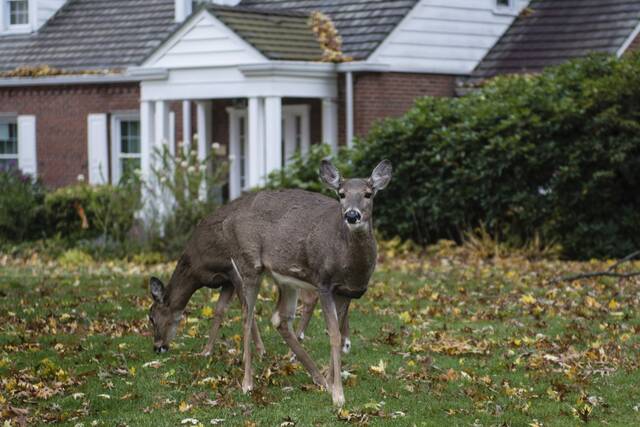
Oakmont is taking the next steps toward deer population management.
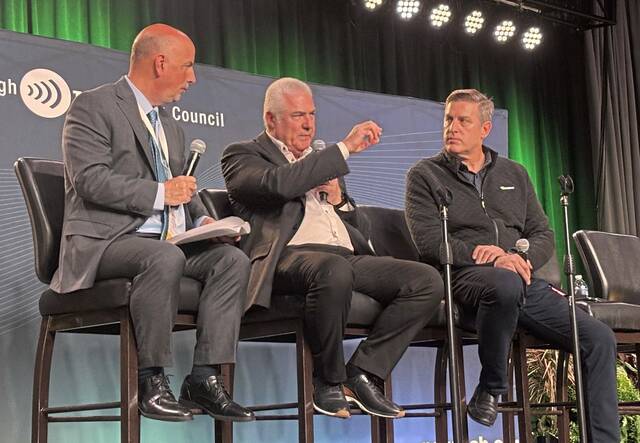
During Oakmont Council’s agenda meeting Tuesday, Luke Leonard, owner and operator of Suburban Whitetail Management, spoke about deer management program options available to the borough.
Council member Deborah Ormay said 10% of Oakmont’s population responded to a borough survey sent to gauge public opinion on the deer.
“It was clear from the results of the survey that people felt there was an issue with the deer in our community,” Ormay said.
Leonard said his company operates primarily in Ross, McCandless and Bradford Woods. He said the business works in conjunction with surrounding communities.
Suburban Whitetail offers two programs for deer management.
The first offers archery hunts between mid-September and the end of January coinciding with the Pennsylvania Game Commission’s archery season.
“All we do is archery in this program and it’s deer only,” Leonard said. “We don’t do any type of trapping.”
Leonard said the hunts would take place in the borough’s parks and on private property with permission from property owners. Leonard said landowners are able to determine times when hunters can come to the property, where on the property they’re allowed and how often hunters can use the property.
“I basically connect the hunter and the landowner,” Leonard said.
All hunters with Suburban Whitetail are vetted, he said. Applicants are required to pass a proficiency test where they have to shoot three arrows at 20 yards, 30 yards and 40 yards at targets. They also go through an interview process.
Hunters are required to donate their first deer, and every third deer after that to help feed those in need. Leonard said it’s common for hunters to donate more than required.
“Last year we donated over 20,000 meals to Hunters Sharing the Harvest,” Leonard said.
Hunters Sharing the Harvest is a donation program where hunters can share their extra venison to food pantries and community assistance centers across the state, via a network of participating butchers.
“You’ll notice after a year or two, (the deer population) is going to plateau,” Leonard said about the impact of the archery hunts. “We’re not going to harvest as many deer as we’re building onto (hunting properties). The reason being is because there’s only so many properties we’re allowed to hunt on.”
He said once neighborhoods hit a plateau, they have to look at other steps to manage deer population.
Leonard said the program charges $300 per deer. He sets a threshold number, and the borough would be responsible for paying for that number of deer.
If hunters harvest more than the designated number, the borough is not on the hook for those deer. If hunters harvest below the designated number, the borough only pays for the amount of deer harvested.
The second program Suburban Whitetail offers is a cull. He called the cull method a “deer nuisance control.”
“It’s no different than termites in your foundation, raccoons in your garbage or bats in your attic,” Leonard said. “You’re removing an animal off the landscape, and you’re trying to do it as quickly and efficiently as you possibly can.”
The cull would take place after the regular hunting season from the end of January to the middle of April. Leonard said his hunters would be using suppressed rifles, night vision scopes and in some cases, the hunters could use bait to entice the deer to come closer.
“A cull is a way to remove a lot of deer, very quickly from the landscape,” Leonard said.
Hunters participating in the cull are required to go through background checks, Game Commission permitting and tests, and other qualifiers before they can participate.
He said the method requires steps including a deer management program to present to the Game Commission for a permit and tags to carry out a cull.
There would be no threshold number designated for the borough’s payment, Leonard said. They would be charged $300 per deer.
The success of programs is measured by resident complaints and vehicle and deer accident statistics, Leonard said.
Borough manager Scot Fodi asked Leonard to explain sterilization options for the deer rather than killing them. Leonard said while it’s a common question, it isn’t a feasible method. The chemicals used for sterilization are not approved by the Game Commission, which makes the process illegal.
“First off, it costs around $3,500 or more per deer,” he said. “Secondly, it’s very ineffective in the way that it’s done because I don’t know if I’m sterilizing the same one or not sterilizing the same one. It’s a mess.”
When a doe is sterilized, Leonard said, it is no longer able to give birth but will still enter heat during mating season.
Bucks will still attempt to get the doe pregnant, but the doe will remain in heat as bucks will continue to chase her.
“What happens is (the doe) will either die of starvation or exhaustion because she does not come out of the heat,” Leonard said. “So, it’s actually, in my opinion, a very cruel method.”
Council plans to continue discussing its options before pursuing a management program.