Members of the University of Pittsburgh’s chapter of Engineers Without Borders toiled in the heat Saturday and Sunday to help make life better for people nearly 4,000 miles away.
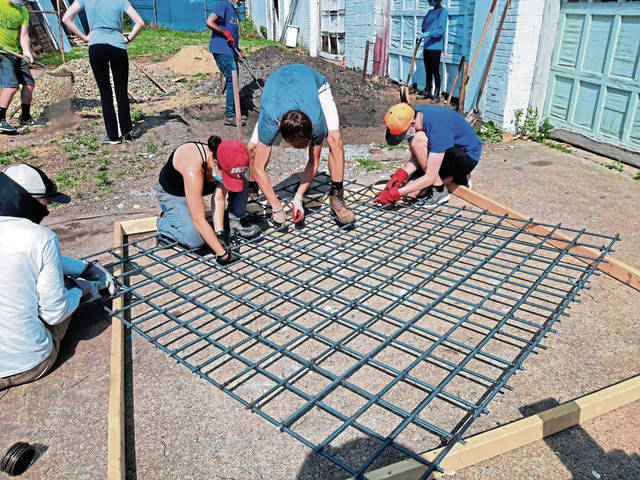
The group gathered to build a reinforced concrete slab at the Habitat for Humanity ReStore in New Kensington as part of an instructional video on installing latrines in a remote village in Bolivia.
New Kensington’s shout-out to the small Bolivian town of Carijana was the result of an Engineers Without Borders’ project to build composting latrines for the town’s 52 households and its bus station.
More than 60% of the population in Bolivia is without sanitation, and less than 10% of rural Bolivians have private toilets, according to the WaterWorld website. The lack of sanitation causes diseases and water pollution.
The covid-19 pandemic made traveling to Bolivia impossible for the group. Instead, they produced an instructional video on how to build a latrine for residents there to take on the project.
The Pitt Engineers Without Borders mentor is Dennis Mialki, a Tarentum-based engineer who serves as vice president of Allegheny Valley Habitat for Humanity.
That local nonprofit’s ReStore in New Kensington, a low-cost home improvement store at 225 Freeport St., also was in need of an outdoor cement pad.
About 10 Pitt students and volunteers from Habitat for Humanity assembled this weekend to build the wooden form and to set the rebar to reinforce the strength of the concrete, which will be be poured next weekend.
The project wasn’t just about laying a concrete slab but how to teach someone how to lay a concrete slab in a remote Bolivian village, without electric concrete mixers and a nearby hardware store, Mialki said.
“They have to use what they have, which is a lot less than we have,” Mialki said. The wood framing and rebar were cut by hand. No electric saws. Instead of modernized tools to measure the level of a surface, Mialki’s team used a tube filled with water.
Habitat for Humanity is a beneficiary of the video project, as the nonprofit will now have an outdoor staging area for appliances and other large items donated to the ReStore.
“Having an outdoor space to clean donated items is a big element we need, especially with CDC compliance and our other checks,” said John Tamiggi, executive director of the New Kensington Habitat for Humanity.
“These instructional videos from our New Kensington site to Bolivia hopefully will spin outward and be used in other training efforts outside of Bolivia,” he said.
“It was a wonderful blessing to partner with a great international operation and connect to the Alle-Kiski Valley,” Tamiggi said.