





The latest data center discussions in Springdale may have raised more questions than they answered Wednesday night.
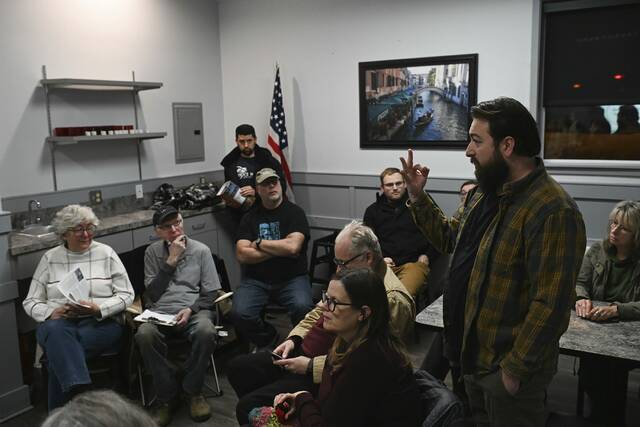
Local people gathered at From Italy Pizza for a packed open forum with environmental groups to organize the community, while developers fielded questions and revealed new details a half-mile away in the Springdale Borough Building’s gymnasium. The meetings drew more than 100 residents.
At the community conclave, residents heard a presentation from environmental group Protect PT, which was formed in Penn Township, Westmoreland County, to oppose drilling operations there before expanding throughout the region to weigh in on sensitive environmental projects.
But, during a sometimes rowdy, informal back-and-forth discussion, attendees confronted a fundamental question: Should the community oppose the center outright, or accept it and work to craft beneficial conditions to place on developers?
Sharon Spirk, a Springdale resident who attended several previous meetings, advocated for the former option but seemed skeptical that residents could ultimately oppose the project.
“Are we up against a brick wall? I mean, I feel like we are,” she said. “I don’t feel like we’re getting the truth. I feel like we’re sinking, and I don’t know who to call.”
If the community is hoping to block the project entirely, Protect PT community advocate Jim Cirilano said their best bet is the zoning hearing board rejecting variances for the center, which would likely disrupt developers’ plans.
Members of the board haven’t issued a decision on a half-dozen variances after wrapping up testimony last month.
But others, like Cheswick resident Michael Montgomery, said the community would be better served by attempting to craft stringent conditions on the developers to ensure any issues arising from the project are mitigated.
“If we can’t stop it, we have to put things in place that give our residents the best chance to have the healthiest environment moving forward,” Montgomery said.
Still, several residents continued to express worries about the center’s potential effects on the electrical grid, water resources and the environment.
Springdale Township resident Erin Auvil worries the community would ultimately become a “guinea pig” as more data centers are proposed for the region.
Though the meeting stemmed from a push by Springdale resident Marty Garrigan, Protect PT, among other environmental organizations, took the lead in organizing it.
Garrigan said he hopes Wednesday’s meeting is not the last time the community gathers, and he believed the meeting progressed “really well.”
The second meeting
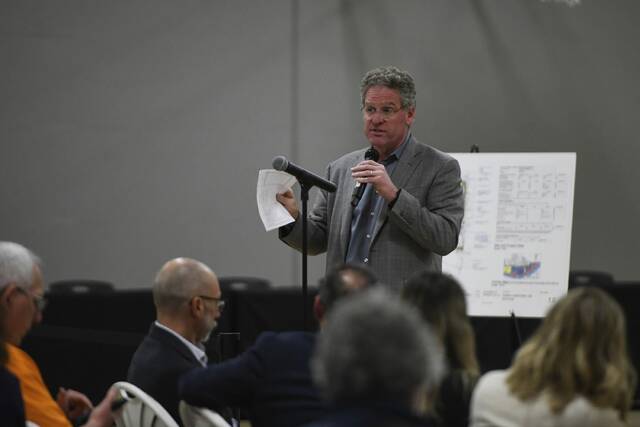
Down the road at the borough building’s gym, Brian Regli, a consultant for land developer Allegheny DC Property Co., fielded questions and offered remarks for about four hours.
Several people who attended the community meeting migrated to the developers’ Q&A, which occasionally led to tense or outright hostile exchanges.
Among other well-worn topics, Regli and sound expert Jeff Babich presented the results of a noise study that tested the current ambient noise of areas around the center as well as projected noise the complex would generate.
Babich said the maximum expected noise on especially demanding days would be 57 decibels on Pittsburgh Street. According to a Yale factsheet, that’s something like a household refrigerator hum.
On most occasions, its levels would be lower, however, and well below the borough maximum of 85 decibels.
Regli also discussed possibly constructing noise shields on the building and landscaping near Duquesne Avenue to dampen sound.
After the Pennsylvania Public Utility Commission passed a tentative tariff last week for large-load users on the electric grid, Regli said developers are also considering constructing some on-site power generation for times of peak energy demand.
That could come in the form of battery storage, natural gas, geothermal or solar power, but Regli said the center would still rely on the region’s electric grid for the vast majority of its energy consumption.
The on-site generation could be activated to take strain off the power grid and avoid additional charges from electrical transmitters during peak demand, he said.
When would it be ready?
Montgomery questioned how fast the project could come together if it were approved.
Regli said ideally the center would initially go online within two to 2 1/2 years. But the consultant told TribLive it could ultimately take 3 1/2 to five years.
“I am hopeful that we get a ‘yes’ for conditional use. Many of you may not be hopeful for that outcome,” Regli told the crowd. “If that outcome occurs — we get a ‘yes’ on conditional use — I am hopeful you guys keep showing up. These are conversations that are really valuable.”
Neither of the meetings was part of a formal hearing process.
The Springdale Planning Commission will reconvene at 6:30 p.m. Monday and may offer its recommendation to borough council to approve or reject the project. A recommendation to approve could come with conditions.
But it’s ultimately up to the council to make a decision.
Council reconvenes at 5:30 p.m. Nov. 24 to continue expert testimony.