
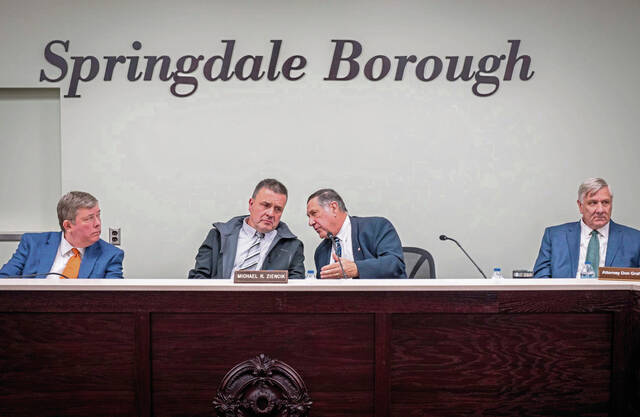
Despite significant pushback from residents and environmental groups, Springdale Council members said they were powerless to reject a proposed data center project in the borough.
Council voted, 5-2, Tuesday to approve a conditional-use application from land developer Allegheny DC Property Co. to build a massive AI data center at the site of the former Cheswick Generating Station.
During and after the meeting, council faced sharp criticism for the vote.
But Councilman Joe Kern, who voted to approve the application, said he thinks the criticism results from a fundamental misunderstanding.
“Ultimately, we have to do our job,” Kern said. “We have no leg to stand on to reject it.”
That job on Tuesday, Kern said, was to act as a sort of legal judge, not as a private citizen.
Developers had spent months laying out a legal case for why their proposal fell within Springdale’s ordinances and conditions.
Last month, Springdale’s planning commission voted unanimously to recommend council approve the project.
And earlier in December, the borough’s zoning hearing board opted to approve half a dozen variances requested by developers.
Kern said Springdale spent weeks trying to find an attorney with an expertise on data centers to advise them, ultimately settling on Butler County-based lawyer Donald Graham.
Graham did not respond to TribLive requests for comment.
The borough “tried everything,” Kern said, but it simply didn’t have a legal case against the application.
“We did the best we could with the resources we had,” he said.
Steve Yakopec serves as the solicitor for Lower Burrell, Upper Burrell and New Kensington’s zoning hearing board. Though he wasn’t involved in the data center process, Yakopec said that, as long as a use is permitted and meets borough conditions, council members’ hands are typically tied.
“If you meet all the conditions, and you’re turned down by council and you take an appeal, that decision is going to be overturned,” Yakopec said.
In that situation, an appeal would take place in Allegheny County Court.
He compared the situation to disputes between local municipalities and fracking firms, where natural gas companies often have won out despite popular resistance.
Aside from the legal costs of fighting the appeal, an overturned rejection also would mean the borough would lose its opportunity to impose further conditions on the project, Yakopec said.
That’s a risk Councilman Dan Copeland said he wasn’t willing to take.
“You’re losing all of your bargaining as a community,” he said. “As a community, what do you do?”
Springdale Council tacked on 19 additional conditions with its approval.
Those conditions limit the hours for diesel generator testing, outline future noise studies and enter the borough and developers into a community benefits agreement, among other things.
Councilwoman Dolly Stephens also mentioned fears of losing conditions before she cast her vote Tuesday to approve the project.
“We have things outlined, and if we don’t vote ‘yes,’ we’ll lose all that, they’ll come in anyway, and there will be no regulations in this community,” she said.
That didn’t stop two council members from dissenting, however.
Toni Robbins had long stated her opposition to the proposal, but Jeff Hartz said he didn’t make his final decision until Tuesday night.
“When all these people didn’t want it, that’s what cinched it for me,” he said. “I’m a people person, not a politician.”
Still, he didn’t disagree with his colleagues on council regarding their legal predicament. While he said the borough was “between a rock and hard place,” he decided he’d rather take his chances in court.
Hartz said it was the hardest decision he’s ever made.
Springdale can’t retroactively apply updated ordinances on developers, but data center-specific ordinances are something other municipalities could consider ahead of time, Yakopec said.
Those ordinances could outline things like noise limitations or aesthetic considerations for better community protection, but there’s little a municipality can do to outright reject a permitted use, Yakopec said.
Kern said he’d also be looking to modernize Springdale’s ordinances, specifically those related to noise and zoning, ahead of any further development in the borough.
Personally, the recent conditional-use process and hostility from some residents, Kern said, has been taxing.
“It’s stressful,” he said. “I live in town. I have a family. I have a business.”
Copeland spoke in similar terms, citing backlash and personal jabs on social media.
But he was still confident in his decision.
“You’ve got to have thick skin to be in the game,” Copeland said.