
https://triblive.com/local/valley-news-dispatch/substitute-teacher-shortages-leave-some-districts-scrambling-to-avoid-vicious-cycle-in-schools/
Substitute teacher shortages leave some districts scrambling to avoid ‘vicious cycle’ in schools

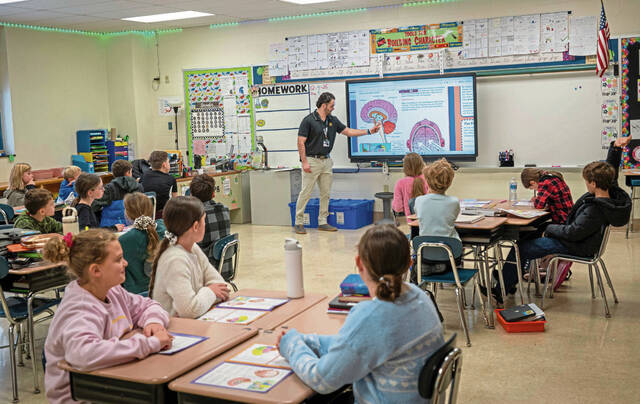
During Allegheny Valley School District’s two-month search for a consistent high school biology teacher, Superintendent Patrick Graczyk said other teachers, outside substitutes and even school principals stepped in to keep the science class going.
Eventually, the district found a long-term substitute with an emergency biology certification to fill the role left by a recent teacher resignation, Graczyk said.
It’s not the first time Allegheny Valley, and a lot of other districts, have been left scrambling by substitute shortages.
“It’s a patchwork quilt we’re trying to put together rather than having a consistent teacher,” Graczyk said.
It’s a trend noticed statewide.
According to the Pennsylvania School Board Association’s 2025 “State of Education” report, 82% of districts reported a shortage of substitutes — the highest of any staff category.
And that’s an improvement. Previous reports cited shortages in 99% of districts in 2022, 92% in 2023 and 88% in 2024.
Despite the modest gains, substitute teacher staffing remains a persistent issue for districts throughout the state, said Lisa Duval, assistant superintendent for the Norwin School District.
Duval suspects the issue is tied to the statewide teacher shortage.
More than 2,600 teaching positions were vacant in Pennsylvania as of June — filled either by substitute teachers, educators covering classes during their free periods or students being assigned to other sections of a course, according to data released by the state.
A December 2023 amendment to the Pennsylvania school code enabled the state Department of Education to collect and release teacher vacancy data for the first time. The October 2023 report, the first of its kind, revealed 2,156 vacant teaching positions.
“I think that is a direct reflection of the overall teacher shortage that’s being experienced, not just in Western Pennsylvania, but across the country,” Duval said. “More people are getting full-time teaching jobs and, therefore, there’s not as many people who are able to substitute that have a teaching degree.”
‘You need that experience before anyone will hire you’
When Duval started her career in education 30 years ago, substitute teaching in a district was the method to secure a full-time job.
“The way that a newly certified teacher got their foot in the door was by being a substitute,” she said. “That allowed you to gain experience and get exposure. You earned your way into a full-time position by demonstrating what you could do as a substitute teacher.”
Now, Duval believes, the tide is turning.
“What we’re experiencing is that, when someone graduates or comes out of school with their teaching certificate,” she said, “they actually have a much greater chance of getting a full-time job, because there is a teacher shortage.”
But that isn’t the case for every aspiring teacher.
Nicholas Lippa, a 2024 Duquesne University graduate, has found value in substitute teaching at Bethel Park, Chartiers Valley and, most recently, Hempfield Area.
Lippa, 24, of Pittsburgh, interviewed for several full-time teaching positions in the region this summer. Though none of the jobs came to fruition, each district offered Lippa a long-term substitute position.
Hempfield gave the best offer, he said — a year-long teaching job in a fifth grade science, social studies and health classroom at West Point Elementary.
“A lot of districts, whenever you’re applying, they ask for your years of experience,” Lippa said. “It was always difficult, because I didn’t have a lot of experience. A lot of districts I know wouldn’t hire a student fresh out of Duquesne.”
Lippa doesn’t doubt that a substitute teacher shortage exists. But there is no better way to learn crucial teaching skills than by working in a classroom, he said.
“You need that experience before anyone will hire you,” Lippa said. “Spending a year or two of subbing has built up my repertoire of experience and just made me a better teacher as is.”
‘I need to be able to support my family’
Despite having plenty of experience, substitute teaching is still a must for Mt. Lebanon resident Tracy Taylor.
The single mother of four served as a full-time English teacher in Massachusetts for years before taking a break in her career to raise her family and return to her native Pittsburgh.
As her kids grew up, Taylor, 55, decided to return to teaching, hoping to resume as a full-timer.
But so far, she’s taken mainly day-to-day substitute jobs at Mt. Lebanon School District — apart from a previous long-term substitute position she took when the district’s 10th grade English teacher went on sabbatical.
Taylor, a certified reading specialist, has a master’s degree and years of experience, but she still has to take on supplemental work to make ends meet.
Substitute teachers’ pay is partially to blame for the shortage, she said. Taylor makes $125 per day at Mt. Lebanon, or about $17.85 per hour.
“I need to be able to support my family, and it’s not very doable on a substitute’s pay,” she said.
Many potential substitutes, Taylor said, may be drawn to more affluent areas — including Mt. Lebanon — and less willing to fill roles in lower income districts.
Beyond pay, Taylor said the positions she takes mostly come down to location. With a family to manage, it’s simply easier to fill in at districts like Mt. Lebanon or Upper St. Clair instead of trekking further afield, she said.
Substitute shortage creates ‘vicious cycle’
Allegheny Valley has struggled most to find substitute teachers for specialized high school-level courses, such as science, math and business, said Graczyk, the superintendent. That has led administrators to call local universities in search of recent or upcoming graduates to fill substitute positions, he said.
In the meantime, Allegheny Valley teachers have been left to fill in the gaps to ensure continuity of learning for students.
That means sacrificing planning periods, which Graczyk said can echo the issues in one classroom throughout others as teachers scramble to make up for lost time.
“It’s a domino effect that’s not helpful,” he said.
“Vicious cycle” is the preferred term of Chris Sefcheck, superintendent of New Kensington-Arnold School District.
Before the start of this school year, New Kensington-Arnold hiked its daily rate for substitutes from $100 to $130 in an effort to attract more subs.
“We’re very aggressive with chasing down subs for interviews and then hiring them full-time,” he said.
Still, New Kensington-Arnold lacks around five substitutes on any given day, Sefcheck said. That leaves the district relying more heavily on its full-time teachers to cover classes, which can impact staff morale, he said.
Some districts have opted to hire substitute teachers with emergency certifications to broaden the pool of available educators, said Mackenzie Christ, spokesperson for the Pennsylvania School Boards Association.
Emergency certifications are temporary teaching credentials available to college graduates who have professional experience in certain fields, like math or science, but who did not study to be teachers. The candidates must meet all other criteria, such as background checks, to get the certification.
Others districts have opted to cancel cultural arts classes, professional development or large district meetings to open up more time for classroom needs.
“While these strategies may help a district increase their substitute fill rates, some are more disruptive to the classroom than others,” Christ said in a statement. “Piecemealing coverage by shifting staff in and out of classrooms is a method of ensuring classrooms are covered, but often takes away from the instructional flow and continuity of the classroom.”
Schools lean on emergency certifications
Greensburg Salem typically fills 90% of its daily substitute teacher needs, said Assistant Superintendent Kara Gardner.
Hiring 10 building substitutes districtwide offsets some of that need. But emergency certified substitutes also play a role in keeping the district’s classrooms running, Gardner said.
The substitute teacher pool that Greensburg Salem draws from includes about 40 emergency certified educators, she said. Gardner estimates only one of them is a retired educator whose original teaching certification expired.
“It puts a body in front of students, but I think it comes with its own set of issues and concerns when we’re discussing individuals who don’t have teaching certifications,” she said. “I would say that there’s also really great people who come out of that who actually want to be teachers but just can’t afford to go back to school because there’s just not an easy way to do that.”
Districts get creative to fill teacher absences
Plum Borough School District, which has a larger student body and budget than many of its neighbors, uses a different model.
The district has about a dozen building subs, who report to one of Plum’s five schools every day for guaranteed work, said Assistant Superintendent Matt Thomas. Though more expensive, the model means Plum typically doesn’t struggle to get teachers in the classroom, he said.
“We actually have been pretty fortunate,” he said.
It’s a proactive approach that allows the district to draw from its bullpen, as Thomas calls it.
The district’s real struggle has been to fill support positions like paraprofessional roles, he said.
The substitute teacher shortage has pushed Franklin Regional to use a third-party staffing platform, Edustaff, to help fill in during educator absences, said Assistant Superintendent Matthew Delp.
The switch will go live in January. Up to this point, the district has managed substitute teacher hiring internally, Delp said.
“We were relying, naturally, on our local community, folks that are within the immediate region who are interested in becoming substitute teachers,” Delp said. “And, as we interviewed those folks, 40% may not even take a vacancy at any point in time.
“Even though we were getting interested candidates, some folks weren’t even taking those open opportunities to act as a substitute teacher within the district.”
The district has two or three building substitutes at each of its four schools. But that’s not enough to make up for the 40 teacher absences that may occur on a given day, Delp said.
On average, Franklin Regional fills 75% to 80% of the substitute teaching positions it needs each day, he said. The rest are addressed by teachers covering classes for their colleagues.
A challenging, but noble job
It’s no secret that substitute teaching has its challenges, said Taylor, the Mt. Lebanon teacher.
“It isn’t for the faint of heart,” she said. “Subbing, you don’t know the kids, so you’re going in blind.”
Lippa, the recent Duquesne graduate now at Hempfield, said that while working as a substitute at Chartiers Valley, his teaching responsibilities ran the gamut.
“I would be pretty much wherever they needed me for that day,” he said. “Sometimes I was in for special education. Sometimes I was in for an itinerant position. Sometimes I was a paraprofessional.
“That’s where I really learned the ability to jump in and go with the flow.”
That flexibility is what makes substitute teachers so important to a school’s operation, Delp said.
“Substitute teaching is a challenging position,” he said, “but it is a noble one, and it certainly maintains that continuity of education for all students when teachers have to have absences.
“Hopefully, there will be an increase so we can collectively provide what the students need.”
James Engel and Quincey Reese are TribLive staff writers. James can be reached at jengel@triblive.com. Quincey can be reached at qreese@triblive.com.
Copyright ©2026— Trib Total Media, LLC (TribLIVE.com)