






Momentum is growing for a push to ban cellphones in the state’s public schools.
State Reps. Mandy Steele, D-Fox Chapel, and Jill Cooper, R-Murrysville, are among those spearheading House Bill 1814 to restrict cellphones in classrooms.
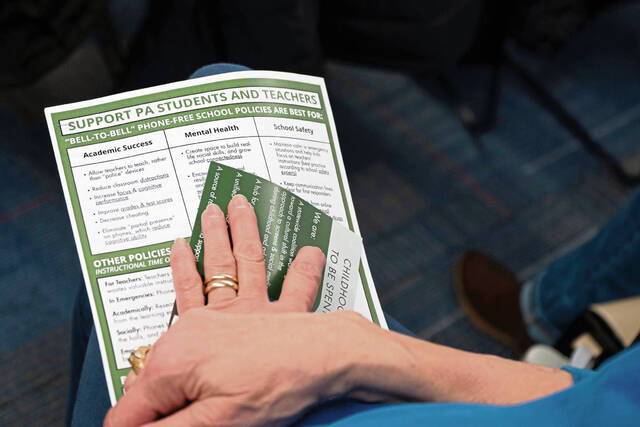
It’s a proposed bell-to-bell ban, meaning students would secure their cellphones in a lockbox or some kind of holder and not be granted access to it until the end of the school day.
There would be exceptions for students who are first responders, students with individualized education programs (IEPs) and those who need a cellphone for medical monitoring of an immediate family member.
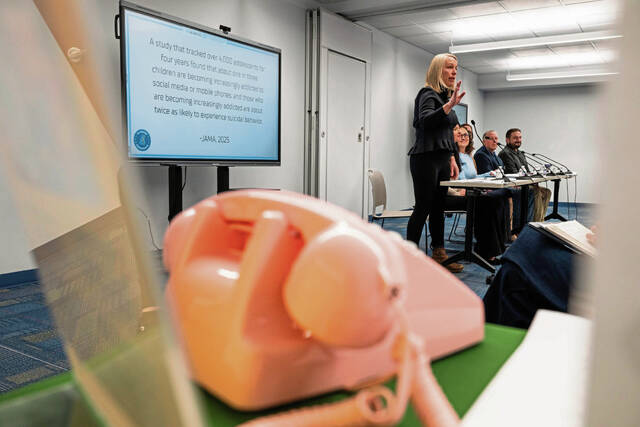
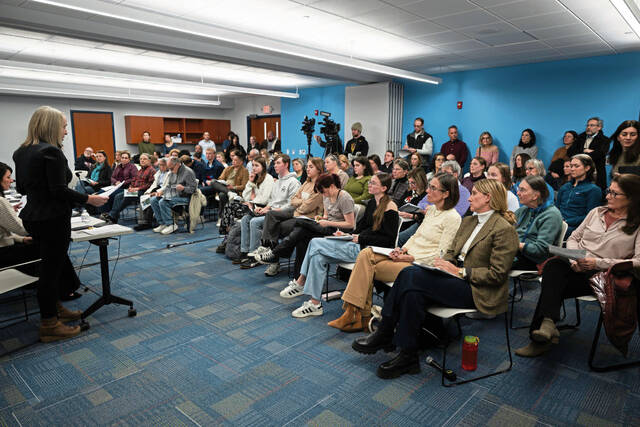
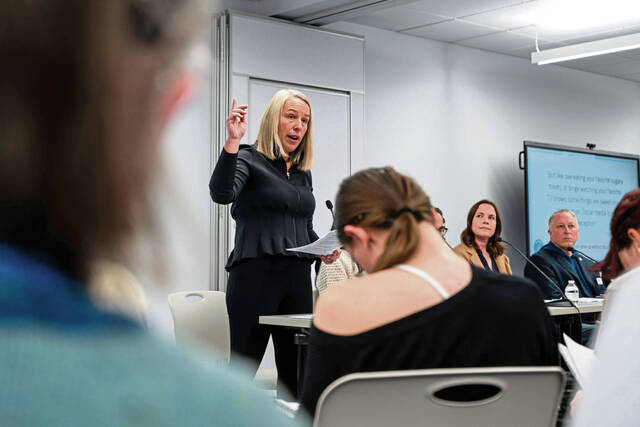
Steele hosted a town hall meeting Tuesday evening at Cooper-Siegel Community Library in Fox Chapel, which was also livestreamed.
Speakers included a pediatrician, a teachers union regional president and a parental advocate, among others, to educate people on what a problem cellphones in schools have become.
“I have seen what the allure of these devices does to kids,” said Steele, a mother of four. “It’s disturbing to witness this as a parent. I have seen how incredibly negatively impacted they are when they’ve got these devices in their pockets around the clock.
“It’s not just me that sees this, obviously. It is so many of us who are watching the way children are experiencing childhood now and are alarmed. It’s something that’s clearly wrong here.”
It was standing room only with at least 60 people attended the event at Cooper-Siegel, including several Fox Chapel Area School Board members, Fox Chapel Mayor Jonathan Colton and other local leaders from O’Hara and neighboring communities.
PA Unplugged co-leader Kelly Marsh said the attendance proved cellphones in schools is a big issue.
“We are so happy that this is elevated to a stance that people are coming together and having these really important community discussions so that everyone can hear from all the various stakeholders and make sure they understand whey we’re here,” she said. “This issue transcends a rule in a school building. This is really a public health crisis.”
The Senate’s version
The state Senate last month approved a bill to implement a bell-to-bell ban on student cellphone use in school. It was co-sponsored by Sen. Devlin Robinson, R-Bridgeville.
Senate Bill 1014 would create a consistent statewide standard, Robinson said shortly after its passing, and help curb classroom distractions, boost academic performance and address growing concerns about mental health.
It now heads to the House for consideration. The Steele/Cooper bill is still in committee.
School director: lawmakers overreaching
School Director Amy Cooper said the proposed House bill goes beyond what is appropriate for the state Legislature.
“(This bill) represents a significant departure from Pennsylvania’s longstanding approach to public school governance,” Cooper said after the town hall.
“Decisions regarding student conduct, discipline and day-to-day operations have historically — and appropriately — been the responsibility of locally elected school boards operating within the framework of the Public School Code.”
She also said it would replace locally adopted policies with a one-size-fits-all mandate, undermining the role of school boards to respond to their communities’ unique needs.
“The requirements are specific and allow for little flexibility for individual districts to make decisions that best meet the needs of their students, educators and families.
“Guardrails would give school districts guidance, best practices or model policies. Not a statutory mandate that diminishes local control and imposes logistical burdens without funding or support.”
Some attendees agreed, asking why a law is necessary if school districts are already implementing their own cellphone policies.
Uniform standard needed?
David Taylor, Pennsylvania State Education Association Western Region president, said not every school district regulates the devices in the same way. Having a state law would set a standard.
“We are actively attempting to put those commonsense restrictions into place,” Taylor said. “Everything goes back to local control in this state. Everybody knows that. You have one community that is very stringent about it. Another one that’s so-so about it. Another one that’s another way about it.”
He said teachers are being relegated to being cellphone police and taking time out of teaching.
“We need a law so that it is accurately applied across the state,” Taylor said.
Mental health studies point out problems
Steele and panelists referenced multiple studies that have shown an increase in youth mental health problems, cyber bullying and phone usage, with the average student being on their phone about 70 minutes a day.
That adds up to one full school day per week.
A decline in mental health and academic performance coincides with the widespread adoption of smartphones, according to the National Institutes of Health. Since the early 2010s, teen depression has surged by about 150%, according to the institute’s website.
Some reports show teens recognize the distractions.
In a study conducted by the Brookings think tank, 76% of teens voiced a preference for some form of restrictions on phone use during the school day. In addition, the Pew Research Center reported a higher number of adults favor phone restrictions, from 68% in fall 2024 to 74% in summer 2025.
Other technology
Panelists also heard concerns about iPads and district-provided devices. They acknowledged technology could be problematic as well as useful, and present challenges that need to be tackled.
Fox Chapel Area School District does not ban cellphones. It has an electronic device policy that states they may be used in authorized areas or as determined by the building principal.
Approved uses include for educational or instructional purposes, as determined and supervised by the classroom teacher, before and after school, in the cafeteria at lunchtime, in the hallways during the passing of classes, on the bus or other vehicles if authorized by the driver, and in the library and study hall if authorised by the classroom teacher.
Students may be required to lock phones in an approved lockbox during classtime. School-specific rules for electronic devices are outlined in individual school handbooks.
Fox Chapel students‘ takes
Several students from Fox Chapel Area High School’s Advanced Placement Government class took part in the discussions.
Senior Anya Butler said she is leaning toward supporting a bell-to-bell ban. But she has concerns about students needing access to their cellphones in case of an emergency.
“It kind of enforced what I already thought,” Butler said. “I think the statistics are definitely there. I definitely think the safety aspect should be investigated more.”
Senior Sabina Mantella said a lot of high-schoolers have their cellphones during school while middle school and elementary students usually do not have easy access to their devices. She supports a cellphone ban for the youngsters and more self-restraint for upperclassmen.
“In our generation, cellphones are so a part of our daily lives,” Mantella said. “Even though we are graduating, it sort of raises questions for our current classmates. What’s going to happen if this bill does get passed? I think it’s important. My high school experience would be very different if there was a phone ban.”
She said some teachers do make students put their cellphones in pouches or on a table during class.
Senior Ori Goldin noted the proposed bill does not have a funding clause. He asked how school districts would be able to afford cellphone storage required by the law.
Taylor, the union president, said there are corporate funds and state grants for school safety that could be used to buy equipment if necessary, but a locked drawer would work just as well.
Goldin said it’s important for students to take advantage of town halls and other opportunities to meet and interact with their leaders.
“I was glad to see my state representative come out and speak with constituents,” Goldin said. “I wish more representatives did that more frequently. Coming into the meeting, even after reading through the bill, it seemed to me at first there were issues that needed to be addressed, such as funding.
“Such as high school needing to be a place where students are prepared for adult life, and don’t have their rights restricted in ways that would prevent them from being adequately prepared for adult life. I had concerns, like several other students and community members, about what kind of impact this bill would have on safety in schools. I felt like many of those concerns were addressed. I have definitely gotten more answers than questions out of this community meeting.”