


Editor’s note: Behind the Art is a recurring series highlighting artistic works throughout the county.
One day in early November, a defendant in Judge Christopher Feliciani’s criminal courtroom looked to the ceiling at three century-old oil paintings, pondering their meaning aloud in an exchange with the judge.
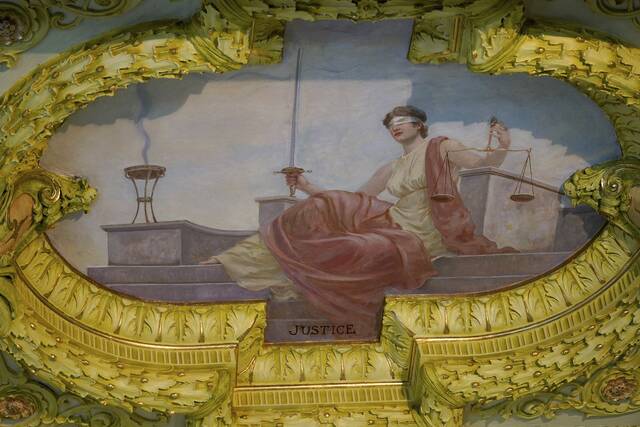
There’s one labeled “Justice.” Feliciani said he believes it depicts Themis, a goddess in Greek mythology who is often referred to now as Lady Justice. The blindfolded woman in the painting is holding scales and a sword.
“That’s just recognizing that justice should be blind,” he said. “Everyone should be considered equal before the courts, regardless of their background or their race or nationality.”
Attorney Mark Sorice said the woman’s seated position could symbolize patience and deliberation.
Another painting on the ceiling is marked “Mercy.” A woman wearing a dress touches the head of a naked man who is crouched down with his head in his hands. A book sits nearby.
The third is labeled “Moderation.” It depicts a naked man holding a ferocious-looking black dog by a leash in one hand and a fasces, a type of ax carried by those representing power in ancient Rome, in the other. Sorice said the work could symbolize restraint of harshness while still showing authority.
Feliciani has been in the second floor courtroom at the Westmoreland County Courthouse in Greensburg for about 10 years. It was the same courtroom where he got an acquittal in the 1990s as a young public defender.
The symbolism in the three ceiling paintings are messages he often thinks about when dispensing justice, especially if he’s having a difficult time making a decision.
“I tend to kind of look up at the paintings and what can I do to demonstrate some level of mercy here or are these people going to be satisfied,” Feliciani said.
The courthouse was built in the early 1900s. Around the same time, French artist Maurice Ingres was commissioned to paint interior wall and ceiling murals, according to Sorice and historical information from the county.
People coming into Feliciani’s courtroom, which is painted green, often look around the artwork, carved wooden details, brass chandeliers and heavy curtains. The look indicates a level of seriousness, he said, that important matters take place there.
In addition to the ceiling artwork are several portraits of men on the walls who were judges or other important figures in the county’s founding along with their last names. Those include Henry D. Foster, a member of the U.S. Congress in the 1800s, and Judges Jeremiah Murry Burrell and Joseph Buffington who presided over Westmoreland County court in the 1800s, according to historical information provided by the county.