Officials from Westmoreland and seven neighboring counties are studying a proposal for local governing entities to step up and invest in infrastructure needed to expand or enhance broadband connectivity in underserved areas.
Virginia-based consultant Design Nine is preparing a survey for the Regional Broadband Task Force to gauge how residents get internet service, what they’re paying for it and how they want to use it. The survey soon will be available to complete online or using paper copies.
According to estimates based on a previous survey, nearly 6% of the 928,919 residents in the eight targeted counties (also including Fayette, Cambria, Somerset, Blair, Bedford, Huntingdon and Fulton) lack access to wired broadband service of at least 25 megabits per second download and 3 megabits per second upload.
In Westmoreland, the most populous county in the study, 2.3% of the 354,751 residents fall below that level of service. About 1.6% of Blair County’s 123,842 population and 2.2% of Cambria County’s 134,550 population are lacking that basic level of connectivity. At the other end of the spectrum, 55.2% of Fulton County’s 14,506 residents are without the service.
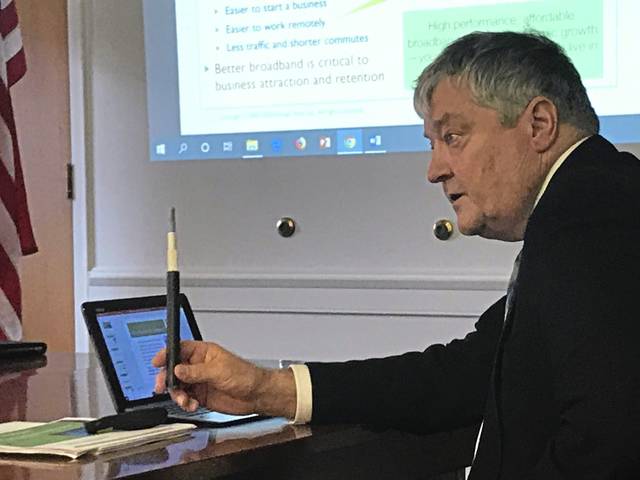
About a dozen stakeholders from multiple counties attended a kickoff meeting Tuesday at Ligonier Town Hall.
James Smith, president of the Greensburg-based Economic Growth Connection, argued that the 25 mbps benchmark is outdated as a connectivity goal, especially for businesses. “I’ve got businesses telling me if they don’t have a (gigabit per second), it’s not sufficient,” he said. “This is a business necessity moving forward, just like electricity. If we don’t have the ability to offer that, we’re going to lose.”
Smith cited connectivity issues at a business incubator in New Kensington. “They do very large video files,” he said. “They cannot move those files right now to the clients they need to move them to.”
The intent is for the study to reflect the varied levels of internet service needed by different communities across the region, said Brandon Carson, director of planning for the Altoona-based Southern Alleghenies Planning and Development Commission that appointed the task force in 2018. He cited major health care facilities among typically heavy users of data.
“Do we start with what we can now, and try to roll out better service to folks who are limited to about dial-up?” Carson asked.
“Farmers now are actually big broadband users,” said Jack Maytum, senior business analyst for Design Nine. He explained some owners track their cattle using radio frequency identification tags.
Maytum agreed that broadband connectivity has become a necessity, handicapping towns that lack it in the competition for jobs. “In some communities, it’s almost a panic,” he said. “They’re losing the fight for economic advancement.”
To address that problem, Maytum suggested municipal governments consider investing in the infrastructure — underground conduits, utility poles and communications towers — that can be leased to wireless or fiber-optic broadband service providers.
He argued that wireless service alone can’t satisfy the demand. “The radio spectrum is limited,” he noted, while, with fiber-optic cable, he said, “the information capacity is practically unlimited. Fiber is the backbone of the infrastructure.”
He acknowledged that wireless expansion, through tower development, can be achieved more quickly than expansion of the fiber network.
With the study that is in its beginning stages, Maytum suggested the eight counties are “ahead of the game. You’re ahead of most areas.”
The study is being funded by a $50,000 grant from the Appalachian Regional Commission, with each participating county paying a $6,250 share toward the local match.
The study will include cost estimates for developing recommended broadband infrastructure in the region. Maytum said Design One representatives will return to conduct a round of public meetings once a draft version of the study is available.