
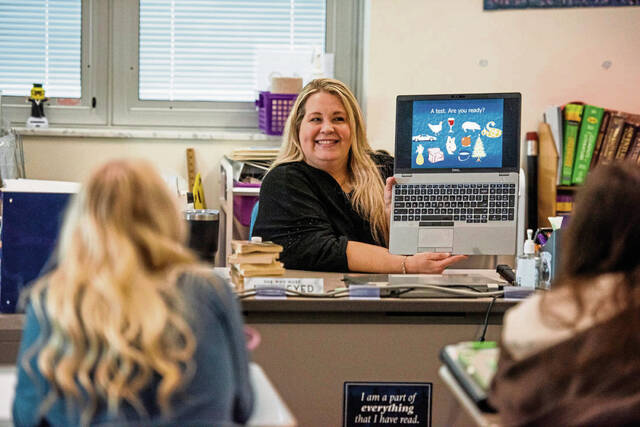
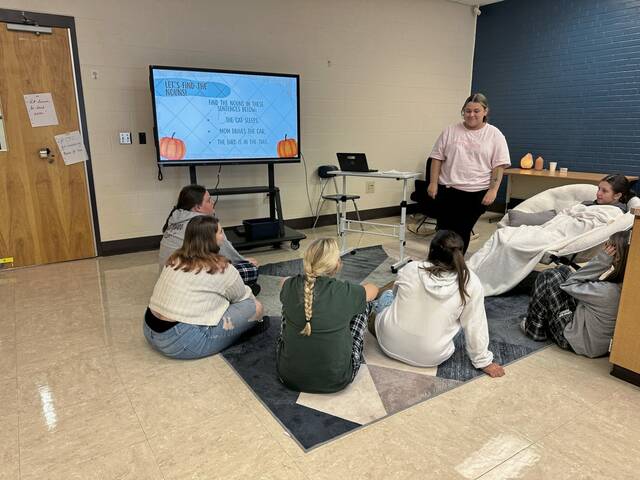
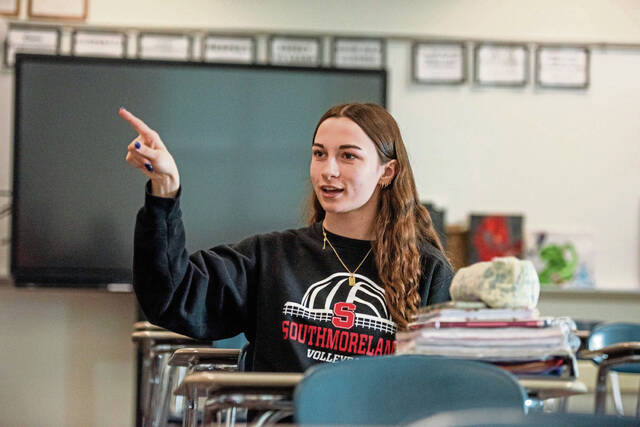
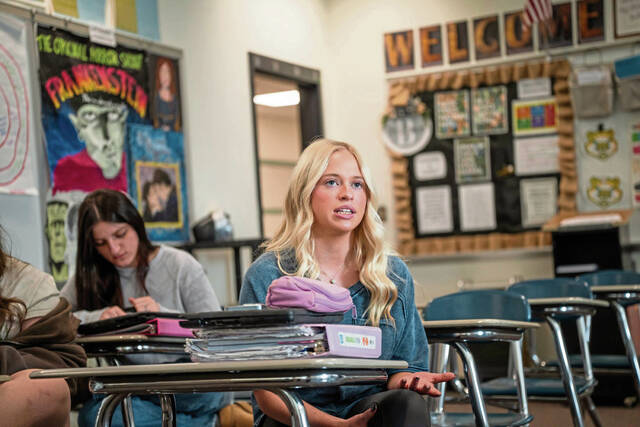




When aspiring teacher Ainsley Martin enrolls at Pitt-Greensburg in the fall, she will have six education credits under her belt with the help of a program launched by one of the university’s professors.
Martin, a senior at Southmoreland High School, has known that she wants to become a teacher since her freshman year. She uncovered her passion by shadowing her mother, a kindergarten teacher at Southmoreland Primary Center, and observing classrooms through the district’s Youth Education Assocation club.
“I just really like working with younger kids, and that pulled me toward education,” she said.
For $450, Martin completed two introductory college-level education courses at Southmoreland: social foundations of education and education psychology.
“I thought it would really benefit me (and provide) a head start on college,” she said.
The program was launched at Southmoreland and Charleroi Area high schools in 2024-25 and expanded in the fall to Milton Hershey School, a private institution in Dauphin County.
Created by University of Pittsburgh at Greensburg education professor Melissa Marks, the program aims to filter more teachers into Western Pennsylvania.
“If schools are offering this program and they’re able to attract their students into education, their students are going to want to come back and teach at their schools,” said Marks, a Cleveland native who has taught nearly 23 years at Pitt-Greensburg. “Especially in districts in areas where there might be (teacher) shortages, pushing kids to take a course like this … then allows students to get a head start, go to a college of their choice, get the financial support that they need and graduate. Then, they can go back to their home district.”
Similar programs elsewhere
Similar programs, called Aspiring Educators, are provided at two Westmoreland County career and technology centers: Central Westmoreland and Northern Westmoreland.
Central Westmoreland started its program in 2023-24 with students from a handful of Westmoreland County school districts.
Northern Westmoreland launched its course for Alle-Kiski Valley two years ago, hoping to draw students back to the region to teach.
Enrolled students spend half of their schooldays in specialized education classes or at clinical placements across the Valley.
Instructor Ann Fischer said oftentimes the students have strong intent to return as teachers.
“They’re very invested in the area,” Fischer said. “So whenever I ask them to do anything where they kind of look at their future plans or their future selves, nine times out of 10, they want to come back to the district.”
Burrell High School junior Aubrey Turk, who’s been in the program since its start, said she’d like to teach in Pennsylvania, at least for the start of her career.
Turk has learned about child psychology and classroom management, which she said are preparing her to be the elementary teacher she’s wanted to be since childhood.
“It’s really fun. I love the students at that age because they will just make your day more interesting,” she said. “They’re so sweet and funny.”
Pittsburgh Public Schools has taken another approach to addressing the teacher shortage, creating a pathway this school year to help working paraprofessionals achieve teacher certifications. The district received more than $360,000 from the state in June to establish the program.
Marks aims to tackle teacher shortage
Education has changed since Marks began her teaching career 35 years ago at a middle school in Cincinnati.
It was common at the time, she said, for Pennsylvania college graduates to move to Virginia, North Carolina or Florida to pursue their first teaching job.
“For years, people were told, ‘Don’t go into teaching. It doesn’t pay well, and there’s no jobs nearby,’ ” she said. “So people stopped going into teaching.”
Nearly 1,660 teaching positions were vacant in Pennsylvania as of October — filled either by substitute teachers, educators covering classes during their free periods or students being assigned to other sections of a course, according to data released by the state.
Schools in and around Philadelphia bear the brunt of the teacher shortage, according to a 2024 report by nonprofit Teach Plus Pennsylvania.
But Southmoreland High School teacher Amy Brown predicts Western Pennsylvania’s teacher supply will be strained within the next decade, as Gen X educators — born between 1965 and 1980 — begin to retire.
Ahead of the 2024-25 school year, 7,200 teachers left the education profession, according to data published in December by the state Department of Education. That’s more than the 6,600 teachers the state certified in 2023-24.
“Right now, I think we have a minor teacher shortage,” Brown said. “But in the future, I think we’re going to have a serious teacher shortage, once Gen X teachers start to retire.”
Southmoreland is already noticing the impact, Brown said.
Most of Southmoreland’s substitute teachers used to be recent college graduates aspiring to work in the district. Now, the three primary substitutes at the high school are retired teachers, she said.
Program offers tuition savings to high schoolers
But Brown is confident opportunities such as Pitt-Greensburg’s college-level education program will chip away at the issue.
“I have known since I was in high school that I wanted to be a teacher,” she said, “and I wish I had the opportunity to have a program like this to get a head start on my education in high school.”
The two courses in the program are three credits each, costing high schoolers about $225 per class. That’s a savings of about 87% over Pitt-Greensburg’s regular tuition rate, said university spokesperson Susan Isola.
One three-credit class costs an in-state, full-time student about $1,722, Isola said.
Pitt-Greensburg also offers automatic $500 scholarships to up to four students from each district participating in the education program, as long as they commit to attending the university.
In addition to the financial savings, the program offers high schoolers early exposure to the teaching profession, Marks said.
“Sometimes, (students) go into the classroom, and it’s fun and they like it,” she said, “but it’s not what they want for their lives.
“And it’s great, because if they decide ‘I don’t want to become a teacher,’ I would so much rather them figure that out early and find something that will make them happy.”
So far, 93 high schoolers have participated in the program, Marks said. Each course follows Pitt’s education curriculum and comes with about an hour of classroom observation per week, she said.
Southmoreland students shadow classes at the district’s primary center — an experience that has helped senior Makenzie Martin develop the love of teaching she inherited from her grandparents.
Makenzie Martin, who is not related to classmate Ainsley, plans to study education at Saint Vincent College in the fall. The education psychology class she is taking this school year — which teaches students the science behind learning — has given her a jump on her studies.
“It’s really important to understand a person,” she said, “because stuff that they go through can determine how they act toward you. Sometimes, you just need to have more patience and compassion for other people.”
Other college partnerships
At Central Westmoreland and Northern Westmoreland, Aspiring Educators programs partner with several area colleges, including Point Park University, Indiana University of Pennsylvania and Seton Hill University.
The credits earned also can be articulated into noneducation degrees, said Jason Hicks, director of the Northern Westmoreland center.
The program has garnered interest from students across the Alle-Kiski Valley, but it is looking to increase its numbers, he said.
Burrell High School senior Emma Spiering will start a speech pathology program at IUP in the fall with nine credits.
The program has given her direction and prepared her for future education, she said.
“It has shown me what kind of teacher I want to be,” she said.
Hicks said he hopes more students and parents will explore the program as it aims to save time and money.
“We want to work with them to cultivate their learning, their talent,” Hicks said, “which ultimately is going to become a win-win for everyone in our area, because highly qualified candidates will become good quality teachers.”