
https://triblive.com/local/westmoreland/hempfield-area-joins-chartiers-valley-in-piloting-ai-weapon-detector-created-with-carnegie-mellon-research/
Hempfield Area joins Chartiers Valley in piloting AI weapon detector created with Carnegie Mellon research

Hempfield Area will join a group of 15 school districts nationwide expected to pilot an AI-driven weapon detection system designed with the help of a Carnegie Mellon University scientist.
CurvePoint, based in Pittsburgh’s North Shore, was launched about a year ago by CEO Skip Smith and Chief Scientist Dong Huang, a senior project scientist in Carnegie Mellon’s Robotics Institute. The company developed Wi-AI, an AI model that uses Wi-Fi signals to detect concealed weapons, including guns, in schools.
Huang has spent the past eight years developing the technology, Smith said. It has been adapted to the education space more recently.
“We focused on humans and guns in schools,” Smith said, “because we are super frustrated with this very American problem of kids being at risk in schools where they’re trying to learn.”
There were 352 shootings at school districts in 2023 — an all-time high — and 336 in 2024, according to the K-12 School Shooting Database created by Idaho State University professor David Riedman.
These figures include any time a bullet hits school property, a gun is fired or a gun is brandished with the intent to harm. It also includes shootings at sporting events or after-school activities, according to the database.
A shooting at Brown University on Dec. 13 killed two students and wounded at least eight.
System launched at Chartiers Valley
Chartiers Valley was the first school district in the country to agree to pilot the program at its high school. The district began testing the system in April and the school board approved an agreement with CurvePoint in October, said Superintendent Daniel Castagna.
CurvePoint aims to have the system operational by January, he said.
Thirteen other school districts — which Smith declined to name — are expected to join the pilot within the next month. Though most of them are in Southwestern Pennsylvania, others are located in Philadelphia, Florida and along the West Coast, he said.
Once all 15 districts are on board, CurvePoint will begin a testing period that will last until April, Smith estimates. If Wi-AI meets certain performance parameters, the school districts will officially sign a contract with the company.
Wi-Fi signals interact in specific ways with different types of objects, Smith said. For example, the data that is collected from these interactions allows the system’s AI model to distinguish between an umbrella and a gun, he said.
So far, CurvePoint has trained Wi-AI to detect handguns and long guns, Smith said, but the company aims to teach its system how to detect additional types of weapons — such as knives — in the future.
CurvePoint has yet to test whether Wi-AI can detect ghost guns — a weapon that is 3D printed or assembled by the owner using nontraditional materials. But Smith is confident the system will be able to identify these alternative firearms, as long as they are of similar shape and size to a long gun or handgun, he said.
For the 15 pilot schools only, the system installation is free of charge, Smith said. Districts will be required to pay an annual fee for CurvePoint to monitor and analyze the data coming into the system.
According to an agreement Hempfield Area school board directors approved Dec. 8, the fee would be $60,000 a year for the first three years.
CEO: ‘Cost of securing schools’ on the rise
This isn’t the first time Hempfield Area has invested in school security.
The district uses a system called ZeroEyes, a software that analyzes security camera footage to detect weapons, said Jamie Schmidt, director of innovation, strategic partnerships and safety.
Hempfield Area also has purchased 12 OpenGate metal detectors for its high school, Harrold School and middle schools in 2024. The devices — two parallel poles that create a gate for students to walk through — cost a combined $114,500. The district plans to install the OpenGate devices at the elementary schools next year, Schmidt said.
But the district’s existing safety precautions are not foolproof, Schmidt said. ZeroEyes, for example, can only detect visible weapons — not concealed ones, she said.
Chartiers Valley does not have metal detectors, but Castagna has come across challenges with the devices during previous employment in other districts.
“In a high school setting, you have 1,000 students that are entering usually one or two entrances, and they have to get through that entrance within a 20- to 25-minute time period,” he said. “There’s a lot of human error that happens with metal detector use, because you have to have the manpower stationed there.
“Every time it goes off, you have to do some type of search. And then there’s just the volume of kids that are passing through that becomes too unmanageable to really be effective.”
Wi-AI allows school resource officers and administrators to address a detected weapon before it is out in plain sight, Smith said.
“We feel that if a perpetrator has a gun in their hand and a school resource officer then is forced to put his or her gun in their hand,” Smith said, “that increases the likelihood that there will be a bad outcome to that interaction.
“Whereas if we can identify a concealed weapon, then the school resource officer has the opportunity to intervene in a less escalated way.”
But Smith doesn’t deny the need for other security systems.
“People paint with a broad brush and they say that all these solutions are competitive,” Smith said. “We don’t believe that. We believe these solutions are complementary. That’s unfortunate, because it does mean that the cost of securing schools in America is increasing.”
Schmidt: Tech adds ‘another layer’ to school safety
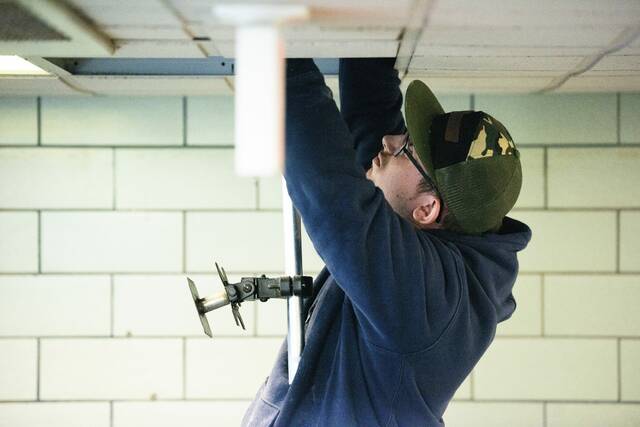
Wi-AI systems were installed last week at five Hempfield Area High School doorways, including the main and auditorium entrances, Schmidt said.
“Student and staff safety is the top priority of the district, and being able to provide another layer that is pretty comprehensive and really doesn’t put any more work on our staff is something that is very enticing to the district,” she said. “We’re happy that we can get in and get this program implemented.”
In lab tests, Wi-AI has been able to identify concealed weapons with 95% accuracy and a 4% false positive rate, Smith said. But Smith admits that in a real school environment, the system may come across weapons or concealment strategies it hasn’t yet been trained to respond to.
That’s why the pilot period with schools such as Hempfield Area is important, he said.
It’s a process Castagna has already begun to witness firsthand.
“We just watched student flow to see how the model was getting crisper and more accurate and deciphering what a pen was, as opposed to what a weapon or an umbrella was,” he said. “It was neat for me. It was my first time watching an AI model get smarter and learn as it grew.”
Copyright ©2026— Trib Total Media, LLC (TribLIVE.com)