
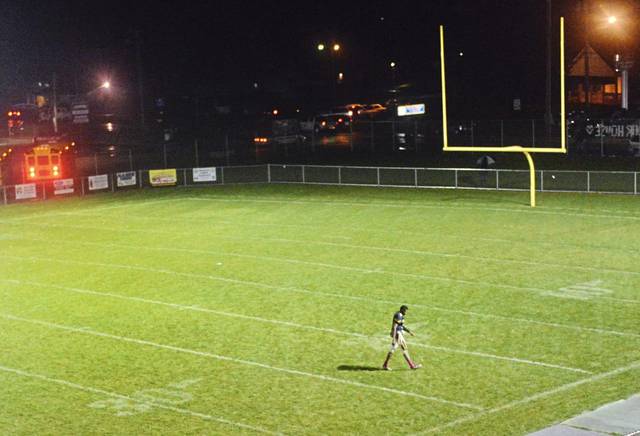



Greensburg’s Offutt Field was thrust into the spotlight on Nov. 2, 1962, and on Sept. 9, 1988 — though for opposite reasons.
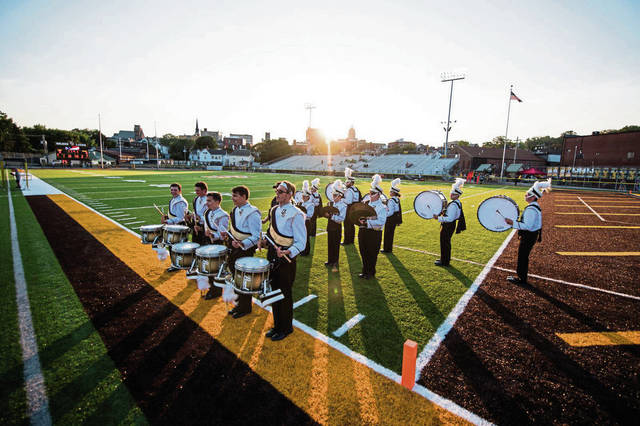
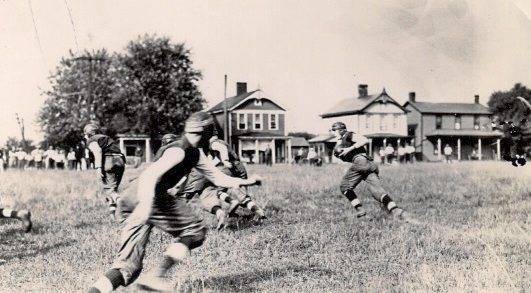
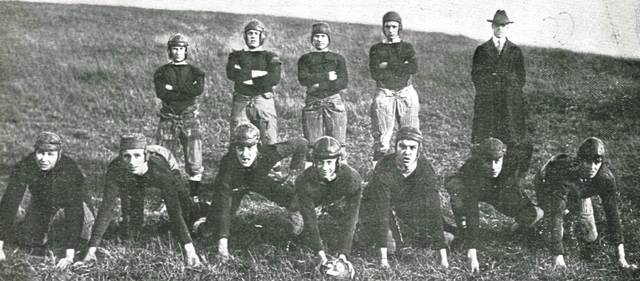
Nestled in a dip between hills on the city’s eastern end, the field originally known as Athletic Park has played host to a variety of community events and sports, including local high school football games, beginning in 1894.
Home to the Greensburg Salem Golden Lions, Offutt is among a number of athletic fields that have remained central landmarks in Southwestern Pennsylvania communities as many stadiums have been incorporated on high school campuses.
Offutt survived through 1914 and 1949 studies of other proposed Greensburg field sites. In addition to the Lions, it is used on Saturdays by the Seton Hill Griffins university team, and once served as a dual home field for the Greensburg Central Catholic Centurions.
“It was one of the first fields with lights,” according to Huddie Kaufman, Greensburg Salem sports historian and former Tribune-Review sports editor. The lights were installed in 1937, at a cost of $5,000, the late historian Robert B. Van Atta noted in his 1999 “Bicentennial History of the City of Greensburg.”
During the 1962 season, Offutt drew a massive crowd of about 12,000 to witness a late-season showdown between the Lions and their next-door rivals, the Spartans of Hempfield. Unfortunately for the hosts, all-state quarterback and future Westmoreland County Commissioner Dick Vidmer led the Spartans to a 19-0 victory, preserving Hempfield’s unbeaten record while ushering the Lions out of that year’s regional WPIAL race.
A last-minute 13-10 win for the Lions against visiting Southmoreland garnered national media attention in 1988 — and a video clip of the bizarre Offutt play was preserved through TV sportscasts and YouTube.
Southmoreland punter John Grabiak took a snap and faded back, running off the few remaining seconds on the clock, but he failed to down the ball to end the play. “The buzzer went off, and (Lion Jason Howard) batted the ball out of his hand and ran in for a touchdown,” Kaufman said.
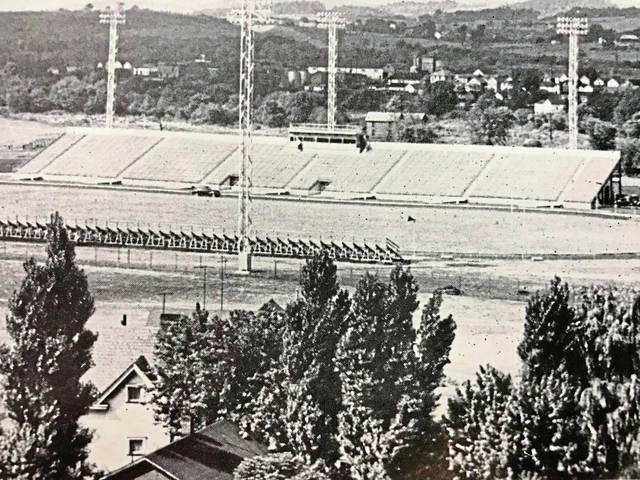
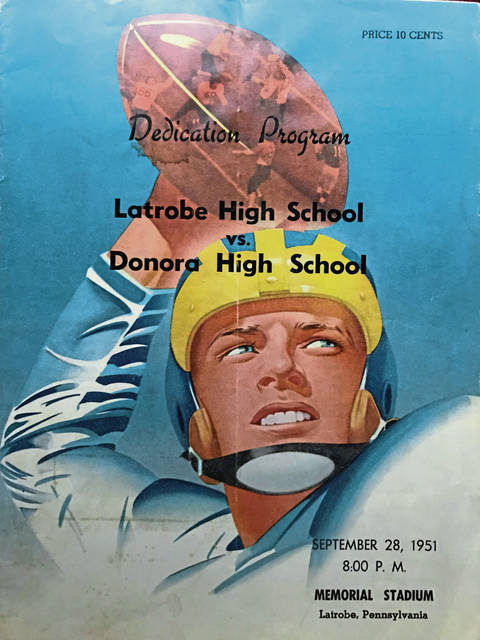
Latrobe’s Memorial Stadium, dedicated to military veterans, opened on Sept. 28, 1951, when the Wildcats hosted a squad from Donora High School. The steel grandstand seated more than 6,000, overlooking a quarter-mile running track.
Along with adjacent Legion Keener Park, the stadium was developed on property bordering the Loyalhanna Creek deeded to the local American Legion post by the Keener family. More than 200,000 cubic feet of fill was needed to raise it above the level of flooding that affected the region’s waterways in 1936.
Additional construction of a Pro Football Hall of Fame never got beyond the drawing board when Canton, Ohio, was selected as the site for the hall.
But the Latrobe stadium, one of a declining number in the area with a grass field, has maintained a prestigious association with the NFL. It hosts an annual Friday Night Lights practice by the Pittsburgh Steelers during their summer training camp at nearby Saint Vincent College in Unity.
“I think that’s a big thing for our town, our community and our program,” Wildcats Coach Jason Marucco said of the practice, which raises money for school sports. A 1991 Greater Latrobe alumnus, Marucco played for the Wildcats as a wide receiver and defensive back before returning as an assistant coach, and taking over the head coaching spot in 2014.
“Every time I get to lead our football team out onto the field, I’m thankful and try to enjoy it,” said Marucco. “I think the field’s in-town setting, with a steel mill behind it, brings to mind Western Pennsylvania football.”
Longtime Wildcats equipment manager Jim Feather, a 1971 Greater Latrobe graduate, cited a legendary 1956 postseason game at Memorial Stadium that didn’t involve the Wildcats. Jeannette, whose roster featured future Penn State and Steelers standout Dick Hoak, defeated Charleroi, 16-13, on a late field goal.
“That was a tremendous game,” Feather said. “They said it was standing-room only. You couldn’t have put another person in that stadium.”
Beyond football, the stadium is the setting for the Latrobe Police Department’s annual National Night Out community outreach, and it has hosted the now-defunct state police rodeo. The stadium’s track is used during an annual Relay for Life fundraiser for the battle against cancer, and as the starting point for foot races that are part of the town’s 4th of July and summer banana split celebrations.
Apollo’s Owens Field, site of the Apollo-Ridge Vikings home football games and the oldest sports facility still in use in the Alle-Kiski Valley, marks its 100th anniversary this season. The field, on donated farmland along First Street, underwent a $3.5 million reconstruction in 2010 and now could be in line for either new sod or artificial turf.
Vikings fans who prefer the in-town locale were relieved when Apollo-Ridge opted to renovate rather than move the field east to the high school campus in Spring Church.
Improvements to Owens Field included a new field house with locker rooms. The field also has served as a venue for a fireworks display and a celebration of NASA’s Apollo moon landing.
Debbie Stewart, of North Apollo, served as secretary of the Apollo-Ridge Stadium Boosters, a group that formed in 2008 and raised thousands of dollars to support improvements at the existing field.
“The people from McIntyre, a lot of them wanted (the field) at the school,” Stewart said. “It would be closer for them, but most everybody wanted to keep it where it was. Everything changes, but there are just some traditions you like to continue with.”